Showing posts with label Japan stories. Show all posts

Wednesday, January 04, 2023

Hiroshima, Japan: Spring 2002

(Travelogue--Japan Travelogues)


Another travelogue rescued from the archives.  This is yet another old home movie converted to DVD. This video is a continuation of the Kyoto video. Same trip, we just moved down to Hiroshima next. I had never been to Hiroshima before this trip, (although after this, I would since go back several times).

The atomic bomb museum (sometimes called peace museum) there is well worth checking out, although I remember being slightly disappointed because I didn't learn much new. I guess I was expecting to be more blown away than I actually was.

Kyoto, Japan: Spring 2002

(Travelogue--Japan Travelogues)
This is yet another travelogue I'm rescuing from the archives.  This video is the visit to Kyoto in Spring 2002.

 
Another old home movie converted to DVD. During spring break my first year in Japan my parents and youngest sister came over to visit me.

I was eager to show off my little town of Ajimu, the life I had made for myself, and all the little local places I had discovered. My parents wanted to see some of the big tourist spots as well though, so they flew into Osaka, and I took the train up and met them at Kyoto.

Even after close to a year in Japan, this was my first time visiting Kyoto. In fact, if memory serves, it was my first time getting out of Kyushu since I had arrived. Aside from going to the neighboring Fukuoka prefecture once or twice, I don't think I had even left Oita Prefecture. (Obviously my adventurous spirit leaves much to be desired.)

So, I finally got out of my town and went up to meet my parents in Kyoto.

The cherry blossoms were in full bloom, so Kyoto was at it's most beautiful.
It was also at its most crowded. Everyone wanted to see the spring cherry blossoms, and plus it was spring break for every single school in all of Japan. Some of the public parks were so full of people you literally couldn't even find a place to stand.

Also, after having spent so long in my little town in the boondocks of Japan, and being accustomed to being the only white person around, I remember being surprised at how many foreigners there were in Kyoto. At some of these tourist spots, there were more foreigners than Japanese.

Sunday, May 06, 2018

Reviews of Places (Travelogues)

34 Most Beautiful Places in Oita Prefecture, Japan ,
Abraham Lincoln Presidential Library and Museum, Springfield, Illinois,
Ada Park (in winter),
April 30th Park (Công viên 30 tháng 4) District 1, Ho Chi Minh City, Vietnam ,
Australia Index
Ballarat--Victoria, Australia ,
City Museum, St. Louis, Missouri,
Townsend Park (early spring)
Yabakei / 耶馬溪 ,
Yamaga / 山香 ,
Yamakuni / 山国 ,
Yonozu / 米水津村 ,
Yufuin/ 湯布院 , Part 2

I haven't been posting any photos from my trips for a long time.
This is because of the decision I made 10 years ago to separate my public blogging from my personal blogging.  My trips were my personal life, so they went on the personal blog.
But, I've been thinking about it, and I've decided there's nothing overly personal about posting photos from places you've visited.  It need not give away any information about your personal life, it just gives out geographic information.
So I'm going to try to start doing it again.
At the moment, I'm thinking I'm going to start doing it from this moment forward-- i.e. I'm not going to worry about all the trips I went on in the past 10 years that I didn't blog about.  We'll just consider those opportunities gone.  And I'll focus on trips I take in the present.
I've got a few pictures and videos from my latest trip to Quang Ngai province that I will be posting soon.
I'm going to start indexing my travelogues at the top of this post.
I'm starting with all my "Travels Through Oita Prefecture" posts, which I'm now repurposing as "Travelogues".   Plus I'm sneaking into the above index My Trip to Tokyo and My Trip to Miyazaki.

Youtube Playlist HERE

Wednesday, January 17, 2018

Stealing from Facebook: I saw this on a friend's Facebook page today.


Way back in 2001, in the months before I left for Japan, I was trying to learn Japanese by listening to language tapes.

My college roommates thought it was the funniest thing ever, because half of the phrases would consist of an English word just pronounced with a Japanese accent, and a lot of extra vowels added.

One example that caught their attention was "Whisky Sour", which the language tape gave in Japanese as "ui-su-kii sawaa".
They had fun imagining trying to order a drink in Japan.  Imagine going up to the bar and saying "Whisky Sour" perfectly normal, and having the bartender just stare blankly at you.  Then the second time say (exaggerated Japanese accent) "Wiisukii Souroo", and presto, you get your drink.

Sounds ridiculous, right?

However, once I actually got to Japan, I found out that this ridiculous scenario was the reality.  You actually do need to pronounce English words with a Japanese accent in order to make yourself understood in Japan.

One book I was reading on learning Japanese* said that a major problem English speakers have when is that they pronounce all the English loan words as English, instead of with the Japanese syllabary.
For comparison's sake, the author said, imagine a French speaker who insisted on pronouncing all the French loan words in English with a French accent.

I guess that sounds reasonable enough.
Nevertheless, as the above video indicates, pity the poor foreigner who tries to make himself understood by saying "McDonalds" or "Starbucks" instead of "Makudonarudo" or "Sutabakkusu"

* This was years ago, so I forget the title and author.

Friday, April 07, 2017

Tonoharu Part 3 by Lars Martinson

(Book Review)

Background
So, I don't know if anyone remembers this, but I reviewed Tonoharu Parts 1 and 2 on this blog 2 years ago.

It was a slight breach of protocol for me.  In the first place, I don't usually include comic books on my book review project, and secondly, I probably should have waited until the whole series was completed before I rushed in with my two cents.

But the books jogged enough of my memories from the JET program that I found it impossible to resist commenting.

And now here I am with part 3.

I don't really have too much to say about part 3.  To be perfectly honest, if I hadn't already blogged about parts 1 and 2, I wouldn't be blogging about about part 3 now.  But since I started to talk about Tonoharu, I feel like it would be incomplete not to talk about part 3.

So here we go.

The Review
A lot of the same things I said for parts 1 and 2 hold true for this as well.
Tonoharu perfectly captures the day-to-day monotony that is living in a small town in Japan as an assistant English teacher.

There's a certain genius in how well Lars Martinson conveys just how monotonous a JET's life can be.  You kind of have to admire his skill.  His panels of the character sitting alone and walking alone in a small town in Japan so perfectly convey the isolation many JETs feel.

And yet...at the same time, you have to ask why anyone would want to read this?  Certainly this has got to be of limited interested to anyone who is not a JET, right?

Well....at least on the plus side it's short.  It's a comic book, after all, and not a long one at that.  I think from the time I opened up the first page to the time I got to the last panel was only about 30 minutes.
The artwork is meticulously detailed.  If you're interested in art, you should find Lars Martinson's panel drawings interesting.
I'm not particularly interested in art, so this was all wasted on me.  I didn't even realize how much artistry there was in the book until I saw some of Lars Martinson's youtube videos on it.

My Own Reflections
I spent much of my review of parts 1 and 2 talking about my own experiences on the JET program, so I'll comment here on my own experiences as well.

As I said in my review of parts 1 and 2, I did at times feel isolated in small town Japan, just like the protagonist in Tonoharu.  I think every JET feels this way sometimes.  But more often than not, I loved my time in Japan.  I felt like I was on some big adventure--especially in the first couple years.  So it's important to keep things in perspective.

On another note:
Another thing I noticed teaching English in Japan is that the first year junior high school students (7th graders) would come in with lots of enthusiasm to learn English.  They were very interested in America and American culture and they really wanted to learn English.
Sadly, within a few months of studying English at the junior high school level, that enthusiasm would be drained out of them.
It was really sad.  At the time I thought the Japanese education system was to blame, but maybe some of this dropping in enthusiasm would be inevitable with any foreign language study.

Anyway, Tonoharu part 3 does a good job of depicting exactly this phenomenon.
To its credit, Tonoharu doesn't blame the Japanese teachers.  It shows that the Japanese teachers are just as much victims of the system as the students are.
In the comic, one character, a Japanese teacher of English, explains. "They [the first year students] are so interested in English and AETs [Assistant English Teachers--i.e. Westerners]. We teachers want to protect the students' enthusiasm.  But we have to prepare them for high school entrance exam.  And there is so much to study.  We have to advance too quickly.  The result is students lose their enthusiasm.  They only remember for the test.  But if we slow down, students aren't ready for high school entrance exams.  And parents are angry.  We can't find a good solution. "  (p.76-77)

This book also captures what is the best part of being an Assistant English Teacher in Japan--how enthusiastic the students can be about getting a chance to talk to you.
I loved the chance to talk to students who really wanted to talk to me.  It was the best job in the world when you got to interact with the students.
However, as is also depicted in Tonoharu many of the students could be shy and awkward.  They wanted to talk to you, but they struggled to work up the courage.
Since I was a bit shy and awkward myself, sometimes my self-consciousness and the student's self-consciousness would combine to make some really awkward interactions.

Links to Interesting Videos
The author and artist, Lars Martinson, has a couple of Youtube videos in which he describes his experience creating this book.  Watching these videos has given me a new appreciation for the artistry behind this book (something that I'll admit did not immediately grasp me when I first read it).

Introducing Tonoharu


More from Lars Martinson's Tonoharu


4 Time-Saving Tips (from a guy who spent 13 YEARS drawing a comic)


Video Review
Video review here and embedded below


Link of the Day
Chomsky: Humanitarian Intervention Propaganda

Wednesday, February 15, 2017

The 34 Most Beautiful Places in Oita Prefecture, Japan

So, the other day I was checking CNN's website, and I saw this article:

Japan's 34 most beautiful places

Side note: Why 34?  Why not 26 or 42?  Apparently lists of 34 are a thing now?  A google search for "34 most" shows that a lot of people are counting to 34 now on their listicles.  Does anyone know why?  Was this some meme I missed?

Anyway, back to the point...

"Hmm," I thought.  "I sure saw a lot of beautiful stuff in Oita prefecture.  I wonder if any of that made their list."

So, I checked it out, and sure enough, there were 2 entries from Oita prefecture on CNN's list: the Kintestu Beppu Ropeway (at number 6) and Usa Shrine (at number 14).

Now, don't get me wrong, I like both the Kintestu Beppu Ropeway and Usa Shrine.  Beppu, as a city, certainly has its charms, and Usa Shrine is tremendously historically and culturally important.  But I wouldn't particularly put them on a list of the 34 most beautiful places in Japan.  They wouldn't even make my list of the 34 most beautiful places in Oita prefecture.

So, I decided to go through the photos on my blog archives and come up with my own list of the 34 most beautiful places in Oita prefecture.
I've done my best to rank these in order.  (Number 1 is the most beautiful, and they gradually get less impressive from there.)  Of course the standard disclaimers for any sort of subjective list apply. These are just my personal feelings, and other people will take different views. And, to the extent that one's own personal feelings are difficult to quantify, and given that feelings are inherently unstable and change from day-to-day, I'm not even sure it's a perfect reflection of that.
In addition to the standard disclaimers, I've got 4 more special disclaimers for this list.

Disclaimer 1: Unfortunately, I never got around to visiting all of Oita prefecture, so this list unfortunately omits Kamitsue-Mura, Notsuhara-Machi, Hasama-Machi, Shonai Machi, Ogi-Machi, Kuju-Machi, Naoiri-Machi, Kiyokawa Mura, Asaji-Machi, Ono-Machi, Chitose-Machi, Inukai-Machi, Nostu-Machi, Yayoi-Machi, Honjo-Mura, Ume-Machi, and Naokawa-Mura.
If anyone is reading this from any of those towns, let me know what I missed in the comments.

Disclaimer 2: Because these lists work best as visuals, I'm only going to include what I have photos for.  Any descriptions that are only in written form aren't included on this list.
I am, however, giving myself some lee-way on the quality of my photos.  There are, for example, some really beautiful places in Oita prefecture that I didn't quite do justice on film--sometimes because the flat screen can't really capture how impressive these sprawling landscapes are in real life.  Other times because I took my photos at the wrong time of year.  (Most of these places look most beautiful in spring and summer, when all the vegetation is in full bloom.  But unfortunately several of these photos I took during the winter).
In these cases, I'm just going to post my photo, and then make a short disclaimer about how the photo doesn't really do it justice.

Disclaimer 3: Related to disclaimer 2, the camera I used back in 2007-2009 was never really top of the line, even at the time.  But technology has moved on now so that these pictures look embarrassingly low-resolution compared to the average picture you see on Facebook these days.  But these pictures are what I've got, so these are what I'm using.
That being said, to see these pictures in their full resolution (for whatever that may or may not be worth) click the pictures to see the enlarged version.  (But of course you already knew that, you technical person you.)

Disclaimer 4: In order to keep this post from getting cluttered, I've limited myself to only one photo per place.  In cases where one photo doesn't quite do the place justice, I've included links to my other photos in the text description.

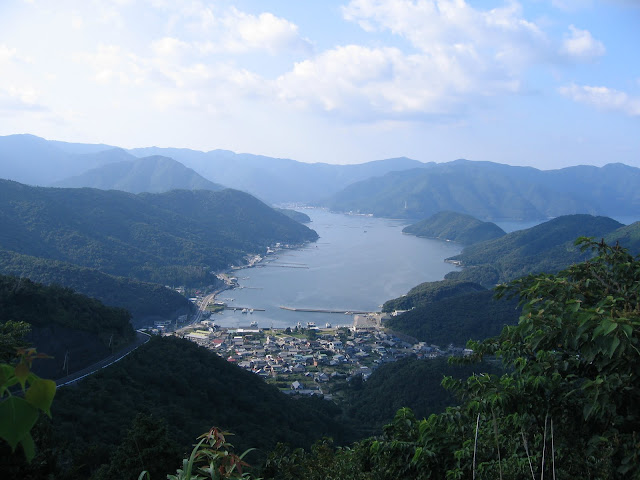
1. Sora no Koen (sky park) in Yonozu


This picture doesn't do it justice, because the view is really best experienced in 360 degrees--standing up on the hilltop, and seeing all the wide blue ocean and mountains laid out before you was breathtaking.

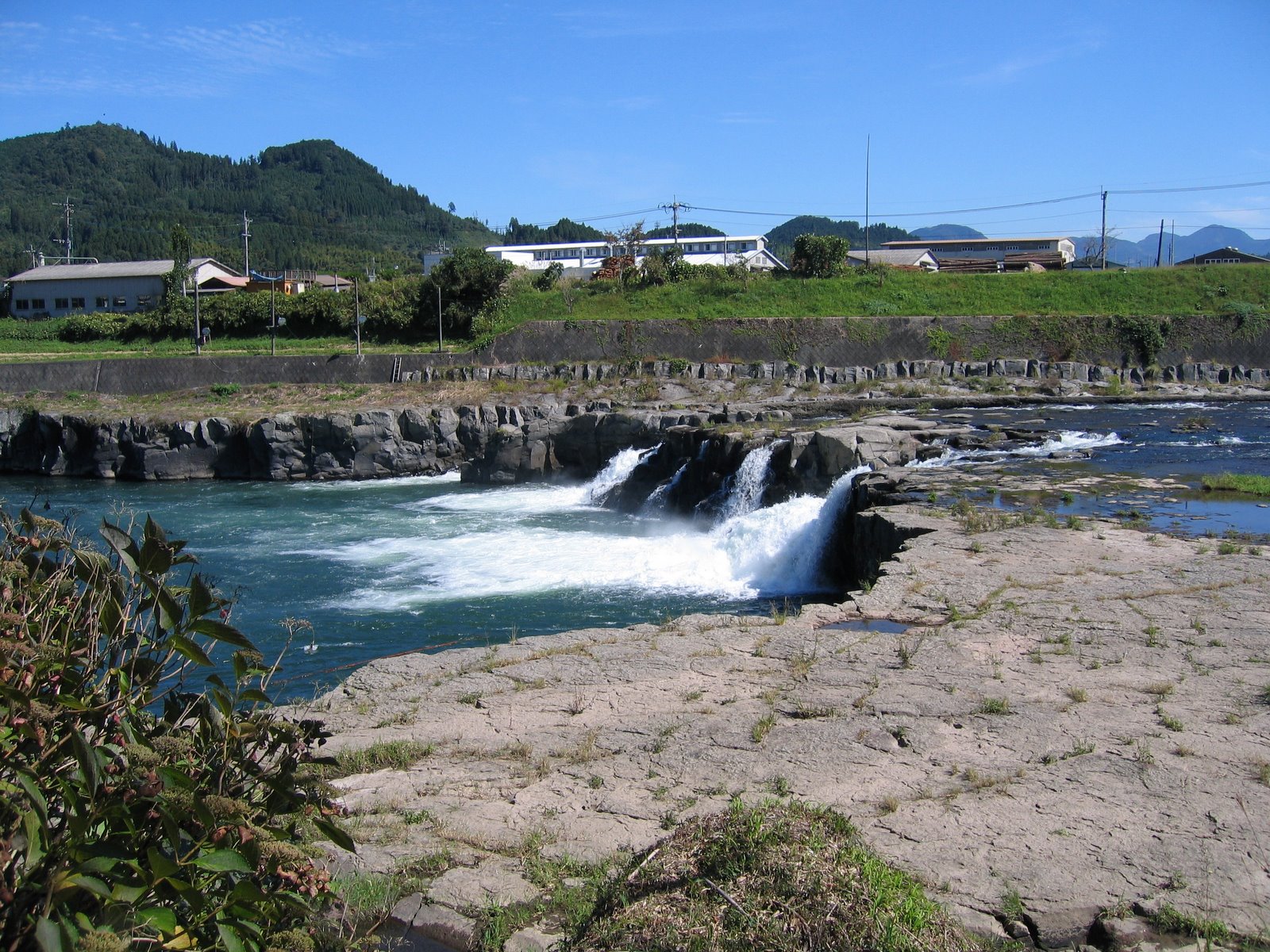
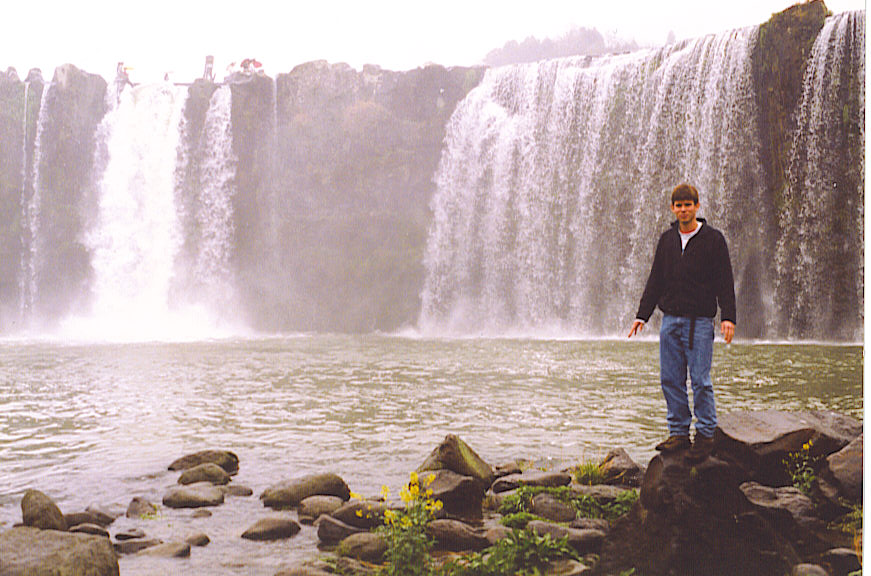
2. Harajiri Waterfall in Ogata Town


Again, a picture doesn't really do it justice.  It's a horse-shoe shaped waterfall, so you really have to see it from all 3 sides (something I couldn't capture in this picture).  Also, this picture is from fall, but to see the Waterfall at its fullest, it's best to go in spring just after the rainy season--see here.

3. Ryumon Waterfall in Kusu (Or possibly in Kokonoe.  I got a bit confused on the exact town boarders with this one.)


This picture isn't bad, but it doesn't get all the angles.  To see the pool at the top, look here.  For the view looking down, see here.

4.  Higashishiya Waterfall in Ajimu


At the risk of becoming a broken record, once again the picture doesn't really do it justice.  You have to see it up close to appreciate how big and magnificent it is.

5. Fukino Waterfall in Ajimu


This picture was taken at the lookout point, overlooking Fukino Waterfall.  But you can also walk up to the base of the waterfall, and get some great views from there as well--see here for example.

6. The view from the Road leading to Hatozu Beach in Kamae Town


There are tons of great views like this along the Southern part of Oita prefecture of the mountains running into the ocean.

7. Seaside Temple on Himeshima Island


The actual temple is not so impressive, but the seaside around it is amazing.  Unfortunately I couldn't capture all this one one photo, but see here for the view to the left of this temple.  

8.  Aoi No Domo in Honyabakei


This is a view from the cliffs of the valley below.  A view of the river below the cliffs can be seen here.  I regret to say I never got a good picture of the cliffs themselves.  

9. Taikkiri Valley in Innai


A beautiful little walk down a lovely little river.  It culminates with a view of a Waterfall, which you can view from the top looking down.  (Or at least, you can view it if you ignore the safety signs).  See here for the waterfall at the end.

10. Waterfall in Yabekei


If I ever knew the name of this particularly waterfall, I've forgotten it.  (We always just called it the "Yabakei Waterfall" during my days.)  The river leading down to this waterfall is quite beautiful as well.  See here.  

11. The view of the rivers in Yufuin


The peaceful rivers in the town of Yufuin can be very beautiful, especially during Cherry Blossom season.

12. Fukami Valley in Ajimu


There are a lot of beautiful valleys in Oita Prefecture, but this is one of my favorites.  You can see the rice fields along the valley carved in like steps.  See here for a better view of the terraced rice fields.

13. Sakura Waterfall in Amagase


This is just off the road from a small charming faux-Bavarian bath house town on the river.  See here for pictures of that town.

14. 3 Day Moon Waterfall in Kusu


For the view from the front of the waterfall, see here.

15.  Kamidozaki Natural park and look out point in Kamiura


For the view from the left side, see here.

16.  Monkey Jumping Point in Yamakuni


Another place where the pictures don't really do it justice.  But when the river is full after rainy season, this river turns into an impressive rapids between these big rocks.

17. Jion Waterfall in Kusu (or possibly in Amagase--the map was a bit confusing)


18. Peace Park on Mount Hachiman in Sanko Mura


The picture doesn't really do it justice, but this is a beautiful example of a Japanese garden built into a mountain slope.  So as you keep climbing up, you keep seeing more and more of the garden.
It's hard to really capture all the views of Mount Hachiman in one picture.  For more pictures, see the Sanko Mura post.

19.  Kanarase Mountain Hike in Innai


The picture doesn't do it justice.  In part because it's hard to summarize a 3 hour hike in one photo.  (For more photos, see my post on Innai.)  And also, because I took this photo at the wrong time of year, in November, when most of the foliage had died for the winter.  To see this in its full glory, go in late spring.

20. Kyusuikei Gorge in Kokonoe


The famous bridge in Kokonoe is just a tourist trap, but the views of the Kyusuikei Gorge leading up to it are absolutely gorgeous.  Also a beautiful little waterfall is on the road going up this gorge--see here.

21. Nokogiri Mountain Hike in Yamaga


This is another hike that goes on for a long time, and is impossible to completely capture in one photo.  For more photos, see my post on Yamaga.

22. Asahidai scenic overlook in Kokonoe


Kokonoe is filled with these gorgeous views of long flat stretches of land with mountains in the background.  The static image of the camera doesn't really do justice to the beautiful long stretches of road.  The road through the Handa plateau in Kokonoe is actually probably more impressive than the Asahidai scenic overlook when you drive through it in person, but the Asahidai scenic overlook comes out better on film, so I'm putting it up here.  (For a picture of the Handa plateau, though, see here.)  

23. Oka Castle in Taketa


The ruins of an old castle, now covered with grass and cherry blossom trees.

24. Sento Mountain Hike in Kunimi


This is another long hike that is impossible to summarize in one picture.  For more pictures from this hike, see my post on Kunimi.  For a great view from the top of the mountain, see here.

25. Yamakuni River in Yabakei


This picture is from Yabakei, but the whole stretch of road following the Yamakuni river also includes Honyabakei and Yamakuni town.  It's a beautiful drive following a river valley winding its way between the mountains.  (This picture doesn't do it justice, first of all because it's a very long river that can't be captured in one photo, secondly because the foliage was not yet in full bloom on the mountains when I took it.)

26. Kirikabu Mountain in Kusu


This is the view from the top of Kirikabu looking down.  For a view of the mountain from the ground, see here.  

27. Takahira Park Look Out Point in Kamae


This picture doesn't capture the full 360 view, so also see here and here.  

28. Mount Yufu in Yufuin (also on the border with Beppu)


This is the view looking up the mountain.  For a view looking down at the town below, see here.  

29. Hita River in Hita


Perhaps to fully appreciate, you need to see it at night when it's all decorated with paper lanterns.  Also, although this picture is off the main downtown stretch, the most beautiful parts of the river are just slightly downstream, here and here.

30. View of the Ocean from Tagauraenchi Peace Park in Tsurumi


If some of these pictures are starting to get repetitive, it's because a lot of Southern Oita is nothing but mountains against the oceans.  But I never complained.  The sight of those lush green mountains against the deep blue ocean always looked beautiful to me.

31. The rice fields in the valley of Ogata


I was fortunate enough to catch Ogata on a beautiful sunny summer day when I went down there.  But in addition to its beautiful waterfall, Ogata also has gorgeous green rice fields carved into the valley.  See also this picture here.  

32.  Futago Shrine in Kunisaki (or possibly in Bungo Takeda--the border is unclear).


A beautiful shrine in the middle of a mountain forest.

33. Sen no Iwa in Ajimu


Unfortunately I totally took these pictures at the wrong time of year.  But on a spring day this area looks a lot greener and sunnier, and these rock formations are really cool.  For a view from the top, see here.  

34. Kakaji Mountain in Kakaji


Another long hike that is impossible to capture in one photo.  For more photos see my post on Kakaji.  Also, although this was my first and only trip to Kakaji mountain, I'm relatively sure this must have looked more beautiful in the spring when all the foliage was in bloom. 

Link of the Day

Tuesday, November 15, 2016

Please Be Friendly to International Students

I was originally going to do this as an addendum to my post-election blogpost on racism.  But I decided it worked better as a separate post because the issue is really a lot larger than this current election.

But this blog post takes the current election as a starting point.

I'm currently teaching English in Vietnam, and many of my Vietnamese students have  been concerned about what they've been seeing on the news.  This is particularly true of those students who had been hoping to attend university in the USA.

Recently, a student told me he had heard on the news that since the election, the white people were now telling colored people to get out of the country.  He wanted to know if that was true.

"Some people are saying that, yes," I answered.

"Will I still be able to study in the USA?" the student asked me.

"Are you asking me about the law, or the social attitudes?" I responded.

"Um, both," the student said.

"The law hasn't changed yet," I said.  "It may change in the future, but these things take time.  Most likely your visa won't be affected.  As an international student, you'd be bringing a lot of money into the university system, and so you're not the kind of immigrant that Donald Trump is worried about.  As for the social attitudes... I really don't know.  You've been watching the news?  You've been seeing the fighting between the Trump supporters and the anti-Trump protesters?"

The student answered that he had.

"Well," I continued.  "Then you know there is a fight going on in America right now.  And I don't know who is going to win it.  But it could well be that things are going to get harder for non-white people."

The student got depressed, and I wondered if I had been a little bit over-dramatic in presenting the issue.

And who knows.  Maybe I was.  If you disagree with my assessment of what is going on in America right now, then fair enough.  I can't claim that I have any special knowledge or intuition that you don't.

But I have learned over the years not to try to sugar-coat American racism to prospective international students.

And unfortunately, I've learned this the hard way.

10 years ago, when I was teaching English in Japan, I had a student who was temporarily moving her family to America because of her husband's job.  She had two high-school age children, and she was very worried about potential discrimination or racially-motivated bullying that her children might face in America.

At the small English school I was  at, there were two of us English teachers, and she asked both of us for advice.  My colleague presented a somewhat pessimistic view, saying that, yes, bullying was a problem, and her children might be targeted. This started to worry the poor woman.

I, on the other hand, presented a very optimistic view.  "Don't listen to Stuart," I said.  "He's full of it.  You have nothing to worry about.  While there is a race problem in America, it's mostly a Black-White issue.  But everyone loves the Japanese.  Japanese culture is popular all around the world nowadays.  Your children should be very popular in their high school.  All the American kids will want to make friends with them."

That conversation was 10 years ago now.  Since that time, the move to America has been over and done with.  The family went to America, spent their time there, and returned to Japan.

And my prediction turned out to be completely wrong.
The son was bullied constantly in American schools.  The Japanese mother wrote to me that her son's classmates constantly made fun of him, or laughed at his poor English.  She wrote in one email to me that they "used him like a toy".  (I'm not entirely sure what that means--probably that they just constantly played jokes on him and used him for their amusement.)

The last I heard from this woman, her son had not completely recovered from the experience.  He's back in Japan now, but has developed a deep hatred of all white people.

The kids on college campuses these days talk a lot about "White Privilege".  And this is probably a classic example of how my white privilege blinded me to the potential bullying that international students could face.  Because I never personally experienced discrimination, or bullying, I just blithely assumed it didn't exist.

In reality, it had been happening all along.  It just had never happened TO ME.

And as you can imagine, I feel really guilty for the bad advice I gave this family.
I don't think my advice was the final factor in the move, but it was probably one factor out of many.
It's something I'll probably feel guilty about for the rest of my life.

That's my most extreme example.  But over the years I've accumulated several stories from international students who have studied abroad.  All of them have some story.  Some of the incidents are major, and some are minor, but almost all of them have some story about being treated rudely or discriminated against at some point during their stay.  (I collected some of those stories and wrote them down in a previous blog post here).

So, I don't try to sugar-coat American racism anymore.  When the students ask me, I try to break the news as gently as I can, but I tell them that they may indeed experience some racism when they are in America.

And then I see their faces just fall.

And I hate it.
I don't enjoy being the bearer of bad news.  I don't like presenting a bad view of my own country.  I really wish I could just tell them that they will have a great time in America and that everyone will be friendly to them.   But I can't in good conscious say that.

So, here is my plea to everyone living in the United States:

Please be nice to international students.

And in fact, if at all possible, try to be their friend.  A lot of them could use friends.  Go to coffee with them.  Study with them.  Invite them out.

Now, I'll be honest, being friends with an international student is not always the easiest thing in the world.  Especially if they're struggling with English.
Their limited English will usually mean that their conversation will be limited.  And so it could mean that it won't be a very stimulating conversation for you.  5 minutes in, and you might find yourself wishing that you were having a normal conversation with your native-English speaking friends instead.

Also, international students can often appear to be anti-social.  Processing everything a foreign language is very difficult for them, and their brain gets tired.  They may become quiet or lose interest in keeping up their half of the conversation.  (This was certainly true for me when I lived in the Japanese countryside.)  They want friends, and they need human contact, but they might not always show it.

So it's a struggle.

But making international students feel welcome is one small one part of combating the growing racism.  And as sacrifices go, it's a relatively small one.
After all, 50 years ago, white liberals were getting physically beaten up and murdered in the South.  Now that  was sacrifice.  Compared with that, spending an awkward 30 minutes talking to an International student isn't so bad.