Interesting Random Facts--How Jack Kirby Characters from the 1970s Figured in the Superman Comic books of the Early 1990s
At some point, we've all heard the complaint. "
Superman is the most boring character ever. Why would I want to read about a superhero who's practically invincible?"
It's true. And yet, despite this, Superman has remained popular ever since the 1930s. Which is no easy feat. (Think of all the other pulp fiction heroes from the 1930s and 40s who are no longer marketable today: Tarzan, Dick Tracy, Little Orphan Annie, Flash Gordon, etc, etc, etc.)
So why do people keep reading Superman comic books?
The answer to that question probably changes from decade to decade, but when I was reading Superman comic books, in the early 1990s, I found the supporting cast was more interesting than Superman himself. In fact, the supporting cast was the main reason why I bought Superman comic books when I was a teenager.
Back when I was reading these comic books in the early 1990s, I had no idea where any of these characters came from. (Back in those days, before the Internet and
Wikipeda, it was a lot harder to be a
geek.)
But in the years since, I've learned their history, and it turns out just about all of the supporting characters from the Superman comic books in the 1990s were created by Jack Kirby in the 1970s.
io9.com tells me that it's Jack Kirby's 100th birthday this year, and that both DC and Marvel have celebrations planned. So after seeing that article, I thought I'd do an interesting random fact on the supporting characters that Jack Kirby created for the Superman series.
Jack Kirby is most famous for having worked with Stan Lee at Marvel, and co-creating most of the iconic Marvel superheroes. (
Hulk,
Thor,
Iron Man,
X-Men,
Captain America). But in the 1970s, Jack Kirby grew dissatisfied with Marvel, and went over to DC.
At DC, Jack Kirby was given control of several comic books, and allowed to launch his own project which he called
The Fourth World (
W), which was intended to one big epic story spread out over several comic book titles. (
The Fourth World is another topic in and of itself. See this article:
Kirby’s Fourth World Gambit for more information)
As a launching off point for his
Fourth World series, Jack Kirby was given control of on of the Superman books,
Superman's Pal Jimmy Olsen (
W).
Superman's Pal Jimmy Olsen was at the time one of DC's weakest books, and there are conflicting stories about why this book in particular was given to the great Jack Kirby. One version is that Jack Kirby boasted he could take the worst selling book and single-handedly turn it around into one of the best selling ones. One version is that Jack Kirby requested he be given a weak book so that nobody would lose their job. One version is that this was DC's way of pre-emptively snubbing Kirby and keeping him in his place.
But, once Jack Kirby began his run on
Jimmy Olsen, he immediately began packing it full of strange and bizarre characters, starting in issue 113 in October, 1970.
After
The Fourth World project was cancelled, these characters largely fell into disuse. But they were brought back into the post-
Crisis Superman world in the late 1980s by in Superman Annual 2.
And they remained a staple of the Superman comic book world through the 1990s. (When I got to reading the Superman comics).
By the time I got to reading the
Superman comic books in the early 1990s, these characters were all fully integrated into the
Superman story-line.
So who were these characters?
Well, first of all keep in mind that Jack Kirby had a tripped out imagination. So all of these characters are incredibly bizarre, and some have convoluted stories.
If you're a certain kind of geek, the fact that these characters are so bizarre and weird just increases the fascination with them.
If you're not....well, then this probably isn't your cup of tea.
Back in the 1940s, Jack Kirby had created a comic book team called "
The Guardian and the Newsboy Legion" (
W).
The Guardian had no superpowers, but he had a big gold shield that he used to clobber back-guys with--he closely resembled Captain America (who Jack Kirby also created). The Newsboy Legion were a gang of boys newsboys who solved crimes in their spare time.
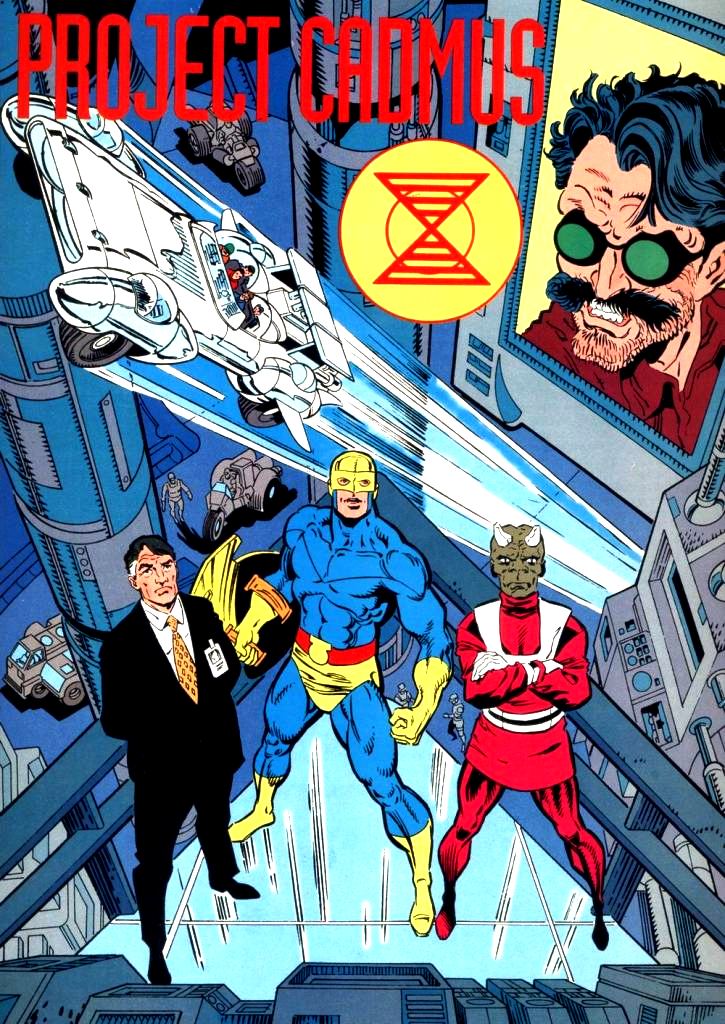
When Jack Kirby brought these characters back in the 1970s, he had them working at a top secret cloning facility, known simply as The DNA project or "the project".
When this concept was brought back in the 1980s and 1990s, it was renamed Project Cadmus (
W). The name comes from the Greek mythological hero Cadmus, who created a race of new men from dragon teeth (
W).
By the time of Project Cadmus, the Newsboy Legion are all grown up, and they are now the scientists who are running Cadmus's projects.
But... the younger versions of themselves are still running around Cadmus as well, because the Newsboys cloned themselves. (Actually when Kirby originally re-introduced these characters in the 1970s, the younger newsboys were the sons of the originals. But in the post-Crisis 1980 and 90s, they had been ret-conned into being exact clones of the originals).
There's probably a thin line between a genius idea and a really stupid idea, but when I was 14, I thought this was so bizarre it was cool. You had the adult version of these characters, and kid versions, both appearing in the same comic book. How insanely stupid, and yet incredibly bizarre, was that!
Tonally, the newsboy legion (a bunch of boys running around solving crimes) belonged to a different era of comic books. They came from the era when comic books were a lot more kid friendly in the 1940s, and they were out of place in the dark gritty 1990s. But in a way, that made them all the more bizarre, and all the more interesting. Here was a relic from the 1940s comic book era running around in the Superman comic books of the 1990s.
The Guardian himself (
W) was also still around, although he was also a clone of the original (which explained why he wasn't an old man at this point, and could still run around doing superhero stuff).
I always thought the Guardian was really cool as a kid. For one thing, he was essentially just another version of Captain America and his shield, and
I always thought Captain America and his shield were really cool. But I also thought it was strange that the Guardian was a superhero in his own right, and yet was stuck as just a supporting character in the Superman comics. That added another element of fascination to the whole thing.
Another Cadmus staff member was Dubbilex (
W), who was a mutant creation of Cadmus, and had telepathic powers (Dubbilex was also originally created by Kirby in the 1970s, but featured prominently in the Superman comic books in the 1990s).
Cadmus had a created several mutants known as "D.N.Aliens" (aliens created by mutating DNA) who lived underground in a society called The UnderWorlders. Some of the Underworlders were friendly and helped the good guys, but some of them were violent mutants, and often they would get out of control. (
W)
The Underworlders could be violent, but they were also victims of Cadmus's maltreatment, so they could also be sympathetic characters.
The original founder of Cadmus was a mad scientist named Dabney Donovan (originally created by Jack Kirby in the 1970s, and like all the rest of these characters updated again in the 1980s/90). (
W) When these characters were re-introduced in the 1980s, Dabney Donovan had been replaced by the US Government, and was in hiding.
By the early 1990s, Dabney Donovan had been replaced by Paul Westfield, an unscrupulous government beauracrat.
Paul Westfield is actually the one person on this list who was
not a Kirby creation. Writer Dan Jurgens created Westfield in 1991 (
W).
This added a layer of moral ambiguity to Project Cadmus. The Guardian, the Newsboy Legion, and Dubbilex were all good guys, but they were frequently working on morally dubious projects because their boss wasn't always good.
Now that I'm older and a little more sophisticated, I realize this kind of story is pretty cliche, especially in comic books. (Recently Marvel's been doing the same thing with
Agents of Shield--good guys stuck inside a corrupt organization). But when I was 14, this seemed like pretty complex stuff, man, and it really fascinated me at the time.
Paul Westfield's himself had some moral complexity to him. Although his character changed from issue to issue (depending on who the writer was) he usually wasn't so much straight up evil as he was Machiavellian. He wanted what was best for the world in the end, he just thought that the ends justified the means.
A perfect example of his character is when we find out that in Vietnam, he had killed his commanding officer in order to save the rest of his men.
Again, from the perspective of adulthood, all of this seems pretty trite and cliche. But this seemed like heady stuff at 14.
In 10th grade, it certainly felt like none of the literature I was reading at school was giving me characters this complex.
Dabney Donovan was always lurking in the shadows planning his revenge on Paul Westfield, which added extra drama to the Superman comics in the early 90s.
Until after years of build-up, one day in 1993 Dabney Donovan finally struck, and that was the end of Paul Westfield.
In Kirby's original version in the 1970s, the Cadmus project was run by a group of super-intelligent hippies known as the Hairies (
W)
A faction of the Hairies were a bicycle gang known as the Outsiders,
They lived in a tree house village commune on the outskirts of Metropolis.
These characters were also brought back in the 1980s and 90s. They didn't appear quite as often as The Guardian and Cadmus, but they would show up from time to time in the early 1990s Superman comics.
Like the Newsboy Legion, these characters fascinated me in the 1990s precisely because they were so tonally distant from everything else that was happening. They were a relic from the 1970s, and they were completely out of place in the dark gritty comics of the 1990s. And yet, here they were.
And there were more Kirby characters popping up in Superman comic books in the 1990s: Morgan Edge (
W), Intergang (
W), Dan Turpin (
W), et cetera. But I don't have time to talk about them all, so I think I'll end things here.
One Final Addendum...
Whisky Prajer recently commented about Carl Barks comics that "
they're not as much fun to re-read as they are to remember (alas)."
And, alas, I've discovered the same is true with Superman Comic books and the Jack Kirby characters. Or for that matter, most superhero comic books.
About 10 years ago, I actually went through the trouble of special ordering a lot of these comic books by mail, including
The Fourth World Ominibus series (
W) in which Jack Kirby first debuted these characters.
It was expensive, but I had been feeling a little bit down at the time, and I wanted to treat myself to some escapist entertainment.
I couldn't even finish reading it.
The thing with a lot of comic books is that the concepts and stories are fascinating in the abstract, but the medium is so juvenile that none of the stories really get developed. The pictures are very visually appealing, but there's so much picture that the story doesn't have many lines to get developed. And half of every issue is always taken up by a fight scene.
It catches your imagination when you're 14, definitely. And the general ideas stay in your mind for years afterwards, leaving fond reminiscences of how fun and bizarre those storylines are. But it's a mistake to go back in your 30s and try to read these comic books again.
That warning aside, if anyone does want to risk it, pretty much all of these comics can be read
here.