Showing posts with label Scott Thornbury. Show all posts
Showing posts with label Scott Thornbury. Show all posts
Thursday, May 18, 2023
“The concept of method has not been replaced by the concept of postmethod but rather by an era of textbook-defined practice. What the majority of teachers teach and how they teach … are now determined by textbooks.” Akbari, R. 2008. Postmethod discourse and practice. TESOL Quar
The citation got cut off at the end there because of Twitter's word count limitations. The full reference is Akbari, R. 2008. Postmethod discourse and practice. TESOL Quarterly, 42/4, p. 647. This is one of Scott Thornbury's favorite quotes, and I picked it up from him.
In fact, I had misremembered it as being a Scott Thorbury original.
I even attributed a version of this quote to Thornbury in a old post here:
...there's a quote from Scott Thornbury. I can't find it now, but I believe it goes something like: "Textbooks are the new methodology." (Hopefully I'm not misquoting him.)
But I googled it just now and realized that it was Thornbury quoting someone else. Among other places Thornbury has used this quote, see HERE.
I wanted to bookmark this quote so that I could find it again easily, and perhaps link to it in the future. And so I figured the easiest way to do that would be to send it out as a Tweet.
Tuesday, June 07, 2022
OK but surely a traditional sentence-level or even word-level dictation would be more effective? How can you be sure that discrepancies are caused by phonological miscoding rather than by higher level flawed inferencing? For example...
For what it's worth, I regret this. I shouldn't nitpick Scott Thornbury. After all, I've learned so much from him over the years--see HERE, HERE, HERE, HERE, HERE and HERE.
(TESOL Worksheets--Workshops and Teacher Development)
Responding to Errors: docs, pub
Error Correction: docs, pub
[Notes: These two sheets contain very similar content, but the first one only contains examples of error correction and I use it to give teachers as a self-study. The second sheet contains the same as a first sheet, plus more examples, and I use it for teacher training in workshops.
The content is adapted from a book by Scott Thornbury. I became aware of it via a colleague who was using a very similar worksheet, which I re-typed and edited slightly--in other words, none of this is my own original content.]
Responding to Errors
What options has the teacher got when faced with a student’s error? Let’s imagine that, in the course of a classroom activity, a student has been describing a person’s appearance, and said:
“He has a long hair.”
Here are some possible responses that the teacher might consider:
“No.”
“He has long hair.”
“No article.”
“No. Anyone.”
“He has…?”
“He has a long hair?”
“I’m sorry, I didn’t understand.”
“Just one? Like this? (Draw a bald man with one long hair) “Ha ha ha…”
“A long hair is just one single hair, like you find in your soup. For the hair on your head you wouldn’t use an article: He has long hair.”
“Oh, he has long hair, does he?”
“Good.”
Teacher says nothing but writes down the error for future reference.
Look at these student errors. What kind of errors are they? Why do you think the learners might have made the error?
At my school we mustn’t wear a uniform.
If I’ll see her, I’ll tell her you want to talk to her.
Student: I used to go out every weekend.
Teacher: And now?
Student: Oh yes, every weekend I go out.
My girlfriend is very hungry with me because I crashed her car.
Yesterday I’ve been to the zoo with my best friend.
A: Do you like my new clock?
B: Yes, is the strap made of leather?
I like very much watching TV.
He has a long hair.
Background
First of all, some disambiguation.
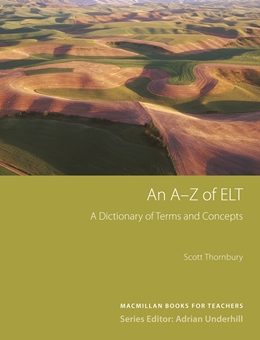
Scott Thornbury has multiple versions of "An A-Z of ELT" across several platforms. It was first published as a book in 2006. It then became Scott Thornbury's blog. The purpose of the blog was, in Thornbury's words:
In 2006 Macmillan published my dictionary-encyclopedia of English language teaching called An A-Z of ELT. On the off-chance that there might be a second edition of that book, I am using this blog to revisit some of the key entries, and discuss, critique and update them where necessary, while at the same time inviting comments from interested practitioners. I will be choosing items in no particular order, and in line with the issues that happen to interest me at the moment. Your comments and suggestions are very welcome.
Despite Thornbury's modesty, the blog was much more than just a placeholder waiting for the second edition. The entries that Thornbury blogged about were like full essays in themselves, and the blog was very popular among language teachers, (I've mentioned it on this blog myself in the past--see here and here), and perhaps the blog is even more popular than the book. The long-awaited second edition of this book came out last year: The New A-Z of ELT.
The book I read, and am reviewing, is the 2006 first edition. Because that's the version that was in my school library.
My History with this Book/ Why I Read this Book
This book has sat on my shelves ever since 2014, when I did the DELTA Module 1 by distance. It was recommended that we use a copy of either Longman Dictionary of Language Teaching and Applied Linguistics by Jack C. Richards and Richard Schmidt or An A-Z of ELT by Scott Thornbury. Our school had both, so I had copies made of both books.
Both of them are reference books. Neither of them are intended to be read straight through.
Of the two, Longman Dictionary of Language Teaching and Applied Linguistics is written more like a dictionary with a formal style and short brief entries on 2,800 topics. An A-Z of ELT is more conversational in tone and has longer more discursive entries on only 376 topics.
When I attempted to use Quizlet to memorize these terms a couple years ago, it was obvious that the short dictionary definitions of Longman Dictionary of Language Teaching and Applied Linguistics would be suitable, whereas An A-Z of ELT would not be. But if you wanted a more interesting informal read, you would go to An A-Z of ELT.
The past couple years I've been leading a book club for professional development at work based off of the DELTA reading list (HERE). And this book frequently gets suggested by the other members. And I've always shot it down. "An A-Z of ELT? No, that's a reference book. We wouldn't want to read it for book club. There'd be nothing to discuss."
But then about a month ago, I found myself flipping through the book. Initially I think I picked it up to look up something, but then I got so engaged by Scott Thornbury's conversational style that I started looking up stuff randomly.
And then, I thought, "Well why not just read the thing?"
The Review
This will be a short review, since there's not much to talk about with a reference book.
A book like this isn't meant to be read cover to cover. (If it was, a much more logical way to organize it would have been thematically instead of alphabetically.) And yet, I suspect I'm not the first person out there who has read it cover to cover.
In all my reviews of Scott Thornbury's books, I've always praised his readable style. And, despite being a reference book, this book is readable.
You wouldn't want to read too much of it in one sitting, of course. A few entries a day are probably good. But if you just nip away at this book slowly during your lunch breaks, there are all sorts of interesting little tidbits here and there.
I'm at the point in my career now where a lot of this is review instead of new information. (If that sounds like I'm bragging--it shouldn't. After teaching English for 16 years, doing a Masters, a CELTA, and the DELTA Module 1.... I should at least be at the point right now where I'm familiar with the basic terminology of the field.) But I did also pick up a lot of new information.
We'll see how much of this I'll remember in 5 years. I'm slightly worried that reading straight through a reference book isn't the best way to retain information, but we'll see I guess. At any rate, regularly revisiting all of this stuff is the best way to learn it in the long term. So it's good to keep hitting these basic ELT primers. I think the information gets a little bit more into my long term memory with each book.
There's no point going too much into the content of this book. It is, after all, a reference book. The content is anything and everything.
There were a few spots were I wish Scott Thornbury would have expanded more on some point, but there's no point in going into those nitpicks. For most of the entries, I was satisfied that Thornbury had covered the key points.
The exception is the entries on some of the more "new-age" or pseudo-science aspects of ELT: multiple intelligences, learning styles, and neuro-linguistic programming. I've been reading a lot of stuff critical of this recently (Russ Mayne, for example), and I was hoping Scott Thornbury would get into the controversy more. He didn't.
This may be, however, because the edition I read was in 2006. And I think 2006 was back before the backlash and against multiple intelligences and learning styles fully took hold.
In fact, in his blog in 2010, Scott Thornbury talks about recent articles on learning styles he's read, admits that he was wrong not to be more critical or learning styles in An A-Z of ELT.
Why I Read This Book
We read this book as part of our professional development bookclub at work.
Usual, we try to stick to the books on the DELTA Reading list (official Cambridge list HERE).
But one of the members asked if we could go off the book list temporarily and read Teaching Unplugged. And we all said: "sure".
To be honest, I'm not sure if Teaching Unplugged is recommended reading for the DELTA or not. I can't find it on any official DELTA reading lists. And yet, the Dogme approach is well-known enough that it's often referenced in DELTA related materials. (When I did the Module 1 distance DELTA, this book was referenced in their reading on "Methods and Trends in ELT"). And I understand that in Delta Module 2, you can do a dogme lesson for your experimental practice. So I think I'm going to go ahead and count this as a part of the DELTA reading list anyway.
A Bit of Background: What is Dogme?
Dogme is a teaching style in English language classrooms. It gets its name from the Dogme 95 movement in filmmaking (W).
I don't know a lot about filmmaking history, so bear with me, but my understanding is that Dogme 95 was a reaction against the over-dependence of special effects in films. Dogme 95 wanted to return focus to the characters and the story in filmmaking. And so they produced a list of rules for Dogme films, such as...
1. Shooting must be done on location. Props and sets must not be brought in (if a particular prop is necessary for the story, a location must be chosen where this prop is to be found).
2. The sound must never be produced apart from the images or vice versa. (Music must not be used unless it occurs where the scene is being shot.)
3. The camera must be hand-held. Any movement or immobility attainable in the hand is permitted.
The Dogme 95 movement was started by the Danish film directors the Danish directors Lars von Trier and Thomas Vinterberg, and "dogme" is Danish for "dogma". I guess because the rules of the movement are quite dogmatic? I don't really know. Like I said, i don't know much about the history of filmmaking. (I'm cribbing a lot from Wikipedia right now).
But I did once work with a cinephile--someone who was obsessed with films and filmmaking--and he once met Scott Thornbury in person at an ELT conference. And when he came back and told me about it, the thing he was most excited about was that he had met someone tangentially connected with the Dogme 95 movement. (He was telling me excitedly about how Scott Thornbury had imported the principles of a revolutionary filmmaking technique into English language teaching). So I guess it is a big deal to cinephiles, and especially cinephiles who end up teaching ELT.
...anyway, Scott Thornbury and Luke Meddings and their friends imported the name dogme directly from the Danish filmmakers, and used it to describe their new style of language teaching. Wikipedia says...
Although Dogme language teaching gained its name from an analogy with the Dogme 95 film movement (initiated by Lars von Trier), the connection is not considered close.
...and yet, the connection is there. Like the filmmaking movement, no outside props are used. Teachers do not go into the classroom with textbooks, or worksheets, or target grammar points. Instead, they simply listen to what the students are saying, and react to it. (...Kind of. Actually I'm oversimplifying a bit, but that's the general idea.)
Sidenote: Scott Thornbury, in addition to being one of the main people behind Dogme in ELT, has a reputation for being one of the most prolific authors in ELT, and for writing on just about everything. In fact I've reviewed 3 of his books previously on this blog: About Language, Uncovering Grammar, and Beyond the Sentence. (I've reviewed Beyond the Sentence twice actually). And I'm actually currently reading another Scott Thornbury book: An A-Z of ELT. Luke Meddings I've never heard of before, so there's a temptation to only reference the more famous co-author, and refer to this as Thornbury's book. I'll try to avoid that.
Readability
So, this book probably was never meant to be read cover-to-cover. Once you get past the first chapter, it's really more of a reference book, or a list of classroom activities.
It's good for what it is, but it's probably not the best book to do for a book club.
(When we met up to discuss it at the end of the month, the person who had suggested the book apologized. "It's okay," I told him. "We end up reading a lot - of these - references books for this bookclub. It's the problem with trying to find engaging books on professional development.")
The book starts out with a bang.
The first chapter (p.7-22) is a blazing indictment of textbooks, grammar syllabuses, commercialization and the state of English Language Teaching generally.
It really pulls no punches.
...although, re-reading it before this review, I realized that all the best and most memorable parts of chapter 1 were when Meddings and Thornbury were quoting from other people. Chapter 1 is really quote heavy. They even fill the margins in with quotes, in addition to all the quotes they jam into the main text.
Top of page 12. Notice the two quotations in the margins? Typically of how all of chapter 1 is laid out.
The quotes in the margins were actually kind of distracting. (I was never sure if I was supposed to read those alongside of the text on that page, or before the text, or after. My eyes kept darting over to the quotes when I tried to read through the text.)
But to give credit where it's due, the authors have managed to assemble a list of really memorable quotes, and put together a powerful indictment of the state of ELT currently.
(Sidenote: The indictment of ELT as an establishment reminded me a bit of the tone of some of Geoff Jordan's blogposts. Ironically, Geoff Jordan occasionally sees Thornbury himself as part of the establishment, and attacks accordingly. See HERE and HERE. )
But then, the bulk of the book is just a list of activities.
Because I've got a certain personality (I like to get a sense of completion by finishing the whole book), I forced myself to read the whole thing before our book club meeting. But boy, did I have to fight to keep myself from dozing off as I read through the whole thing.
I think the correct way to use this book is to try some of these activities out in your classroom, and then reflect on how well they worked. (That approach would probably have given me more material a more interesting review as well).
And actually, that is what I intend to try and do going forward. I was thinking each week I would try out one new activity from this book, and see how it worked.
Actually doing the activities would give me a lot better understanding of this material than just reading through it in a coffee shop (which is what I did.)
And maybe I'll report back in 6 months or so to tell how the new activities worked. But for now, I'm just going to review what I read.
My Thoughts
So, in no particular order, here are a few of my thoughts on the whole thing.
Over-all
There's much to like about the Dogme approach. Certainly, Thornbury and Meddings are right that most ELT textbooks in use are dreadfully boring, and unhelpful to the students.
Short Digression: It continually amazes me how boring most ELT textbooks are. When you look at the reading and listening exercises in ELT textbooks, it's almost as if the textbook writers were trying to make these books bland and boring on purpose!
The travesty of it is that foreign language study is the one school subject where you have complete freedom to use whatever material you want. Other subjects have to focus on their subject material. (A math or science class almost has to be boring by necessity, because you have to focus on the math and science.) But in a foreign language classroom, you could practice the foreign language through whatever medium or story you wanted. You don't have to do reading and listening exercises on the carbon cycle, you can do them on superheroes, or dragons, or double secret agents.
And yet, what do the texttbooks always do? Without fail, they always pick the most boring topics imaginable. (Topics that have appeared in my textbook recently: tunnels and bridges, the history of audio recordings, the history of newspapers, endangered animals, etc.) I mean, if you were actively trying to create an environment where your students hated studying English, could you do much worse?
...all that being said, I do have to confess to being overly reliant on my textbooks. I try not to use them for the whole 2 hours. (The first hour I usually try to do supplementary readings or listenings on topics I think the students would be more interested in.) But I just can't kick the textbooks completely. I like the feeling of completeness that I get from working through a whole unit of the book. I like the feeling of structure that the textbooks give me. (And I suspect at least some of my students have this same personality quirk. Some of them like the structure and security of a textbook.) So even though I frequently have conversations in the staffroom about how awful the textbooks are, I continue to keep using them.
So I'm a bit conflicted on the issue. But a large part of me is sympathetic to what Thornbury and Meddings are saying. Textbooks suck. They don't meet the actual needs of the students, and teachers are overly reliant on them. Better to react to what the students in the class are actually saying.
This is what I've been trying to do more and more over the past couple years, even before I read Teaching Unplugged. And actually, it turns out that I've been doing a lot of the Dogme approach without realizing it.
These "Telling Your Stories" speaking activities that I created last year are actually a lot more Dogme than I realized. My inspiration for doing them was, in part, an episode of The TEFL Show podcast where the presenters talked about how many teachers rigidly follow the grammar syllabus instead of reacting to the language in the classroom. The problem with the grammar syllabus, they argued, is that it doesn't necessarily correspond to the grammar your students are ready to acquire. The grammar lesson on the syllabus for any given day could be a grammar point that your students have already acquired. Or it could be a grammar point that they aren't ready for yet. So it's better for the teachers to just listen to the language points that their students are trying to produce, and react to that.
And so that's what I tried to do with Telling Your Stories. I gave the students a topic, had them talk about it, and tried to react to the language I heard in the room. (I used this as a supplement, not a replacement, to the textbook. But that's not entirely out of step with what Meddings and Thornbury are advocating. The authors say that Dogme doesn't need to be an all or nothing approach. You can have Dogme moments in the classroom even if you have to follow a textbook.)
I was both pleasantly surprised, and a little bit disappointed, to discover how much of Teaching Unplugged was what I was already doing. I was pleased because it meant I had been on the right track all along. But I was disappointed because I was expecting something a bit more revolutionary or mind blowing. Meddings and Thornbury have a long list of Dogme lesson plans in Teaching Unplugged, but most of them amount to the same thing--give students a topic to talk about, and then react to the language that you hear.
In my less charitable moments, I was tempted to regard Dogme as not a new approach, but just a list of conversation topics (But then, is there anything wrong with that? Maybe that's what students want and need?)
Taken as a supplement to the traditional curriculum, there's absolutely nothing wrong with Dogme. No doubt, working with students on their emergent language instead of the grammar syllabus is what the students need.
But although the authors state that teachers can use Dogme as a supplement, they are also arguing that, really, it would be better if you ditched the traditional curriculum completely and just did all Dogme all the time.
And here's where problems could arise.
...Potentially.
...I don't know actually, all of this stuff is still a matter of debate. But here are some causes for concern.
Potential Problems with Dogme
All Language Comes from the Learners--No Input
The authors seem to be arguing that the learners don't need a lot of outside input to expand their language. No place in the classroom for extensive reading and listening. Rather, the teacher listens to what the students are trying to say, and helps them expand it into more correct or more complex language. And this is where the language development comes from.
But is this enough? Can you get from simple sentences to complex sentences without a lot of exposure to it in the input?
Problems with Monitoring
Part of the Dogme approach is that the teacher is monitoring what the students are saying, and then responding to it. But in my own experience, I have often have trouble monitoring what the students are saying in larger classrooms. It may work fine for a group of 6 students, but what about a group of 19 students? It's hard to hear what individual students are saying about the roar of background conversation.
Also, I've noticed that it's easy for me to spot mistakes and emergent language with elementary learners, because they are all using simple sentences, which makes errors easy to spot. With advanced learners, it's hard for me to notice errors in complex sentences. Especially if I'm only overhearing half of a sentence while I try to monitor the whole class. To pick up on the problems in complex sentences, I find I have to listen to one learner really closely for an extended period of time. Which is difficult to do if you have a lot of other students to attend to.
Topics Too Personalized?
My CELTA tutor once told us that lessons go best when the students are allowed to talk about themselves. Everyone is obsessed with themselves, everyone's favorite topic is themselves, everyone wants to talk about themselves, so if you give the students ample opportunity to share about themselves in class, they will always have a positive experience.
Dogme appears to be built on this assumption as well. Almost all the Dogme topics are personalized and learned centered.
If my CELTA tutor was right, then this approach is perfect. But I sometimes wonder--was my CELTA tutor right? Does everyone want to talk about themselves all the time, or is that only a certain personality type? Are some people more interested in the outside world of ideas or fantasy? Does everyone feel comfortable always sharing about themselves in the classroom? Will learners get bored talking about themselves after week 3?
Grammar Syllabus
I think Meddings and Thornbury are right in the sense that you can't force learners to produce grammar points before they're developmentally ready. The evidence for this is overwhelming.
There is, however, arguably some value in teaching learners to recognize receptively grammar points that they may not be ready to produce actively. (Rod Ellis argues for such an approach in SLA Research and Language Teaching.)
In addition to increasing students' ability to read and listen receptively, there's a theory that this will also help them to notice the grammar structures in the input, which will then speed up their rate of acquisition. (Schmidt's Noticing Hypothesis).
This would be the argument for some sort of structured grammar syllabus as a supplement to Dogme. Not a grammar syllabus that focused on production, and hopefully not a grammar syllabus that took the majority of the class time. But it may be useful to spend sometime making sure students understand receptively the grammar structures, in addition to providing them regular opportunities to speak.
And Thornbury knows this, because he discussed this in his book: Uncovering Grammar
Other Notes
Reflections on Chapter 1
So, as I mentioned above, there are some real kickers in chapter 1. Most of them are quotes of other people, but they are perhaps worth mentioning here and commenting on.
There's some very provocative stuff about how the ELT industry generally, and textbooks specifically, are fueling a culture of global capitalism. And this comes out especially on pages 12 and 13.
Over twenty-five years ago, Gillian Brown noted that coursebooks promoted a kind of English that she called "Cosmopolitan English" because it assumes a materialistic set of values in which international travel, not being bored, positively being entertained, having leisure, and above all, spending money casually and without consideration of the sum involved in the pursuit of these ends, are the norm. ... the consumerist nature of coursebook content also reflects the aspirations of many learners of English, who view the acquisition of English (rightly or wrongly) as a passport to material well-being and international travel.
Depending on your own ideological position, you may be happy to support learners in achieving these goals. On the other hand, you may feel that learners' aspirations are being manipulated in the interests of globalisation and/or the hegemony of English, and that coursebooks simply serve these wider interests. As B. Kumaravadivelu notes:
Because of the global spread of English, ELT has become a global industry with high economic stakes, and textbook production has become one of the engines that drive the industry. It is hardly surprising that the world market is flooded with textbooks not grounded in [the] local sociocultural mileu.
Teachers, like it or not, are complicit in these globalising processes. As Alistair Pennycook points out, "English language teaching beliefs, practices and materials are never neutral. ... It might be said that the English language class may be less about the spread of English than about the spread of certain forms of culture and knowledge." Pennycook identifies these forms of culture and knowledge as being essentially Western, capitalist, and neo-colonialist. The most concrete embodiment of these forms of culture and knowledge is, of course, the coursebook. (p.12-13)
Wow, huh? This caught my attention, and I wasn't the only one. At bookclub, someone else had also highlighted this and wanted to talk about it.
It is definitely true that the English Language Teaching profession is connected to the spread of global capitalism. This is something that I've definitely noticed since coming to Cambodia and Vietnam, where the primary reason for studying English is to get a good job in an international company. (This was less noticeable in Japan, where English language proficiency wasn't necessary to get a good job, and most of my students were bored housewives.)
It has been a source of conflict for me over the past few years. I want to teach English so that my students can have access to literature and culture, but many of them (or their parents) are simply obsessed with passing standardized exams.
It is also noticeable how heavy most of our textbooks skew towards either exam tasks or business English situations.
It is, however, debatable how much ELT is active in spreading capitalist beliefs. I think it's possible to argue that the spread of ELT is connected to global capitalism, but that ELT itself isn't particularly ideological. Although it's impossible to say really, because it's impossible to make generalizations. It varies from school to school, classroom to classroom, lesson to lesson. Onto other notes:
The Lexical Approach
* Somewhat surprised to see an excerpt The Lexical Approach by Michael Lewis favorably quoted on page 9. (Michael Lewis is one of the authors that Thornbury and Meddings bring in in support of their approach). I'm surprised because Thornbury gave a very skeptical review of the Lexical Approach in his 1998 article: The Lexical Approach: A Journey Without Maps? (available online HERE). In the review, Thornbury rejects Lewis's emphasis on lexical phrases alone: "...phrasebook learning without the use of syntax is ultimately impoverished. All chunks but no pineapple. It makes sense, then, for learners to keep their options open and develop and to move between the two systems and not to develop one at the expense of the other."
But I suppose it's not a total contradiction. Thornbury clearly says in his review that there's elements of The Lexical Approach that he likes, so perhaps he's allowed to quote selectively.
Krashen
* Another author that I'm a bit surprised to see quoted is Krashen. (Quoted by Thornbury and Meddings on page 17). Like Thornbury and Meddings, Krashen is against the grammar syllabus. But Krashen is also against forcing speaking. And Thornbury and Meddings seem to be all about speaking.
They say: "The success of immersion programmes in bilingual contexts such as Canada added supportive evidence to Krashen's claims for the value of input, and the need for a 'silent period' before productive skills kick in."
Indeed, this is what Krashen argues. But did I miss something, or is there no allowance for a silent period in the Dogme approach?
...actually come to think of it, there wasn't much at all in this book for beginner students. All of the speaking activities in this book seemed to assume some level of speaking fluency on the part of the students. What do you do with absolute beginners?
Dogme versus Task-Based Learning
And actually, speaking of input...
There's a lot in the Dogme approach that is similar to task based learning. While I read this book, particularly the list of activities, I was reminded of our previous bookclub book: A Framework for Task-Based Learning by Jane Willis. Both approaches involve giving learners a topic to talk about, and then dealing with the emergent language in the feedback. Thornbury and Meddings are familiar with this similarity, and address it on page 17. "...Where a Dogme approach parts company with a task-based approach is not in the philosophy but in the methodology. As we have argued, naturally-occurring talk is sufficiently fertile context for language development, obviating the need for the somewhat artificial and cumbersome tasks associated with a task-based approach."
There's an element of truth here. Some of the tasks suggested by task-based learning advocates are pretty artificial and stupid. But then this is to take task-based learning at it's weakest. Although some of the tasks advocated by Jane Willis and others are less than engaging, not all of them are. A number of the tasks they suggest are personalized around the students--very similar to the list of topics that Meddings and Thornbury suggest in Teaching Unplugged.
To me, the biggest difference between task-based learning (as outlined by Jane Willis) and Dogme is that task-based learning has an input stage. In task-based learning, learners first listen to a recording of proficient speakers doing the same task, and analyze the language used by the proficient speakers before they do the task themselves.
The language input seems like an important part of the process, and I'm a bit worried that it appears to be missing from Dogme.
I think that Thornbury and Meddings are arguing that all of the language should come from the learners. The teacher should take whatever language is emerging from the learners, and work on expanding it with them.
But... while this would work fine with simpler language points, would it work well with complex sentences. Will this naturally just emerge on its own without a lot of input?
All that being said, the main problem with the input stage in Jane Willis's approach is that it is SO labor intensive on the part of the teacher. (I've experimented with it myself. I got a couple of colleagues to perform a task, recorded it, and transcribed it for use in the classroom. To arrange a time to meet with my colleagues, to the recordings, and to do the transcribing took me hours.)
The beauty of Dogme is that it's all zero prep or very low prep. How can you beat that?
Other Notes
* While I was finishing off this book, a colleague approached me to get some ideas for an end of course lesson.
"Here, try this book out," I said. "There are lots of good ideas in here."
Later, when I saw her after class, I asked her, "How did it go?"
"Great," she said. "I did Everyone's a Teacher," (p. 29--a Dogme lesson in which the students translate proverbs or idioms from their own language into English, and teach them to the teacher proverbs or sayings from their language.) "In fact it worked too well," she said. "They didn't want to leave at the end of the lesson, they were so excited to teach me all these phrases."
...yet another reason for me to try out these activities myself...
* Email from my manager:
"This is the only time I'll interfere with the book club: Make sure that it's clear to teachers attending that this does NOT mean teaching unplanned or improvising (as Meddings seems to suggest). It's a very good book for teaching teachers to respond to student production in the lesson, though. Interested to hear how this goes."
Bookclub Notes (I posted these on the bookclub Facebook Page):
Hey gang,
First of all, I think I've contacted everyone who's interested, but we're meeting at 12:30 tomorrow. (Room number still to be determined.)
I waited until the last minute, as usual, but I did chain myself to my desk for a few hours this afternoon, and I actually did finish the book.
I wont lie, I found it pretty boring to read through. That's no knock on the content or the ideas in the book. I'm just not sure this book was ever meant to be read straight through. I think it's more of a resource for lesson planning.
How did you guys find it?
Hopefully we'll get some interesting discussion out of it tomorrow. But to try and jumpstart some of the discussion ahead of time, I'll just jot down a few observations here:
1) The first chapter was actually really interesting. (Before we got into just the listing of activities). I was particularly struck by their evaluation of textbooks. To quote: "Over twenty-five years ago, Gillian Brown noted that coursebooks promoted a kind of English that she called 'cosmopolitan English' because 'it assumes a materialistic set of values in which international travel, not being bored, positively being entertained, having leisure and above all, spending money casually and without consideration of the sum involved in pursuit of these ends, are the norm.'" (p.12-13).
Yeah, that sounds about right to me.
2) Also in the first chapter, I was surprised to find "The Lexical Approach" by Michael Lewis quoted approvingly in the first chapter, given Scott Thornbury's brutal take down of the book in his review: The Lexical Approach: A Journey Without Maps. http://nebula.wsimg.com/9129eed8a13130f4ee92cf2c3ce5b13e…
In his review, I got the impression Scott Thornbury was against the idea of abandoning the grammatical syllabus in favor of a lexical syllabus. Did he change his mind?
3) I was a bit underwhelmed by a lot of the activities in the books. The first chapter seemed to promise a revolutionary new way of teaching, but then once we got into the actually activities, it sounded to me like it was just a list of conversation topics. (Some of them better than others, to be quite honest). I feel like I've already been doing a lot of this--giving my students conversation topics, and then giving them feedback on the language they are using. https://drive.google.com/drive/folders/0B5QgMDk6npsRNEg0eFdHc2N3a00
4) Tangentially related:
This video is worth watching mostly just because it's interesting. https://youtu.be/j31Bj-XIFSk
(Scott Thornbury has a talent for making anything interesting.)
But it also does tie in with some of chapter 1. Particularly the part from page 10 about how Conversation Scaffolds Learning.
Post 2
Oh, I completely forgot to mention it, but also related is CAT: A framework for Dogme by Ken Lackman appearing in English Teaching Professional, Issue 87, July 2013. https://www.etprofessional.com/cat-a-framework-for-dogme
This is from Kasey and at one point it used to be hanging up in the Center 1 resource wall. (Perhaps we should bring it back?)
This is a very short book--121 pages, of which only the first 80 pages are text (the last 40 pages are photocopiable materials and classroom activities.)
It's also a very readable little book. (Scott Thornbury is always readable).
I am, therefore, embarrassed to admit how long it took me to finish writing this review. I finished this book way back in December, and it's taken me about a year now to get this review together.
So what happened?
Well, as always, plain old procrastination played a big role.
But aside from that, despite the fact that I found this an easy book to read, it was a difficult book to review because Scott Thornbury touched on a lot of issues, and I had difficulty sorting out my thoughts. The book touched on the nature of grammar itself, the meaning of grammar, the natural order hypothesis, the way the brain learns languages, cognitive linguistics, etc.
Sometimes with some of these books I struggle to write a coherent review not because I don't have anything to say, but because I have so much to say that it's difficult to know where to begin. (I had the same problem with The Lexical Approach and The Case for Christ.) So, over the past year I kept mentioning this book on my blog, and promising to get around to the review, but never doing it (see--here, here, here, here, here, here , here , here and here).
But then, last month, when we needed to choose a new book for the book club, and nobody had any good ideas, I decided to kill two birds with one stone, and suggested this book. (This book is on the list of recommended books for the DELTA, so it counts as part of the DELTA reading list.)
And now here I am with the review.
As I mentioned above, when it comes to readability, it's a really quick and easy read.
However when discussing the subject matter, there are a lot of tangents one could go off on if one were so inclined.
But if one starts opening up all those cans of worms, the book review would never get finished. So I'm going to deliberately hold myself back and NOT write all my thoughts about everything in this book. Instead, I'll just try to summarize it in the briefest of terms.
Scott Thornbury is perhaps the most well-known author in the TESOL profession.
Scott Thornbury has a reputation for communicating ideas very effectively. He apparently borrows heavily from other linguists, but because he writes in such a clear and easy to understand way, many teachers prefer to read Scott Thornbury than to read the original academics.
I mention this as background, because in reading these pages, my primary thought was what a wonderful job Scott Thornbury was doing at communicating his message. The man truly is a wonderful communicator.
A lesser writer would have simply stated their argument. But Scott Thornbury does an excellent job of building his argument from the bottom up. He gives lots of examples, and encourages the reader to think about what is going on. Then from these many examples, an argument gradually starts to emerge.
It's a masterpiece of communicating. (While reading this book, I thought about Steven Pinker's thoughts on "The Curse of Knowledge"--video here--the problem that once people know a piece of information, they find it often impossible to assume the mindset of someone who doesn't have that piece of information, which is what makes communicating through writing so hard. Scott Thornbury is a perfect example of someone who has managed to avoid this problem. Thornbury carefully and patiently explains everything to the reader.)
The book is about how to teach grammar--or rather, a book about how grammar is learnt, and suggestions for appropriate classroom activities.
There were some things in this book I completely agreed with, and other things I had questions about.
Scott Thornbury is against the traditional transmission view of teaching grammar--i.e. the idea that a teacher teaches a certain grammar point, and then the students have learned it.
By extension, he also appears to be against the traditional P-P-P approach (present, practice, produce) or at least against the idea that the presentation and practice stage will lead smoothly into production.
Using both his own anecdotal classroom evidence and also linguistic research, Scott Thornbury argues that the human brain can not simply automatize a grammar point in one 90 minute lesson.
When the human brain is focusing on communicating the message, the brain is focused on the content, and not the grammar, and no matter how much the teacher has drilled the grammar, the grammar will inevitably get mangled during free production. (And in my own classroom experience, I've certainly found this to be true. I'm sure every teacher has.)
So what to do then?
An alternative would be Krashen's approach of comprehensible input--give the learner plenty of input, and the learner will pick up the grammar from the input on their own schedule, following the natural order of acquisition. Scott Thornbury never mentions Krashen by name (instead he just refers to this as the "instruction minus" position) but Thornbury rejects this approach as well.
Many learners, Thornbury argues, don't pick up the grammar even after years of living in a foreign country. Learning grammar is so cognitively demanding that the human brain will often resist doing it unless it is forced to, and if learners can get by simply with vocabulary and gestures, many of them will never pick up grammar.
"A diet of nothing else but unrehearsed fluency activities, such as group discussions or communicative games, may make learners over-reliant on lexical processes at the expense of developing their grammatical competence," Scott Thornbury warns on page 20.
Indeed, I encountered many of these types of students during my time working at English Conversation Schools in Japan. And in fact in the very next paragraph Scott Thornbury quotes a description of a Japanese learner who sounded very much like many of my old students.
Sachiko-san was as unabashed and unruly in her embrace of English as most of her compatriots were reticent and shy. ... She was happy to plunge ahead without a second thought for grammar, scattering meanings and ambiguities as she went. Plurals were made singular, articles were dropped, verbs were rarely inflected, and word order was exploded--often, in fact, she seemed to be making Japanese sentences with a few English words thrown in.
(From page 20. Ellipses in Thornbury's original quote. When I looked at the footnotes, I discovered Thornbury was quoting this description from a travelogue (A) and not from the linguistic literature, but it's a good description nonetheless.)
So, Thornbury argues for a combination of what he calls the "instruction plus" and the "instruction minus" positions.
Thornbury argues that grammar is acquired in the following steps:
1. The learner is exposed to massive amount of input.
2. The learner’s attention is drawn to a particular grammatical feature (possibly through formal instruction)
3.The learner starts to notice this feature in the input
4. The learner begins to experiment with using this feature
5. The learner gets feedback on the accuracy of their use (possibly through formal instruction)
6. The correct form is acquired.
This process is pretty much the exact same process I had previously outlined in my two workshops on input: Comprehensible Input in Young Learner Classes and Upgrading Your Input--both of which I had written before I read this book. However I get no credit for being prescient because I was heavily influenced by another book, SLA Research and Language Teaching by Rod Ellis, which Scott Thornbury also relies on. (In fact, much of Uncovering Grammar is simply retreading Rod Ellis, but Scott Thornbury's version is much more reader friendly.)
Scott Thornbury also believes that because learning the grammar is so cognitively demanding, if left to their own devices many learners will end up like Sachiko-san. As long as they can get their meaning across, the learner, or at least their linguistic system, is perfectly happy not mastering the grammar.
In order to overcome this, Thornbury argues, learners have to be put into situations in which the grammatical meaning is essential for conveying the message.
The example Thornbury gives in his book is the present perfect. If teachers simply drill the form of the present perfect, learners will never integrate it into their language. However, if the teacher designs meaning based communicative activities which force the learner to distinguish between the present perfect and the past simple, then learners will begin to pay attention to the use of the present perfect.
My Reservations
I found myself largely in agreement with this book. Which is no surprise, because, as I mentioned above, before I had even read this book I had given two workshops on input which largely expressed the same views as this book.
However, I have two areas of reservation:
1) The TEFL Show did an episode on Krashen [LINK HERE] in which one of the hosts cited research that comprehensible input does not appear to benefit learners unless it is more than 6 hours a week.
I'm been trying to find the source for this claim and I can't. It doesn't seem to pop up on a Google search. But it may well be in the applied linguistic journals, which I don't have access to because I don't work at a university.
For the moment, I'm going to assume the TEFL Show is accurate.
If that's true, that mean that Thornbury's model doesn't really work in an EFL (English as a Foreign Language) environment. In my case, I only see my students for 4 hours a week. I encourage them to study English outside of class, but I know that many of them don't.
If comprehensible input is not effective with less than 6 hours a week, than maybe I should just give up on Thornbury's model, and just drill grammar points using the P-P-P approach instead.
2) Thornbury argues that learners will not pay attention to the grammar unless you force them to by creating a situation where the grammar affects the meaning of the sentence. But I'm not sure this would work for all grammar points. After all, what about the 3rd person singular "s" ? This contains absolutely no meaning at all. How would you force students to pay attention to the 3rd person singular "s"? And what about countable and uncountable nouns? A learner could mess up the distinction between "much" and "many" and still get their meaning across perfectly, right?
Facebook Posts
As part of the book club, I've committed myself to making daily Facebook posts about whatever book we're reading. (A couple people told me they wanted more discussion on Facebook as a way to increase their motivation to read the professional development books, and I've been doing my best to oblige).
Below are all the daily posts I made concerning this book. As often happens to me, I didn't pace myself out well. During the 30 days we had to read this book, I made posts for just about every page in the first half of the book, and then didn't get around to commenting on the second half of the book.
Post 1
A word or two of introduction about the new book: "Uncovering Grammar" by Scott Thornbury.
I've actually read this book once before, but I'll be going through and re-reading it and hopefully posting lots of thoughts on this Facebook page.
This book was chosen in part because it's on the reading list for Delta Module 1.
(See complete Reading list for DELTA Module 1 here: https://drive.google.com/file/d/0B5QgMDk6npsRZFRiaTZqRWgwemc/view)
And a few people on this book club are planning on taking the Delta Module 1 this year, so we try to accommodate that.
However, having read the book, I can confirm it's also of general interest--i.e. it should be useful to any teacher, regardless of whether you're planning on doing the Delta or not.
In the past we've occasionally had to chose between the more theoretical books and the more practical books, but I'm happy to report that this book ticks all the boxes.
There's some interesting theory in here about how the human brain learns and processes grammar. We should get some interesting discussion/debate out of it.
But there are also tons of practical ideas in here for the classroom.
And, as always with Scott Thornbury, the book is very readable.
If you've read stuff by Scott Thornbury before, you know that he has a very light and conversational tone that is very easy to read.
Plus, the book is very short and sweet. So, if you've been wanting to get back into the book club, but feel like you don't have the time, this book will be perfect. It's 122 pages total, but the last 40 pages are all examples of photocopy-able classroom activities. There's really only 80 pages of text here.
Also, if this book sounds familiar to anyone who was at the Productive Skills Workshop last week, that's because I quoted this book in that workshop. The 4-3-2 technique comes from this book.
Post 2
Some more preliminary notes:
Despite being on the Cambridge approved Delta Reading list (https://drive.google.com/file/d/0B5QgMDk6npsRZFRiaTZqRWgwemc/view) the view of grammar teaching presented in this book is quite different from the P-P-P method that is taught on the CELTA courses. Scott Thornbury doesn't bellieve it's realistic to take a grammar point the students have never seen before, present it to them, and then expect them to produce it by the end of a 90 minute lesson.
In Thornbury's view, grammatical complexity slowly emerges over long periods of time.
However, Thornbury is not a Krashenite either. Thornbury clearly believes that grammatical instruction helps the students to learn, but that the teacher's job is to slowly help the grammar to emerge, not to teach it directly.
(This isn't actually unique to Thornbury. As usually, he's borrowing from other linguists. In this book in particular, he's borrowing a lot from Rod Ellis).
However, on page 78, in the section entitled "A Compromise", Scott Thornbury does suggest some ways in which his views could be compromised with the more traditional CELTA method.
An interesting "guiding question" for this book (for those of you who like guiding questions) would be
1) How much of this book is compatible with what we learned in the CELTA? How much is contradictory?
2) How much of this book is practical in our context?
XXXX Commented:
I would dispute that PPP is a huge focus of all CELTA courses .The ILA CELTA course has no PPP lesson plans or guidance notes and most teachers on our course are only exposed to PPP through input sessions. I admit that it is common on CELTA though, mostly as it is easy to assess how well a teacher presented the language and it has clear staging (making it easy for candidates to manage their time effectively - a major area of difficulty for most).
I also think you can challenge what Thornbury says about PPP. Whilst I agree with him that it isn't realistic to learn an entire grammar point in 90 minutes, I think it is feasible that learners can produce examples of that language in a set context within that time frame. Furthermore, how often have you taught a group of learners in our context where no one in the group has ever been introduced to the grammar being covered? I would imagine this is fairly rare. Indeed, one of the criticisms of PPP as an approach is that the presentation and practice don't serve much purpose if the learners are already familiar with the language point (it doesn't offer any diagnostic aspect that approaches like Test-Teach-Test would give).
In response to your actual questions, like most Thornbury books, it contains the mix of easy to digest theory and practical classroom activities that has made him an ELT household name (if such a thing truly exists!). There are lots of ideas that can be applied directly to our teaching context of CLT, though a lot of the content is somewhat outdated and may not appeal directly to our learners, especially teens.
I Commented:
Thanks for the response XXXX.
I remember the PPP approach being the main methodology at my CELTA, but I didn't do mine here, so it's interesting to hear that it's different.
Going outside of Thornbuy slightly, and giving my own personal opinion, my main problem with PPP is that the PPP approach assumes that the students will always be ready to use the grammar in free production by the end of the lesson. But according to the Natural Order Hypothesis, the students will not be ready to learn certain grammar points until they have acquired others.
This is particularly a problem when the textbooks go against the natural order --which the English World textbooks do--3rd person singular "s" is taught in English World 2, way before it is ready to be acquired. Regular verbs are taught in English World 2, and irregular verbs are not taught until English World 3, despite the fact that the Natural Order is irregular verbs first.
I think that following this curriculum, it's impossible to expect the students to accurately use these grammar points in free production. Although they could still be taught receptively, and for controlled practice.
Post 3
p.1
Scott Thornbury mentions the dictionary definition of grammar. He claims the dictionary gives 2 definitions
1) rules by which words change their forms and are combined into sentences --e.g. "I find German grammar very difficult"
2) a book which teaches these rules: "This is the best Italian grammar I've seen."
I find the first one familiar, but the 2nd one a bit strange. I'm thinking the 2nd one is probably not used in American English. We Americans would say "grammar book" instead. Does that sound right to the other Americans?
...on another note, I think some dialects use "grammar" to talk about a primary school, right? But offhand, I'm not sure where those dialects would be. Post 4
Sidenote:
Ever since I saw this Steven Pinker video on "the curse of knowledge", it makes me more appreciative of writers that can explain things really well. https://youtu.be/OV5J6BfToSw
According to Steven Pinker, most people struggle to write clear prose, because once we know something, it's difficult to put ourselves in the position of someone who does not know the same thing. And we assume too much, and consequently confuse our listener.
Scott Thornbury has always struck me as the master of clearly explaining concepts. Despite the fact that he's been working in language teaching for years, and probably learned all this stuff long ago, he is able to break it down so clearly and explain everything so well to the novice reader.
I'm particularly impressed by his first chapter, and how well he explains when and why we use grammar.
Post 5
p.10
Scott Thornbury talks about the differences between "bite man dog' and "dog bite man" and "the dog was bitten by a man"
...speaking of which, if anyone is interested, I have similar sentences on a Google Slides-or images designed to elicit these sentences. (Images are stolen from a Google Images search). https://docs.google.com/presentation/d/11U7dzwDuGR4LtqELzIbQ47ZkNuWcKB-DNogZ8bUYtBw/edit?usp=sharing
I use this when teaching the passive voice in order to illustrate:
I eat a hamburger
I am eaten by a hamburger
The dog bites me
The dog is bitten by me
...It reliably gets a laugh from the students every time.
Post 6
p.12
You've got to give Scott Thornbury credit for choosing interesting examples.
I tried to find more information about that circus incident, but searching through Google only brings up links to this book.
Post 9--This one wasn't me, but was by a friend. I'll call him XXXX
In Chapter 3, Thornbury talks about recasting and says "The research into the effects of these kinds of feedback devices is quite encouraging". Didn't we learn, though, in an earlier book that recasting is ineffective for learners before adulthood? Am I misremembering. Does Thornbury make a distinction between a general recast and a recast with appropriate emphasis as given in his example?
XXXX Commented:
Recasting is a great feedback strategy! Every feedback strategy is appropriate at different times and it depends on the classroom!
XXXX Commented:
Indeed, judging by the research I found on the internet, it has been shown to have proven benefits (though perhaps less than other feedback methods).
I do recall the main complaint being that many learners won't recognize the recast as being a correction. Instead they see it as an alternative form. And even if they do perceive it as a correction, if they don't then use it themselves, it isn't turned into uptake.
Anyway, seems my brain made a generalization based on a previous DELTA book. Wish I could remember the author though.
Post 10
p.15
Speaking of Nim the Chimp, did anyone ever see the documentary Project Nim? It's interesting if you can track down a copy. They detail all the chaos that went on behind this experiment. https://www.youtube.com/watch?v=yxQap9AAPOs
Post 11
p.17
When writing about the linguistic stages a child goes through, Thornbury comments: "At stage 2 he uses pronouns but he seems to be operating on a simple word-order rule: at the beginning of the sentence use 'I'; at any other place use 'me'. This is not a bad rule-of-thumb, since 'I' does start sentences as often as not." *End quote*
Fair enough, it isn't a bad rule of thumb. Which makes you wonder where sentences like, "Me and Jim are going" come from.
To go off on a slight tangent...a while back I was correcting student writing, and I across the sentence: "Me and my friends went to the mall" and was unsure of whether to mark it or not.
Technically it was a mistake, but it was a mistake that even native speakers would make. (I've said similar sentences myself). So I asked around for a second opinion, and was advised me not to mark it.
Of course, according to a descriptivist view of language, native speakers do not make mistakes by definition.
...and yet, it is an interesting use of language. Our language faculty would never allow us to say "Me went to the mall" so why does it allow us to say "Me and my friends went to the mall."
I suppose one answer is that the addition of "and my friends" confuses our language faculty, and causes it to lose track of whether "I/me" is functioning as an object or subject.
But when you consider everything else that our language faculty effortlessly keeps track of, this explanation doesn't really make sense.
For example, the language faculty effortlessly keeps track of subject-verb agreement, even when the subject is separated from the verb by a lengthy clause. (e.g "The boy who I told you about last summer has a new dog.")
And our language faculty effortlessly keeps track of whether the relative pronoun is acting as a subject or object in a relative clause. Every native speaker of English intuitively knows that a relative pronoun can be omitted if the relative clause is defining, and if the relative pronoun is functioning as the object of the clause. And so every native speaker intuitively knows that "This man I like is tall" is acceptable, but both "the man likes me is tall" and "Thomas I like is tall" are ungrammatical.
So with all the complex operations our language faculty can keep track of, why does the addition of 3 little words "and my friends" suddenly cause our language faculty to forget whether to use the subject pronoun or the object pronoun?
XXXX Commented:
Perhaps it has to do with the ease of pronouncing it? Pronouns seem to be the thing native speakers screw up the most, to the extent that hearing the correct pronounciaion of things (e.g. "This is he." on the phone. "He and I...") sounds unusual or overly formal.
Honestly, it's an interesting question. I'm surprised the books so far haven't commented much on the merits of correcting or nt correcting ungrammatical though accepted English.
Post 12
p.18
Thornbury writes: "At first the -ing ending is applied indiscriminately to all verbs. But over time, the learners in the study started to restrict the use of -ing to certain contexts, and mainly as a marker of pastness: 'Yesterday I no working' ".
So, as I mentioned before, this is my second time through this book. I first read it about half a year ago.
After I read this part, I've started to actually notice it. (I think I never noticed it before because nobody had drawn my attention to it.)
Particularly, I noticed this in the level testing booth. I started to notice that a lot of very low level students who come to our school (around Beginner C level) actually do seem to use the "-ing" to indicate pastness, exactly as Thornbury said.
Post 13
p.19
Scott Thornbury talks about the order of acquisition for pronouns.
First between self and not self, then between singular and plural, and finally between gender.
Thornbury writes:
"Interestingly, the gender distinction is the last acquired, suggesting that--psychologically, at least--gender is a more 'distant' concept than either person or number."
Interesting, also, that once again English World manages to mangle the order of acquisition. In English World 1, the "he/she" distinction is taught before the singular/plural distinction.
Post 14
To return to an earlier debate on P-P-P, the quote on page 20 seems to be a pretty good illustration of why we can't always expect learners to produce a certain grammar point at the end of a 90 minute lesson:
"Learners do not acquire pronouns as if they were arranged in a single ensemble or list, since some features are preconditions for others, and must precede them in acquisition. If we wish to visualize the process, it might be convenient to think of it as the growth of a tree; twigs can not grow before branches...Unfortunately, this state of affairs is not often taken into account by teachers or textbooks, and learners tend to be presented with whole sets of pronouns in a single lesson. The result is, very predictably, confusion and frustration."
Post 15
On page 20 Scott Thornbury quotes from a description of a Japanese woman who has fossilized at the lexical level:
"Sachiko-san was as unabashed and unruly in her embrace of English as most of her compatriots were reticent and shy. ... She was happy to plunge ahead without a second thought for grammar, scattering meanings and ambiguities as she went. Plurals were made singular, articles were dropped, verbs were rarely inflected, and word order was exploded--often, in fact, she seemed to be making Japanese sentences with a few English words thrown in."
When I first read this, I thought, "That is a spot-on description of many of my old students in Japan."
However, if you follow Thornbury's footnotes, it turns out this description comes not from the linguistic literature, but from a novel that Thornbury is quoting from https://www.amazon.com/Lady-Monk-Four-Seasons-Kyoto/dp/0679738347
Which... I don't know, how do we feel about this? Is this acceptable for Thornbury to use a novelist's description in support of his point, or not?
But for what it's worth, as someone who taught English for 8 years in Japan, I thought this was an entirely accurate description of many of my old students.
The Japanese public school system is notorious for producing students who know the grammar of English, but can't speak a word of it. However, there exists an industry of "English Conversation" schools in Japan, in which Japanese people go to only study speaking. (At my school, we were explicitly forbidden from trying to teach the students grammar. The students were only there to study grammar.)
Students who went to these "English conversation" schools for years and years ended up sounding exactly like Sachiko, described above.
It was because of this experience that I've never been a Krashen purist--i.e. I've never believed that students could learn grammar only from the input. They need some grammar instruction.
However, my experience has also lead me to believe that you can't build grammar from the bottom up. Students don't learn grammar just by being taught the rules. Rather, they need to have acquired a passive familiarity with the grammar (from the input) before grammar instruction can be useful for them.
This is, I believe, more or less the position Scott Thornbury is also arguing for in "Uncovering Grammar"
Post 17
p.25-26
Scott Thornbury writes:
"Another technique that facilitates grammaring is task repetition. Simply getting the learners to repeat the task, with different partners, or in the next lesson, is a way of producing more grammatically complex language. Having done the activity once--as a kind of rehearsal--learners now have more spare attention to devote to the form of their output. Repetition serves to lower the pressure, increasing the likelihood of grammaring. ... One way of building repetition into this task is to have them tell as many people in the class as possible, with a view to finding out whose weekend was the most similar/most different to theirs. Another is through the 4-3-2 technique . This involves learners performing the same task but within successively decreasing time limits. For example, Student A talks about a topic or tells a story in four minutes, while his or her partner listens and keeps an eye on the clock. Student B then does then same. Then student A retells his or her piece, but this time in three minutes, and so on. The repetition of the task encourages greater linguistic complexity, while the decreasing time limit is aimed at promoting greater fluency."
*ENDQUOTE*
Since I first read this book, I've incorporated the 4-3-2 technique into my classes. I use in the "Telling Your Stories" activity (I would do one of these every class with pre-intermediate students to give them more speaking practice). https://drive.google.com/drive/folders/0B5QgMDk6npsRNEg0eFdHc2N3a00
I did make some adjustments.
First of all, instead of giving each person 4 minutes (followed by 3, and 2), I gave this time for both partners to tell their story.
I did this for a couple reasons.
First of all, to save time. Since I was trying to sneak one of these in every lesson as a supplement to the regular coursebook material, I didn't want it to eat up too much classtime. (And by the time both partners speak for 4 minutes, then both speak for 3 minutes, then both speak for 2 minutes, that's like 18 minutes total).
Secondly, in my experience, it's hard for students to speak for 4 minutes.
Even IELTS students (in my experience) need to be pushed in order to be able to speak for the whole 2 minutes in IELTS Speaking Part 2.
Actually, I don't know what Scott Thornbury was thinking starting out with 4 minutes.
I mean, I get the general idea of the 4-3-2 activity. The first time the student speaks, they waste a lot of time searching for the right words. The 2nd and 3rd time, they can do the same activity in less time. So I understand 4-3-2 in theory, but how many ESL students can talk for 4 minutes? Shouldn't it be more like 2 min-1 min-30 secs?
Anyway, that complaint aside, I've found the basic idea of having the students repeat their story 3 times does seem to lead to better fluency and more accuracy.
I also sneak in some delayed error correction after each round. Which I think also helps with accuracy. Although I'm not sure how Scott Thornbury would feel about it.
I snuck the 4-3-2 technique into the workshop I gave last month on productive skills. https://docs.google.com/presentation/d/1JMIfwaVwBZu27WEYfiX93DmG7XhlzKBaTvkaN8GZcWs/edit?usp=sharing
Post 18
p.28
Scott Thornbury writes:
"One further way of building into a task a degree of distance (and remember, distance is good for grammaring) is to formalize it. Writing, by its very nature, does this to some extent. Another way is to exploit the effect of social distance that occurs when students are asked to perform, eg by making a formal report of an activity to the class. After conducting a survey, for example, students in groups prepare a report which one of them delivers to the class--preferably standing up on in front of the class"
*ENDQUOTE*
One activity I have that works good for this is "Get to Know Your Group". I usually use this on the first day of a new class. https://drive.google.com/file/d/0B5QgMDk6npsRU055aENXdkIzaVE/view
Post 20
So, how many people are using duolingo to study Vietnamese?
I've gotten into some interesting discussions about the benefits and demerits of duolingo. What seems to bug a lot of people is the absolutely absurd sentences that duolingo makes you translate (one example of many "you are that goat").
I thought about this while reading pages 28-29. Scott Thornbury argues that text that go against our mental schemata of how the world is supposed to work are useful for learning grammar, because it forces us to pay more attention to the grammar. What do you guys think?
PS--if you are using duolingo, and want to compete for weekly points, put me on your list of contacts: https://www.duolingo.com/JoelSwagman
XXXX Commented:
From a classroom perspective, I like Thornbury's "grammaring up" tasks involving strange schemata. However, I think this should be just one aspect of grammar learning, along with explicit form-based instruction and consciousness-raising activities and such. Duolingo, however, has taken this nonsensical schemata idea almost as its core. Thornbury, in the same chapter, emphasizes the importance of reducing the processing load of learners, and I find that to be much easier if the learners themselves have memorized meaningful chunks rather than having to contend with yet another pointless expression like "the fish bites the mug" or some garbage.
Duolingo may be good at motivating people to use its app, but I question whether it is good at motivating people to actually use the language. It isn't easy when one has to wrestle these absurd sentences into something conversational.
I Commented:
I think reducing the processing load is only a consideration in freer practice. In controlled practice, it's not so much of a concern. So for the purposes of the duolingo grammar exercises themselves, I don't think processing load is a problem.
It does not, however, give you useful lexical phrases to use out in the real world. Which it sounds like is what you want.
It's a pity Michael Lewis never designed his own version of duolingo.
XXXX Commented:
Fair, I guess I'm focused on that freer practice aspect.
It's a pity indeed. The only "chunks" that language learning apps seem concerned with are the small chunks of time that one can spend using them at a time.
Post 23
p.31
Scott Thornbury writes:
"...you can't devote equal attention to meaning and form. It's a condition not unlike that of the US president of whom it was said that he couldn't walk and chew gum at the same time."
This got me curious. Which one was it? So I googled it and...
As Minority Leader in the House, Ford appeared in a popular series of televised press conferences with Illinois Senator Everett Dirksen, in which they proposed Republican alternatives to Johnson's policies. Many in the press jokingly called this "The Ev and Jerry Show."[43] Johnson said at the time, "Jerry Ford is so dumb he can't fart and chew gum at the same time."[44] The press, used to sanitizing Johnson's salty language, reported this as "Gerald Ford can't walk and chew gum at the same time."[45]
Post 24
p.31-32
Scott Thornbury writes:
"...there is reason to believe that if the system locks at the 'I go...' stage, it may have a knock-on effect, such that a whole range of emergent grammatical structures are effectively 'turned off' too. The learner who gets stuck on saying 'I go" instead of 'I'm going' is as likely to get stuck on saying 'I no like' instead of 'I don't like', and 'I am student' rather than 'I am a student'...."
An interesting idea... that fossilization in one grammatical area somehow spreads out to all the other grammatical areas. Anecdotally, it certainly seems to be true, doesn't it? But it's a pity that Scott Thornbury doesn't explain this more. I would have been interested to hear more about the theory behind why this is.
My best guess is that he's referring to the order of acquisition (something that has come up before in a couple of the books we've read--Ellis, and Lightbown & Spada). The idea that the human brain cannot learn certain structures before others are acquired--or at least cannot use them in free production. https://image.slidesharecdn.com/krashenfivever1-2fv-130603082420-phpapp01/95/krashens-five-main-hypotheses-16-638.jpg?cb=1398794756
Or does anyone else have another guess?
Post 25
p.34
Thornbury writes:
"Therefore, misunderstanding (or pretending to misunderstand) may be a useful teaching strategy. It is a way of showing how form and meaning are powerfully (as opposed to trivially) interrelated."
One of the main problems I have with the whole book (a problem that is illustrated on page 34, but that is true of the book as a whole) is that all of Thornbury's ideas only seem to deal with situations in which grammar and meaning are connected. I don't think there's any place in Thornbury's method for situations in which the grammar carries no meaning. Or am I missing something?
The most obvious example of meaningless grammar in English is the 3rd person singular "s". It conveys no additional information to the listener. How would 3rd person singular "s" be covered under Thornbury's approach?
Post 26
p.35
Scott Thornbury uses a quotation of a father attempting to correct the grammar of his child (and the child resisting correction) to illustrate how difficult it is to get learners to focus on meaning and form at the same time.
If memory serves, Steven Pinker used this exact same quotation in "The Language Instinct". https://www.amazon.com/Language-Instinct-How-Mind-Creates/dp/1491514981
Pinker's point was that children do not pick up on grammar corrections form their parents. Therefore, they cannot be shown in any sense to be taught grammar. Therefore, grammar must be an innate part of our brain's pre-programming, that cannot be taught.
XXXX (who lent me The Language Myth) however, would disagree, no?
Post 27
p.35-40: Noticing and Consciousness Raising
I was really captivated by this section.
I had heard of terms like "noticing" and "consciousness raising" before in other books by other authors, but I was never really fully sold on it before.
But, as always, Scott Thornbury does such an excellent job of explaining things, that after reading his explanation, I was sold on it.
As a result, this caused me to alter my movie worksheets significantly. https://drive.google.com/drive/folders/0B5QgMDk6npsRUndrYlVBZVY5TWs
Before reading this book, I had just presented the movies to my students as pure input. After reading this book, I realized that in order for the input to become intake, my students might need some help in noticing the grammatical forms they were being exposed to.
So, I started adding a "grammar" section to the end of each PowerPoint to show my students some of the grammar in the movie they had already watched.
Because the first time I read this book, I was right in the middle of "The Emperor's New Groove", I started adding grammar sections right in the middle of that movie--from part 16 onwards.
I then continued doing this with Robin Hood and Princess Mononoke, so all of the slideshows for those movies have a grammar section at the end.
The grammar section is meant to encourage noticing of the grammar in the parts of the movie that students have already watched.
Post 28
p.35 Scott Thornbury writes: "Have you ever had the experience, for example, of being taught a new word in a second language, and subsequently noticing it everywhere? It must have been there before, but you simply didn't notice it."
Has anyone ever had this experience?
I certainly had this when I was living in Japan. (Unfortunately I still haven't learned Vietnamese well enough to get to any sort of stage where I'm aware of the input around me--but I definitely had this in Japan).
Getting away from linguistics, I've also had this with just knowledge generally. Like I'll learn about a new author, or a new book, and suddenly I'll start seeing references to this author everywhere. I'll start noticing this author is being referenced in essays, or quoted in speeches. Of course it must have been always there, but I just never noticed it before.
Anyone have any examples of this? I feel like I have tons of examples of this phenomenon, but the one that sticks out the most is the Flashman books. I never heard of them before a British friend introduced me to this series, but then after I started reading them, I started catching references to Flashman in lots of other essays.
XXXX Commented:
No personal examples, but I have indeed encountered the frequency illusion often. Mostly with new words from books.
I wonder to what extent this noticing effect assists learning. I'd imagine having the brain drawn to recently learned material would only help strengthen that memory.
Slideshow Presentation
This is the slideshow I used to aid the discussion at the bookclub meeting: slides, pub