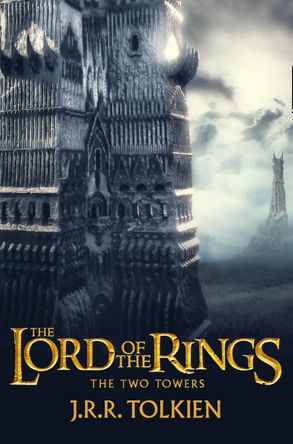
First published in 1954, this was at the time the long-awaited sequel to The Hobbit. (The Hobbit had been published all the way back in 1937).
This is also the first book of The Lord of the Rings Trilogy. The Lord of the Rings Trilogy is one long story that Tolkien split into 6 books. The publisher than decided to divide those 6 books into 3 volumes. This, the first volume, contains the prologue, Book 1 and Book 2. Because this is part of a larger series, it ends with the story unresolved.
It seems to be universally agreed among critics that there was a tonally shift between The Hobbit and The Lord of the Rings Trilogy. The Hobbit was written for children, but The Lord of the Rings is targeting adults.
If you've seen the Rankin-Bass version, you'll know that although The Return of the King is primarily an adoption of the final book in the trilogy, it's also set up to work as a direct sequel to The Hobbit. So for the longest time, I thought I knew the whole story because of the movie. But gradually, as I got older, I became to get hints through bits and pieces of cultural osmosis that The Lord of the Rings trilogy had a lot more story in it than I realized.
In 2001, there was a lot of anticipation of the upcoming Peter Jackson adaptation of these books, and I knew that if I didn't read them before the movies came out, I would never read them.
Also back in 2001, I had newly discovered audio books, and I thought they were the most wonderful thing ever to get extra "reading" done when I was driving around town. I had also discovered that you could check out audio books for free from the public library. So I checked out The Fellowship of the Ring in the winter of 2001. (The library didn't have The Hobbit on audiobook, so I checked out a physical copy of The Hobbit and read that first.)
Now, as I said, I already knew the basic story from the Rankin-Bass movie. I knew that this was going to involve Frodo and Sam journeying to Mordor while their was a big battle outside of Minas Tirith. But I didn't know what other story details would be buried in the extra 1,500 pages. I imagined that there must be a lot of interesting subplots going on to justify the extra length, and I eagerly awaited to hear all about the different factions and plots that I was sure made up the rest of this story. (I wasn't aware of what Game of Thrones was back then, but in retrospect I think I was expecting something Game of Thrones-esque--I was sure that there must be a lot of different plot wheels in motion to justify the huge length of this trilogy.)
I was therefore puzzled, and also frustrated, when The Fellowship of the Ring turned out to have almost no plot at all other than "characters go on a journey". And the journey just went on and on and on through endless descriptions of landscape and countryside. "When is the plot going to get started?" I kept wondering. But the plot never really seemed to kick in.
But also, the more I got into the book, more I was confused about what was happening. Who was this Strider guy and where did he come from? Where did Legolas and Gimli come from?
This was I think partly because as I got increasingly bored by the long descriptive parts of this book, my attention began to falter. (Always a danger when doing audio books). And, I think, this was partly because I was driving around the city while I was listening, and at times distracted by traffic. And, also because I think the narration style of this book doesn't lend itself to audio books. (I think here are some information dense paragraphs that take time to parse.)
But for whatever reason, I finished the book feeling like I only had a vague understanding of the story.
I saw the Peter Jackson movie at a friend's apartment in 2002. (I had been in the Japanese countryside in 2001, and so missed the theatrical release). And then when I saw that movie, I finally felt like I understood what had actually happened
I particularly remember the part of the battle in the Mines of Moria, which had really confused me in the audiobook, only became clear to me after watching the movie.
Why I Re-Read This Book
Ever since 2001, I've felt like I'd only partially absorbed this book, and needed to sit around and read it properly one day.
I should also mention that in the years since 2001, I've spent a lot of time reading about Tolkien on the Internet, and also a lot of time in conversation with Tolkien fans. And I've become more aware of exactly what to expect from a Tolkien book, and what not to expect from a Tolkien book. I've learned that you aren't supposed to go into Tolkien's book for their fast-paced plots, but rather you are supposed to read these books for their atmosphere.
The long descriptions Tolkien gives of the forests and the shire and the mountain passes and the rivers--that's not Tolkien taking forever to get to the point, that is his point.
Now that I know a bit more about what to expect from these books, and their place in literary history, I've been meaning to give them another try for years now. It's taken me a while, but here I am.
The Plot ***SPOILERS****
Back before December, 2001, only nerds actually knew what the plot of these books were. But all that has changed now since the Peter Jackson movies, right? Everyone has seen the movies already. Everyone already knows this story.
Right?
Of course there are some differences from the movie. Boromir's death, which actually takes place at the beginning of the next book, was moved to the end of the first movie in order to give it more of a dramatic note to go out on.
Also the movie infamously cut out the whole Tom Bombadil part. (I say "infamously" because Tolkien fans complaining about Tom Bombadil getting left out of the movie was a big thing on the Internet for a while ... or maybe I just spend too much time online.)
The Reading Experience
Adjusted expectations is really the key to enjoying this book.
Fortunately, now that this is my second time through this book, I knew what to expect. I did not expect (nor did I get) a fast-paced book. I expected a book that would take its sweet time, and that's what I got. I tried to get into it and enjoy the atmosphere.
As a reader, I have long ago acquired the bad habit of letting my eyes glaze over whenever I come to a descriptive passage, and only waking up again when we get back to more dialogue or plot. I was tempted to do this with The Fellowship of the Ring, but I tried to force myself to pay attention to the descriptions, and try to visualize Tolkien's landscapes in my head. And, although this book did require a lot of patience on my part, I largely enjoyed it.
There is also a tremendous amount of long poems and songs in this book. It seemed a bit weird to me. (Is this a musical? Why are characters constantly bursting into song? I mean, I know that in the ancient world, epic poetry was a common form of entertainment, but did ancient people really sing this much?)
As with the descriptive passages, I struggled to keep focused on the longer poems. (Again, my brain had a tendency to switch off during these passages.) But I forced myself to re-read the poetry sections until I felt like my brain had absorbed them.
Then, when the big action scene finally came in the Mines of Moria, the pacing of the book suddenly changed in a way that I felt was jarring. After reading through so many slow descriptive passages for so long, it took me a bit to adjust to the fact that the action was suddenly moving very fast all of a sudden. But I did make the adjustment, and that big fight in the Mines of Moria is a masterpiece of really intense writing! At least for a little while. But then, the action ends, and the long slow journey continues.
Evaluation
This book occupies an interesting cultural space. It's so beloved by popular culture. Which is strange, because it's a very long and slow moving book that requires a lot of patience to get through. I mean, the fans of this book have been not just the literati, but also hippies, heavy metal bands, and comic book geeks. Which is strange, I thought, because it's a book that requires a lot of patience to get through. I mean, can you picture Led Zeppelin actually sitting down and reading this book, with all the endless descriptions? But they did! Jimmy Paige was a huge Tolkien fan.
As for me, I've spent the past 20 years feeling guilty for not having grokked this book the way others have grokked it. So I've come back to this book not with a critical eye so much as with a searching eye--what is it about this book that has captivated so many people?
I feel like I got some more out of this book now than I did 20 years ago. I get the mysticism and poetry of it more than I did before.
But I still came to the end of this book, and thought: "Is that it? How did this very slow moving book captivate so many people?"
Maybe the answer will become clearer as I read through the rest of the trilogy.
Extended Quotation
'Alas! I fear we cannot stay here longer,' said Aragorn. He looked towards the mountains and held up his sword. 'Farewell, Gandalf!' he cried. 'Did I not say to you: if you pass the doors of Moria, beware? Alas that I spoke true! What hope have we without you?'
He turned to the Company. 'We must do without hope,' he said. 'At least we may yet be avenged. Let us gird ourselves and weep no more! Come! We have a long road, and much to do.'
They rose and looked about them. Northward the dale ran up into a glen of shadows between two great arms of the mountains, above which three white peaks were shining: Celebdil, Fanuidhol, Caradhras, the Mountains of Moria. At the head of the glen a torrent flowed like a white lace over an endless ladder of short falls, and a mist of foam hung in the air about the mountains' feet.
'Yonder is the Dimrill Stair,' said Aragorn, pointing to the falls. 'Down the deep-cloven way that climbs beside the torrent we should have come, if fortune had been kinder.'
'Or Caradhras less cruel,' said Gimli. 'There he stands smiling in the sun!' He shook his fist at the furthest of the snow-capped peaks and turned away.
To the east the outflung arm of the mountains marched to a sudden end, and far lands could be descried beyond them, wide and vague. To the south the Misty Mountains receded endlessly as far as sight could reach. Less than a mile away, and a little below them, for they still stood high up on the west side of the dale, there lay a mere. It was long and oval, shaped like a great spear-head thrust deep into the northern glen; but its southern end was beyond the shadows under the sunlit sky. Yet its waters were dark: a deep blue like clear evening sky seen from a lamp-lit room. Its face was still and unruffled. About it lay a smooth sward, shelving down on all sides to its bare unbroken rim.
'There lies the Mirrormere, deep Kheled-zaram!' said Gimli sadly. 'I remember that he said: "May you have joy of the sight! But we cannot linger there." Now long shall I journey ere I have joy again. It is I that must hasten away, and he that must remain.'
The Company now went down the road from the Gates. It was rough and broken, fading to a winding track between heather and whin that thrust amid the cracking stones. But still it could be seen that once long ago a great paved way had wound upwards from the lowlands of the Dwarf-kingdom. In places there were ruined works of stone beside the path, and mounds of green topped with slender birches, or fir-trees sighing in the wind. An eastward bend led them hard by the sward of Mirrormere, and there not far from the roadside stood a single column broken at the top.
***END QUOTATION. From Book 2 chapter 6 pages 433-434****
I thought this was a good example of one of Tolkien's landscape descriptions. Like a lot of these descriptions, I did my best to visualize this, but I struggled.
I also found myself struggling the geographical vocabulary when reading Tolkien's landscapes. What is a "mere"? What is a "glen"? What is "heather" and "whin"? I've heard the word "dale" before, of course, but I couldn't visualize what a "dale" actually was. What is a "sward"? What is a "deep-cloven way"?
(On a separate note, this passage also does a good job of illustrating the style--which is a combination of modern prose style with an ancient epic style.)
Stray Comments
* So, I know Tolkien is still much-beloved today. But if he were a new and unknown writer, there's no way he could get these books published nowadays, right? I feel like the publishers wouldn't allow such a slow pace in a fantasy series nowadays.
* So, between The Hobbit and The Fellowship of the Ring, the name for the bad guys switches from "goblins" to "orcs". But apparently they're still the same creature? Although I often get the impression that goblins are diminutive creatures, whereas orcs are bigger. So are they the same or not? (I've been confused about this for years now. I thought maybe if I read through these books carefully, it would become clear. But it's not really. There's still no explanation about why the name changes from "goblins" to "orcs").
* Are Gandalf's powers ever clearly defined? What exactly can he do? What can he not do?
* Something I remember from the audio book 20 years ago was feeling confused about the Ringwraiths. They are built-up to be so fearsome and scary, but then they never do anything. In the first half of this book, they are always around Frodo and his friends, but never actually attack. After a while it was hard to see them as scary anymore, and they just started to seem ineffectual.
I had the same reaction when I re-read the book.
* Okay, confession time. I've always thought this whole quest to destroy the ring seemed like a bit of a silly MacGuffin. And even though Tolkien does a lot of work to explain the origins and mythology of the ring in this book, I still had trouble buying the idea that the whole fate of Middle-Earth depended on destroying this one ring.
* The character development in this book isn't great, is it? I'm not entirely sure what the difference between Merry and Pippin is. They seem pretty interchangeable. I'm not sure if Legolas will get more developed as the series goes on, but he doesn't really seem to have much of a character in this book except as "elf". Aragorn doesn't really have much of a character. I mean, right on down the line, none of these characters really have that much of a personality to distinguish them from the rest of the crew.
I'm not sure if that happened during the drafts of Fellowship or if it was later in the trilogy. But I suspect it might be from Fellowship. Tolkien makes such a big deal out of the elves in this book.
The elves were also a big part of the story in The Hobbit, but they weren't portrayed as significantly more important than the other races of Middle-Earth in The Hobbit. But in Fellowship, the elves keep popping up over and over again. First we run into elves in The Shire. Then we spend a lot of time with the elves in Rivendell. Then our characters set out again, only to run into another elf civilization in the forest of Lothlorien.
I realize the whole appeal of these books is that the elves represent nature spirits, and you're supposed to immerse yourself in the romanticization of the natural world as represented by the elves, and enjoy the mystical mythical feel of it all. But it all became a bit much for me. After all the time we spent with the elves in Rivendell, I thought all the time we spent exploring a second elf civilization in Lothlorien seemed like a bit much.
* Poor Gimli. It's established repeatedly that there's an ancient rivalry between the elves and the dwarves, but how are the dwarves supposed to compete given that the elves are always portrayed as immaculately perfect and possibly semi-divine?
6 out of 10 stars. I know, I know, I'm a philistine. These ratings are just my subjective experience of the book, and they're not supposed to represent the objective quality of the book. And I'm sure I'm missing out on some stuff. (I'm sure Tolkien is drawing on a lot of stuff here from the Anglo-Saxon and Germanic literary tradition that are over my head.) But, I thought this book did a good job at creating an atmosphere, but not a great job at creating interesting characters or an exciting story.
Started: Revolutions Season 3: The French Revolution by Mike Duncan I already listened to this once, and linked to it HERE, but now I'm going to go through it systematically--listen to it 3 times from start to finish, and then come back with a review.
Part of working through the Revolutions Podcast, as mentioned HERE. I plan to listen to this 3 times through (I'll keep track of my progress at the bottom of this post), and then at the end give it a video review only. (I'll save the written review for when I finish the whole thing.)
Listening Progress
December 19, 2021--3.2-The Broken Regime
December 20--3.4- Necker and the Necklace
December 23--3.7- The Séance Royale
December 24--3.9- What is the Third Estate?
December 26--3.13- The Rights of Man
December 27--3.19 The Massacre of the Champ de Mars
December 28--3.23- The Insurrection of August 10th
December 29--3.29- The Purge of the Girondins
December 30--3.33- The Geography of Terror
December 31--3.38- Thermidor
January 1, 2022--3.41- Bread and the Constitution of 1793
January 2--3.43- The Conspiracy of Equals
January 3--3.45- The Fall of Mantua
January 4--3.50- The Second Coalition
January 5--3.55- The Retrospective
Finished 1st Listening. Started 2nd Listening
January 6--3.4- Necker and the Necklace
January 7--3.6- The Stately Quadrille
January 8--3.8- The Day of the Tiles
January 9--3.10- The Tennis Court Oath
January 10--3.12- The Great Fear
January 12--3.13- The Rights of Man
January 13--3.14- The Women's March on Versailles
January 14--3.15- The Rise of the Jacobins
January 15--3.16 The Society of 1789
January 16--3.17- A Temporary Summit
January 17--3.21a Supplemental- Talleyrand
January 19--3.24- The September Massacres
January 21--3.26- The Trial of Louis XVI
January 23--3.29- The Purge of the Girondins
January 24--3.30- The 250th Episode
January 29--3.31- The Man of Blood Part Deux
January 31--3.33- The Geography of Terror
February 4--3.34- Saturn's Children
February 5--3.34a- The Republican Calendar
February 6--3.34b- Phillippe Egalite
February 10--3.34c- Citizen Genet
February 11--3.35- The Law of 14 Frimaire
February 12--3.36- The Liquidation Process
February 13--Help Scott Help Syria
February 14--3.38- Thermidor
February 16--3.40- The Frozen Rivers
February 17--3.42- The Whiff of Grapeshot
February 18--3.43- The Conspiracy of Equals
February 19--3.44- The War Feeds Itself
February 20--3.46- The Coup of Fructidor
February 23--3.47- The Directorial Terror
February 24--3.48- The Coup of Floreal
February 25--3.49- The Egyptian Expedition
February 27--3.51- The Coup of Prairial
March 4--3.54- The Empire
March 5--3.55- The Retrospective
Finished 2nd Listening. Started 3rd Listening
March 7--3.1- The Three Estates
March 13--3.2-The Broken Regime
March 17--3.3- Resistance to Reform
March 20--3.6- The Stately Quadrille
March 21--3.7- The Séance Royale
March 22--3.8- The Day of the Tiles
March 23--3.10- The Tennis Court Oath
March 24--3.11- The Fall of the Bastille
March 25--3.13- The Rights of Man
March 27--3.14- The Women's March on Versailles
March 31--3.16- The Society of 1789
April 1--3.17- A Temporary Summit
April 3--3.18- The Flight to Varennes
April 4--3.20- The Constitution of 1791
April 8--Fundraiser! 14 Dec 2014 - 21 Jan 2015!
April 14--3.23- The Insurrection of August 10th
May 4--3.24- The September Massacres
May 8--3.25- The National Convention
June 24--3.27- Advance and Retreat
June 26--3.28 The Provincial Revolt
July 7--3.29- The Purge of the Girondins
July 8--3.30- The 250th Episode
July 11--3.31- The Man of Blood Part Deux
July 12--3.32- The Committee of Public Safety
July 13--3.33- The Geography of Terror
July 14--3.34- Saturn's Children
July 18--3.35- The Law of 14 Frimaire
July 27--3.37- The Republic of Virtue
August 3--Help Scott Help Syria
August 8--3.39- The Death of the Jacobins
August 11--3.40- The Frozen Rivers
August 15--3.41- Bread and the Constitution of 1793
August 22--3.42- The Whiff of Grapeshot
August 26--3.43- The Conspiracy of Equals
August 29--3.44- The War Feeds Itself
September 5--3.45- The Fall of Mantua
September 6--3.46- The Coup of Fructidor
September 7--3.47- The Directorial Terror
September 12--3.48- The Coup of Floreal
September 19--3.49- The Egyptian Expedition
September 24--3.50- The Second Coalition
September 26--3.51- The Coup of Prairial
September 27--3.52- There is Your Man
October 2--3.53- The Consulate
October 5--3.54- The Empire
October 6--Special Announcement: Mike Duncan Inks a Book Deal
(This is part of my journey through Revolutions Podcast, which I talked about HERE. As I said in that post, I'm only going to do video reviews for the individual seasons, and then will put together a written review once I've worked my way through the whole podcast.)
(I also saw the HBO John Adams mini-series (W) around 2011, but didn't review it on this blog because it was before I had started reviewing all the TV shows I watched.)
For more information about what this is and why I'm doing it, see HERE.
Finished: Revolutions Season 2: The American Revolution by Mike Duncan--As I mentioned HERE, I'm going to listen to each season through 3 times, and only do video reviews of the individual seasons. I finished the first listening on December 2, the second listening on December 13, and finished the third listening just now.
I've got a number of reviews to film in the next couple days (this one and this one), but I'll try to get this review filmed as soon as I can.
As I indicated on Monday, I had a slip in my writing. I had been doing pretty good up until October--at least 10 minutes a day every day for over a year. But then I had a week back in October when I was really busy teaching and marking, and I allowed myself to go for a few days without writing, and then it was really hard to get back into it. (The lesson is never let yourself take breaks, because it is so hard to get back into it again.)
Part of the problem is that since August I had been trying to do 2 drafts simultaneously--I tried to keep plowing ahead with the first draft for 10 minutes every day, but also work on the second draft for another 10 minutes every day. And that doubled my time commitment. Which made me get burned out faster. Which made me stop.
But I want to try again.
I've been inspired by these Steve Donoghue Writing Videos.
After watching this video, I've decided to do a bit of renaming on my drafts. I'd been calling the draft I've been posting on this blog a second draft, but I've decided that's not really an accurate description. It's more of a first draft on the backstory. All the story in it I'm working through for the first time.
Plus, my so-called "first draft" isn't really a serious draft. It's more just playing around (what Steve Donoghue refers to in his video as being a Pantsers). So I've decided to re-name the so-called first draft as the "zero draft". And the so-called second draft is now the "first draft".
I'm going to try to get back into writing from next week. If I have limited time, I'll try to prioritize working on the first draft instead of the zero draft--this is because of Steve's advice on his video to try to make the writing time a serious exercise in communication, and not just to write an incoherent story that no-one else could ever read.
I remember first hearing this song on the oldies radio when I was a kid. (This was back in the days when oldies radio was still around.) I knew it was a religious song, but I assumed it was about the Christian God. (I never listened too deeply to it, and besides, I didn't know what "Hare Krishna" was back then.)
It wasn't until my 11th grade religion class, when I was studying comparative religions at Grand Rapids Christian High School, and our teacher talked about this song during the unit on Indian religion, that I realized that it was about Hare Krishna. Since we were in a Christian school environment, that meant that this song was being presented as heretical, but that only increased the fascination factor. The fascination was also increased by the fact that it was also a timepiece, linked to that brief moment in time when Hare Krishna became fashionable in the West. (I'm a history nut, so I go in for songs that are linked to particular historical trends.)
So starting from then, I began to take a new notice about this song whenever it came on the radio.
I also began to notice about the same time how insanely catchy this song was. If I heard it on the radio in the morning, I'd be humming the tune for the whole rest of the day.
But it was catchy in a good way. It's the kind of song where when it's stuck in your head, you want to keep listening to it over and over again.
Back in those high school days, I was flirting with religious pluralism, so a song about Hare Krishna seemed pretty cool. Now that I'm older, and a bit more influenced by Christopher Hitchens, I find the whole Hare Krishna movement to be cultish and stupid. But...but, My Sweet Lord is still an incredibly catchy song. I could listen to this all day.