Dane was doing a new style of shout outs, in which he read out the 5 most recent videos for each channel. (5 most recent at the time that he filmed the video.) Unfortunately, in my case, this involved some long cumbersome names and also some Vietnamese. (Sorry Dane!)
I don't really have a ton to say about this one, other than that it was interesting.
Before listening to this podcast, I really knew nothing about the Russian Civil War, so it's been an interesting journey. For example, the past several episodes I've enjoyed Mike Duncan breaking down how badly the Whites have mismanaged everything. I know have a much clearer idea of why the Whites have lost the war.
This episode marks the collapse of the White forces, but Mike Duncan seems to indicate at both the beginning and the end of this episode that the Russian Civil War is still far from over. (Thankfully! I'm not ready to say goodbye to this podcast just yet.)
And as is evident from this episode, there are a lot of players in this Civil War Even with the collapse of the Whites, we still have the Japanese Army, the Black Army, the SRs, and the various national groups still left on the chess board. So presumably the following episodes will focus on them.
*******
So, I get the impression from this episode that, with the exception of the Japanese, the allies are done now supporting the Whites. I'm assuming that includes the Americans.
I was kind of hoping for more of a spotlight on the American involvement in the Russian Civil War. I know it is a minor detail in context of the Civil War itself, but it's something that would be of interest to us Americans.
It's perhaps the kind of thing that would have made a perfect supplemental episode--a supplemental episode on the American army in Russia during the Civil War--except that it looks like Mike has kind of stopped doing supplemental episodes. (The earlier seasons of Revolutions Podcast had occasional supplemental episodes that would focus on interesting things that were tangential to the main narrative, but I don't think the Russian Revolution has had any supplemental episodes.)
I suppose there's still hope he might do something on it yet.
********
Addendum: This isn't about this episode particularly, but this is from Mike Duncan's Twitter feed this past week and I thought it was funny.
I find these Q&As good fun to watch from beginning to end, but since this is my blog, I'll highlight my question:
The "is Dumbledore really gay?" controversy. Or, in other words, can authors add in extra details about their characters in interviews and announcements, or do the authors have to put it in the actual books for it to be canonical?
Steve says, "You must know where I stand on this subject," and indeed, I was 90% sure what his answer would be.
Personally though, I find the question a bit more interesting. To me, it feels like a convention to say that the author has no authority in the interpretation of her books. I can easily imagine another culture in which the convention is to treat the author's announcements as authoritative.
To me, this question is further complicated when the author is still living, and the books in question are a series. J.K. Rowling could easily write another Harry Potter book. (I know she's said she won't, but she could easily go back on that.) So since she has the power to write anything she wants to into future books, we've got to at least take notice of her pronouncements, right?
I didn't mention this in the question, but in my mind I was also thinking about some of the discussion about Pale Fire. Via Wikipedia:
In an interview, Nabokov later claimed that Kinbote killed himself after finishing the book.[14] The critic Michael Wood has stated, "This is authorial trespassing, and we don't have to pay attention to it",[15]
...I don't know. Again, the concept of "authorial trespassing" feels like a convention, doesn't it? Like it's something all the smart literary people have agreed upon, but I feel like you could just as easily say the author has broader authority.
(Book 7 Chapter 46:King Xerxes is surveying his great army, and begins to weep. His advisor (and uncle) Artabanus comes up to ask him why he is crying)
“What a difference, O King, between your behavior now and that of only a short time before. Then you considered yourself blessed–now you weep!”
“Yes,” Xerxes answered, “for I was musing on how short is human life, and the pity of it pierced me through. All these multitudes here, and yet, in a hundred years’ time, not one of them will be alive.”
To this Artabanus replied by saying, “But we mortals experience many other causes of suffering that better merit your compassion. Brief though the span of human life may be, yet there is no man here–no, nor anywhere else either–to whom nature grants such happiness that he will not, and on more than one occasion too, wish for death rather than to continue living. So numerous are the misfortunes that befall us, and so terrible the diseases that afflict us, that life in all its brevity still seems long. Death, to a man whose existence is a burden, provides an escape very much worth choosing. That God should grant us merely the briefest taste of how sweet life can be serves to demonstrate just how much he begrudges us it.”
Wednesday, March 02, 2022
[Update February 16, 2025: The video featured in this post has now been deleted. For more information, see this post here, in which I explain why I deleted it.]
As usual, there is a lot of diverse topics in this episode: The uneasy alliance between the Black Army and the Red Army, the beginnings of the feud between Trotsky and Stalin, the situation in the Ukraine, Anti-Semitism, and the continuing strategic blunderings of the White Army.
It's all the stuff about the Ukraine, of course, that jumps out at the listener.
Last week Mike tweeted: "Just posted Ep. 10.87--Anarchy in Ukraine. I swear I'm not doing this on purpose, it's just that history and current events are almost always basically the same thing." But I think he might have spoken too soon. This episode has even more analysis on the fraught relationship between the larger Russian Empire and the smaller Ukraine.
Or as someone said in the comments for this week: "Is it not crazy that you’re releasing these episodes just as Russia is launching new offensives into Ukraine. The universe, am I right?"
...and speaking of comments, the comments are back up and running now.
For several months, the comments had been turned off. No one knows why. But I thought it was unfortunate, because the relationship between Mike Duncan and his commenters, and how Mike often picked up corrections from the comments, was always part of the dynamic of these podcasts (as I mentioned in my review of The History of Rome). But the comments section got turned back on again a few weeks ago, so we're back to listeners offering their corrections in the comments.
This episode also talks about the anti-Semitism which Mike Duncan claims affected all ideologies at this point in history--which circles back to a similar point Mike Duncan made when talking about the anti-Semitism in the Marx/Bakunin feud way back in the first episodes of the series on the Russian Revolution.
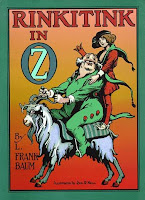
Originally published in 1916, this is the tenth book in the Oz series.
Baum actually wrote this novel back in 1905 as a separate novel from the Oz series. But when he was out of money and needed another Oz novel, he dusted this novel off, and changed the ending to involve the Oz characters. Thus, as Wikipedia says:
It is notable that most of the action takes place outside of Oz, and no character from Oz appears in the book until its climax.
What do you do when you’re running short of money again and your publisher is haranguing you for yet another book in a popular series you are beyond tired of writing? If you’re L. Frank Baum, you take an old unpublished book, throw in a few references to said popular series and squash in an annoying encounter with your series characters, and, voila! An Oz book. Sorta.
Summary of the Plot (***SPOILERS***)
As noted above, almost all of this story takes place outside the Land of Oz.
It's time to get out our maps.
Do you see the two islands in Nonestic Ocean in the upper right-hand corner of the map? That's where almost all of the action takes place. At the very end of the book, the action moves to the Dominions of the Nome King (see the above map), and then finally Dorothy shows up to save the day at the very end, and then all the characters end up in Land of Oz for one chapter, and several Oz characters make cameos.
As is common with these Oz books (for some reason), the title is a misleading. Not only Rinkitink is not actually in Oz for 90% of the book, Rinkitink isn't even the main character. The main character is Prince Inga. Prince Inga lives on a lovely island of Pingaree (see the map). But then the island of Pingaree is invaded by the wicked island of Regos. But then, Prince Inga inherits 3 magic pearls--a blue pearl which gives him strength, a pink pearl which prevents him from being harmed, and a white pearl which can tell him what to do at any time. And so, Prince Inga is able to fight back against the island of Regos.
But if you've ever read a fairy tale before in your life, then you know that sooner or later, Prince Inga is going to lose the pearls. And then, he must search to find them again...
Also, the fat King Rinkitink and his surly goat Bilbil accompany Prince Inga--mostly just to provide comic relief.
The Reading Experience
As is my normal habit with these Oz books, I didn't do my research until after I had finished the book. So when I was reading, I had no idea that this was something L. Frank Baum originally wrote as a non-Oz book. And so while I was reading, I was thinking to myself, "Okay, this is starting out different than the other Oz stories so far. But different is always good. I can't wait to see how this will all tie into the Land of Oz."
As I kept reading, I became more and more amused by how long L. Frank Baum was delaying the entrance of the Oz characters.
Then, of course, once I got to the end and saw how little the book connected to Oz, it became clear that this book must have started out life as a non-Oz story.
It turns out, I spoke too soon. Rinkitink in Oz is even more fairy-tale esque. The plot about the three magic pearls is straight out of The Brothers Grimm.
I'm guessing Dane is also feeling like he spoke too soon. Because if The Scarecrow of Oz didn't need to be an Oz book, Rinkitink of Oz really, really doesn't need to be an Oz book.
So, basically, take everything Dane and I already said about The Scarecrow of Oz, and then just double it.
I said that in my review of The Scarecrow of Oz that not everything in the story made logical sense, but since the book is so clearly operating by fairy tale logic, I did my best to turn off my brain.
And the same is true for Rinkitink in Oz. There were more than a few things that didn't make sense...
(I am willing to grant the magic pearls as part of the story's premise, but where does the magic boat come from? Also, since the White Pearl clearly knows everything, how come Prince Inga doesn't ask the White Pearl for advice more often?)
...but I did my best to shut my brain off and remind myself that it's only a fairy tale.
And, the book clearly does not need to be an Oz book. But it is. It's part of the official Oz canon, so you may as well just try to enjoy it for what it is. I actually found it a refreshing change of pace.
As always with these Oz books, the appeal is not the internal consistency or logic. (These are decidedly the series' weak points.) The appeal is the imagery of the fantastical lands, and the wacky characters.
Baum's descriptions are never overly detailed, but I enjoyed imagining myself in the beautiful island nations.
And I loved the characters of the fat jolly King Rinkitink and his grumpy goat Bilbil. I thought they were a perfect comic pair, and I loved their back-and-forths.
As in all the best fairy tales, the prince’s rescue attempts to not go at all smoothly. He loses the shoes. His parents are taken to the Nome King. Chasing them, he must face three terrible perils in the deep caverns of the Nome King, relying on his wits and strength to survive. And just as the plot climbs to an exciting, dramatic climax—
Dorothy sends it to a screeching halt.
By authorial intervention, she just happens to be watching Inga’s story in the Magic Picture (which by this book has begun to take on the rather ominous aspect of a universal spy), and just happens to decide to go rescue Inga, trotting over to the Nomes, basket of eggs on her arm, accompanied by the Wizard.
I cannot overstate just how unnecessary this rescue is. After all, Inga has a talking magic pearl. And unlimited strength. And invulnerability. (He got the pearls back.) And an irritated talking goat. The only reason he needs Dorothy at all is so that he can be repackaged and sold as an Oz book.
Sigh.
But the Oz interlude, if intrusive and annoying, is at least over quickly, allowing Baum to return to his fairy tale after just a few more chapters.
I also found the comments section interesting. The - first - five - commenters - said that this was one of their favorite Oz books despite the fact that it had very little to do with Oz. Or rather, because of the fact that it had very little to do with Oz. As Seth e. puts it:
Reiterating my love for Rinkitink, for everybody else’s reasons above, and also for the completely nonsensical nature of its attachment to Oz. It’s a laidback, breezy book, at a point when Oz had become pretty precious.
I hate to admit it, but this is my feeling as well. Just when I'm becoming a little sick of the Oz series, I found it a breath of fresh air to read a story that was only slightly connected to Oz. (I don't know. Maybe that's a sign that it's time to stop reading?)
There's also a last comment which indicates that the twist ending at the very end of the book involving the true identity of Bilbil the goat was part of the revisions:
Rinkitink in Oz is the perfect fantasy novel—until, as the reviewer notes, the story reaches the revisions Baum made to his original text. Dropping Dorothy into the middle of everything is bad enough, but for me the true atrocity lies in the treatment afforded one very likeable goat. Bilbil is one of the most amusing characters Baum ever created, but his Ozzy tweaks to the tale turn the surly animal into a pet improvement project for Glinda and the Wizard. What a betrayal! In fact, the only major character who escapes embarrassment at the hands of the author’s revisions is Rinkitink himself. The giggling king stays true to form until he’s reluctantly carried back to Gilgad to rule—a funny closing that surely survives largely unadulterated from Baum’s first manuscript.
I can't find this corroborated anywhere else on the Internet (I've checked). But if this is true, it means that the twist ending about Bilbil the goat being an enchanted prince was not part of the original book, and is part of L. Frank Baum's revisions. And if so, I agree with the commenter. It did kind of ruin the character of Bilbil. He was a perfectly fine comedic character when he was just a grumpy goat. Why ruin it by making him into an enchanted prince in disguise?
By this point in the Oz series, it’s pretty clear that L. Frank Baum has had enough and doesn’t actually want to be writing about Oz anymore. He tried to draw a line under it but had to bring it back, a little bit like Sir Arthur Conan Doyle with Sherlock Holmes, in part because he had no money and his other series weren’t selling very well.
The problem is that this book just reads as though Baum wrote a non-Oz book and then made a token effort to tie it back into the series. When Dorothy and Ozma show up at the end, it’s just lip service to the fans, and they don’t really need to be there except for the whole deus ex machina thing. Overall, this is an unmemorable read.
Dane's not wrong here, but I enjoyed the book regardless. I thought it was an interesting change of pace from the usual Oz books.
Extended Quotation
The prow of the boat grounded on the beach, stopping its speed so suddenly that the little man was caught unawares and nearly toppled headlong into the sea. But he managed to catch hold of the chair with one hand and the hair of one of his rowers with the other, and so steadied himself. Then, again waving his jeweled cap around his head, he cried in a merry voice:
"Well, here I am at last!"
"So I perceive," responded King Kitticut, bowing with much dignity.
The fat man glanced at all the sober faces before him and burst into a rollicking laugh. Perhaps I should say it was half laughter and half a chuckle of merriment, for the sounds he emitted were quaint and droll and tempted every hearer to laugh with him.
"Heh, heh—ho, ho, ho!" he roared. "Didn't expect me, I see. Keek-eek-eek-eek! This is funny—it's really funny. Didn't know I was coming, did you? Hoo, hoo, hoo, hoo! This is certainly amusing. But I'm here, just the same."
"Hush up!" said a deep, growling voice. "You're making yourself ridiculous."
Everyone looked to see where this voice came from; but none could guess who had uttered the words of rebuke. The rowers of the boat were all solemn and silent and certainly no one on the shore had spoken. But the little man did not seem astonished in the least, or even annoyed.
King Kitticut now addressed the stranger, saying courteously:
"You are welcome to the Kingdom of Pingaree. Perhaps you will deign to come ashore and at your convenience inform us whom we have the honor of receiving as a guest."
"Thanks; I will," returned the little fat man, waddling from his place in the boat and stepping, with some difficulty, upon the sandy beach. "I am King Rinkitink, of the City of Gilgad in the Kingdom of Rinkitink, and I have come to Pingaree to see for myself the monarch who sends to my city so many beautiful pearls. I have long wished to visit this island; and so, as I said before, here I am!"
"I am pleased to welcome you," said King Kitticut. "But why has Your Majesty so few attendants? Is it not dangerous for the King of a great country to make distant journeys in one frail boat, and with but twenty men?"
"Oh, I suppose so," answered King Rinkitink, with a laugh. "But what else could I do? My subjects would not allow me to go anywhere at all, if they knew it. So I just ran away."
"Ran away!" exclaimed King Kitticut in surprise.
"Funny, isn't it? Heh, heh, heh—woo, hoo!" laughed Rinkitink, and this is as near as I can spell with letters the jolly sounds of his laughter. "Fancy a King running away from his own people—hoo, hoo—keek, eek, eek, eek! But I had to, don't you see!"
"Why?" asked the other King.
"They're afraid I'll get into mischief. They don't trust me. Keek-eek-eek—Oh, dear me! Don't trust their own King. Funny, isn't it?"
***END QUOTE*** This is from Chapter 2: The Coming of King Rinkitink . The mysterious voice is, a few paragraphs later, revealed to be Rinkitink's goat, Bilbil. I think this quote does a good job of illustrating the dynamic between Rikitink and Bilbil, which make up much of the humor of this book.