(
Better Know a City)
Monday, August 24, 2009
During my first year in Japan, I was finishing a class when I noticed the cover of one of my student's notebooks.
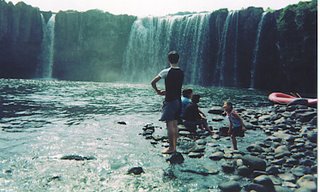
It was a picture of a beautiful waterfall that looked, to my ignorant Mid-western eye, like a scene from some sort of secluded paradise on an exotic island. When I looked closer, I was surprised to see the caption identified it as being right here in
Oita prefecture.
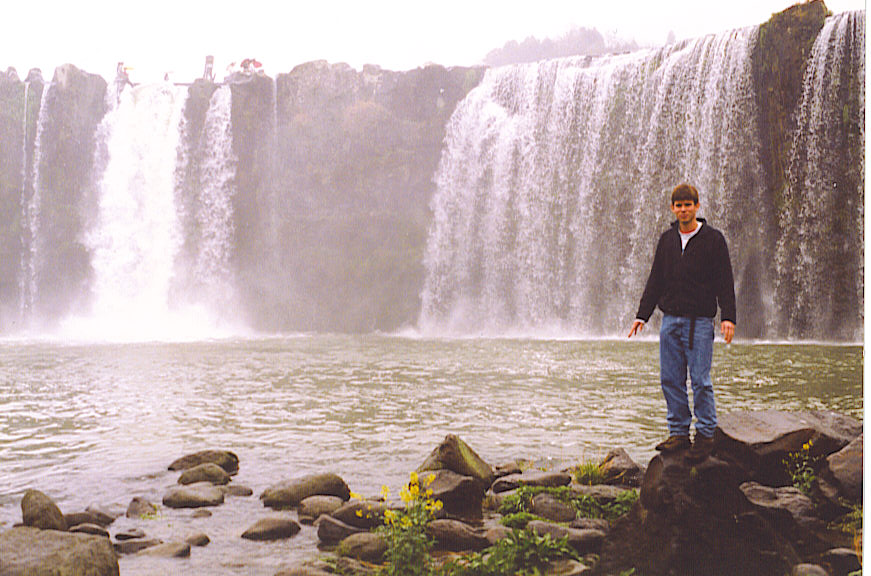
This, it turns out, was the famous Harajiri Waterfall in Ogata town.
Of course I decided immediately I had to get down there and see it in person.
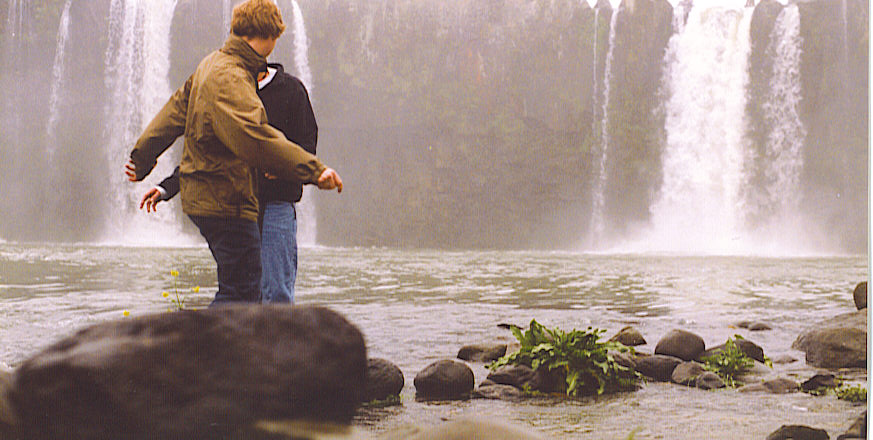
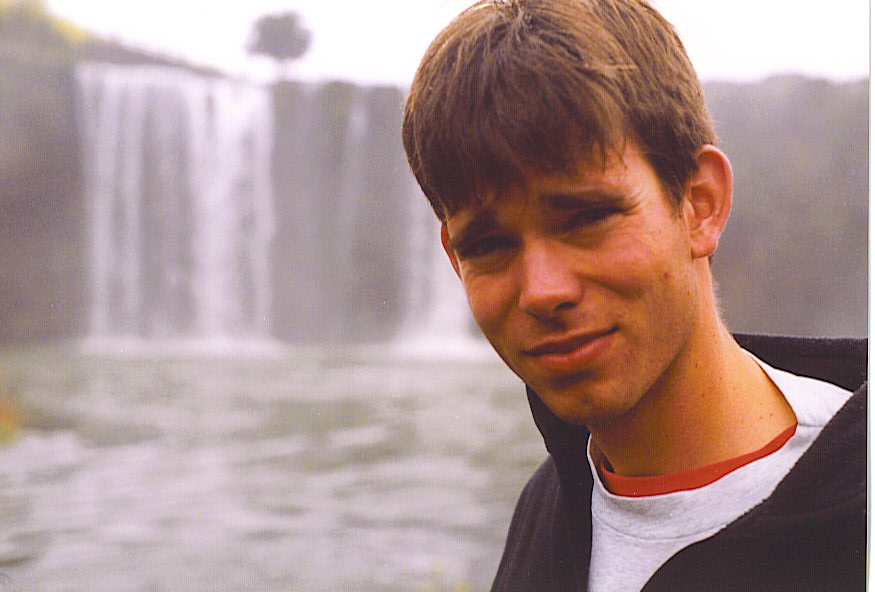
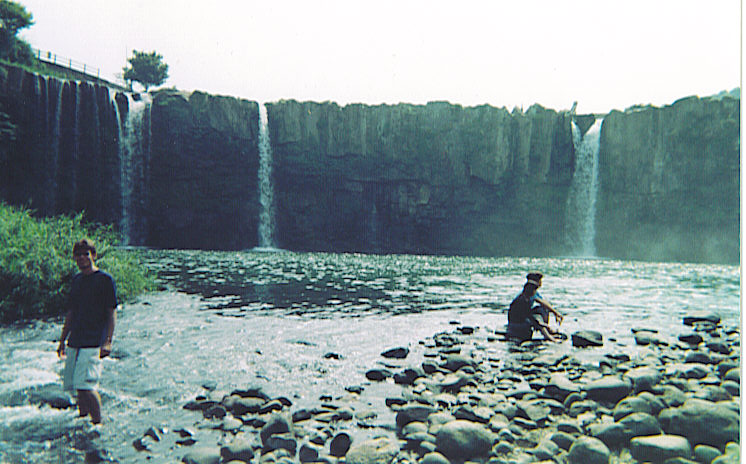
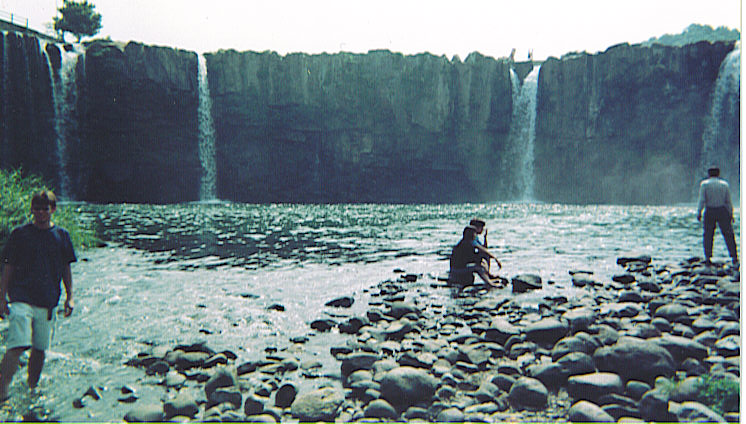
I drove down with my girlfriend at the time, and spent an afternoon walking around and taking pictures.
Later, when
Brett came to visit me in Japan, I made a second trip down.
I have already posted pictures from these two different trips in an old
retrospection--which you
can view here.
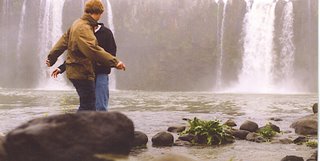
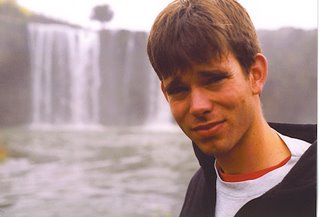
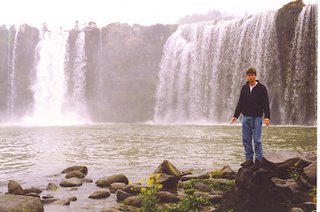
But, actually, while I'm thinking about these photos, I might as well repost them here as well.
(Pictures never really do the place justice. Especially not my pictures. I was never really able to duplicate on film the amazing picture that I had seen on my student's notebook. That picture had been perfectly framed by a professional. It must have been taken after the rains when the water level was at it's peak. And it was in the spring time, when all the surrounding flowers were in bloom. But for what they're worth, here are my pics. )
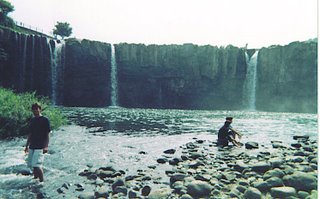
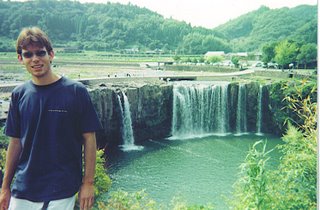
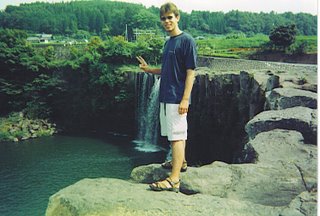
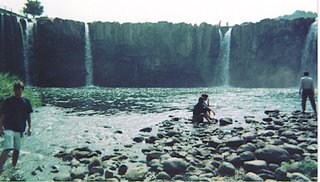
Okay, that was then. Now, 6 years later, I'm making my way back to Ogata town as part of my
"Better Know a City" project.
To get to Ogata, I had to drive through several towns I have yet to explore. Usually I work my way down through these towns in a rough sort of geographic order, but because we're in the middle of the summer heat, I wanted to stay near water-based attractions. I would have gone to the ocean, but with Kamae (see previous post) I've officially finished off all the coastal towns in Oita prefecture now.
Although I wasn't enjoying the ocean view I had gotten used to the last couple months, driving through the rolling hills of central Oita also presented quite breathtaking scenery. Everything was bright green, and much of the mountainsides and hillsides had been carved into rice fields built as a series of ascending steps. These are the famous terraced rice fields, or "tanada" in Japanese, that the Japanese countryside is so well-known for.
At one point I crossed a bridge, and I was now in Ogata town.
Right near the boarder was a parking lot near the river. I immediately pulled over, expecting some sort of tourist attraction.
There was nothing there but a view of the river, but as long as I was stopped I took some pictures and videos anyway.

The drive through Ogata continued to be just as beautiful as the drive to Ogata. In fact I was tempted to stop the car every ten feet just to take pictures, but this would have been impossible.
I waited until there was a slight shoulder on the road, and then pulled over to try and take a few pictures, which will have to be representative of the whole drive. This was an average point along the road. There were several views along the drive that were more spectacular than this, but these are the ones I got photos of.


Since Harajiri waterfall was the main attraction in Ogata, I figured there was no point in delaying it, and I drove straight for the waterfall parking lot.
There's a bit of a tourist development built up around the waterfall. This is still small town Japan, so it's not overdone, but there are a couple restaurants and souvenir shops located in the waterfall parking lot.
I decided to leave my car parked, and start by walking back to the road to get some shots of the drive in.
Because the river is located at a low point relative to the surrounding area, one of the neat things about this waterfall is you never see it until you're right on top of it. The drive there is just a bunch of mundane rice fields, and I backed up down the road a bit so I could get a sense of this on film.

As I took a few pictures, I heard sirens. At first they were far away, but soon a fire engine was zooming past me.
In the countryside these emergency vehicles stick out a bit more than in the big city, and you do notice take notice of them when they go by lights flashing. But disasters happen even in small towns.
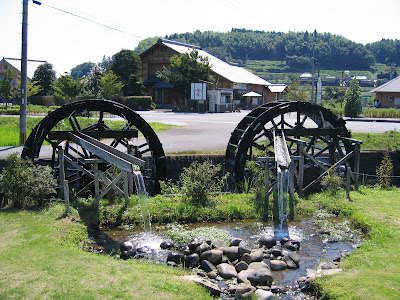
A little bit further down the road there were a couple of waterwheels.
Ogata is famous for its waterwheels. At one time I suspect there might have been a historical connection. Now they seem solely for the tourists. Just in the small area near the waterfall there are several waterwheels.
These ones scooped water out of the river then the water was used to make a small stream. I took a couple pictures and moved on.

Around this time an ambulance went by me sirens blazing. Makes sense, I thought, where there's a fire truck, there's always an ambulance close behind.
Having sufficiently documented the area leading up to the waterfall, I was ready to tackle the real thing.
I started walking towards the waterfall, but I had barely turned on my
video camera when I noticed the fire truck and the ambulance were both parked up near the top of the waterfall. Was there some sort of emergency at the waterfall itself?


As I got closer, I saw that a small crowd had gathered around the edge of the waterfall to watch.
Emergency workers were running all around the top of the waterfall, making notes, shouting to each other, and talking on walkie-talkies.
I wanted to know what was going on, but I was worried that if I asked someone directly it would make me look like a rubber necked gawker feeding off of other people's disasters. Which I guess I kind of was, but it is just a natural human curiosity.
Two old men were talking next to me. "It's too late now," one of them said. "Even if they find the body, it's too late to do any good now."
I caught a few other words, such as "fell" and "watefall" and I guessed someone had gone over the falls.
In my past visits, I had always wondered if it was safe to jump off the top of this waterfall. Perhaps this question was now answered. Maybe someone had tried to jump off or slide down and had gotten hurt.
But why was everyone walking around the top of the waterfall and taking notes? Shouldn't someone be swimming around the bottom of the waterfall looking for the body?
A couple of new people showed up. One of them was looking side to side, and I could tell he was just as confused as me, and he was looking for someone to ask for information. I stepped next to him so I would be able to hear as well.
Sure enough, he soon saw the old men, and asked them, "what happened here?"
"A car went over the waterfall," an old man replied.
This was about the last thing I expected to hear.
True, there was a road going over the river at the top of the waterfall. So it was theoretically possible. But it was hard to imagine.
First of all, there was a bit of distance between the road and the waterfall. The car would have had to not only leave the road completely, but then continue driving several meters over the stone cliffs. Maybe it might have gotten carried along by the water, but the water didn't look deep enough to pick up a whole car.
Secondly, it was just plain difficult to imagine. A car crashing over the side of the waterfall in this sleepy little town didn't seem like the kind of thing that happened in the real world. It seemed like something that would only happen in a Hollywood movie.
The newcomer voiced the same incredulity I was feeling. "A-a-a car? Did you just say a car went over the waterfall?"
But the old man wasn't feeling very talkative. He turned away without elaborating.
As I continued watching, I overheard more conversations and picked up more bits and pieces from the other people standing around. They all confirmed what the old man had said. A car had indeed gone off the waterfall.
The police and assorted emergency workers were now getting into scuba gear at the bottom of the waterfall, and getting a boat ready for launching. Everything was slow and mechanical and nobody seemed in a rush at all, which surprised me because I thought time would be a factor in these situations. I can only imagine that professional rescue workers must know something I don't about how it's better to take your time and do things right than rush off half cocked.
Also, although I took a lot of pictures and videos of the event, I did have mixed feelings about what I was doing. This was, in all probability, a situation where one or more people had lost their lives, and it seemed a bit frivolous for me to be video taping it as if it were a sight seeing attraction.
I did however notice that many of the Japanese people were also taking photos and videos so this made me feel, if not less guilty, at least less conspicuous.
At the same time I noticed that there was a big disconnect between the emotions I thought I should be feeling now, and what I actually felt.
I thought that I should be horrified and saddened by this loss of human life.
In reality, I viewed the whole thing with a detached amusement. The victims, whoever they were, had no connection to me and this whole incident was nothing more than something that made my morning a little bit more interesting.
Nor was I the only one who felt this way. All around me people were talking gaily or laughing. They were using their cell-phones to call up their friends. Two mothers were chatting away to each other while their kids ran around under the tree. To the extent that they even cared about the rescue effort they only regarded it as entertainment.
I realized that someday when it would be my turn to die, it would be the same. The world wouldn't grind to a halt when I breathed my last--children would go on playing, people would go on laughing. Friends and family would be sad of course, but the larger world wouldn't even notice.
Of course I was not so naive to only now be realizing this for the first time, but it was certainly a vivid illustration. It reminded of a poem "Musee des Beaux Arts" that I had studied in one of my literature classes (--
link here).
It also occurred to me that if I had gotten to this waterfall maybe 30 minutes earlier I would have seen the whole thing. If I hadn't had such a big breakfast, or if I hadn't stopped to take all those extra pictures, then the whole thing would have happened right in front of me.
I wished I had been there. From a shallow and sensationalist standpoint, I wished I had been there because it's not everyday from you see a car go over a waterfall, and I'm sure that would have been a sight to behold.
From another standpoint, I wished I had been there because I would have jumped into the water and tried to pull them out of the car before it was too late.
--Okay, so that's easy to say. Who knows, maybe I would have frozen up. But I like to think I would have been quick acting enough to swim out to the car before it sank. Whether I would have been able to get anyone out of the car or not, who knows? But I didn't understand why everyone had just been standing around waiting for the rescue workers to get started.
(Of course I don't know what happened at the time. Maybe some people took some action.)
The police and rescue workers continued at a leisurely pace. They rowed the boat out to the middle of the waterfall, while two workers in scuba gear dived down. (The pool at the bottom of the waterfall must be a lot deeper than it looks).
There was some messing about with a rope. The rescue workers on the top of the waterfall were throwing a rope down to the boat. After a few tries, they caught the rope, and then rowed back across the pool to the shore. Some of the slack was then pulled out so that the rope made a diagonal line between the top of the waterfall and the bottom of the pool.
Although it has taken me only a couple sentences to write this, they were fooling around with that rope for a long time before they got it like that. I never did understand what the purpose of it was.
Since the rescue effort was moving along at a slow pace, I decided to go around and see how much picture and video tape I could get of the waterfall area without getting in everyone's way.
There was a rope bridge across the river overlooking the waterfall, and I walked across this for a couple pictures.


I had not intended to get in the way of the police, but one of them walked onto the same bridge to take some official police photos shortly after I came on.
I had forgotten how much this bridge shook when someone was walking on it. With every step I took, I worried I was shaking up his camera and messing up his photos.
I came around to the other edge of the river, where there were more people standing around watching the rescue workers.
This was the side of the river opposite the tourist center, so almost all of the people here were old farmers: old woman with hunched backs, men with huge straw hats and everyone speaking in unintelligible dialect.
As I came along to look at the view from this side, I saw the rescue workers pull a body out of the water and bring it to the shore. I decided to leave the video turned off for this part.
I don't know how long he had been underwater, but his body looked bloated already. And sickly pale.
I'm not sure what happened to him in the end. For all I know he could have made a miraculous recovery at the hospital. But I thought that in all probability I was looking at a dead body.
To the best of my recollection, this was the first dead body I had ever seen (excluding images in books and television). I suppose this means that since I'm 31, and I'm only now seeing my first dead body, it means I've lead a very blessed life.
As soon as the body got on shore the police men wrapped it in a blanket. Then they carried it a few feet, and a bunch of them took the body under a blue tarp. They were there out of sight for a few minutes, and then they carried him up the steps and up to their cars.
The rescue workers continued diving in the water.
There was some debate among the other standbyers about whether or not more people had been in the car. Some people said there were, some people said there weren't.
I felt no reason to watch this thing play out till the bitter end, so I decided to go and get some coffee and come back out later to see if everything had cleared up.

I went in the tourist rest stop (michi no eki) and looked around. I asked for some maps of Ogata town.
There were, apparently, no maps of the whole town, but they gave me a couple maps of the waterfall and the attractions near the waterfall.
I had originally intended to just get a coffee, but I noticed I was feeling hungry. And the restaurant had set menus that were very reasonable priced. I got a gyudon set (beef on rice) together with a salad, soup and a coffee.
Once I had ate and drank everything, and read a bit of my book, I went back outside to see if the commotion had cleared up yet.
The rescue workers were still going back and forth in their boat. And the crowds were still watching.
So, I decided to head out and explore some other areas of Ogata town.
Near the waterfall there were a few different paths. There was a walking trail called Akeaji Trim Course (presumably because walking it made you loose weight) and a waterwheel cycling course.
I got a little confused initially by the maps, and it took me a little while before I figured out which course was which. Since both of these paths were running roughly parallel to each other, I was constantly switching back and forth between them on the walk down.
By the way, although one of these paths is identified as a walking course, and the other as a cycling road, neither is closed off to cars. A couple times I was in the middle of taking a picture when I had to get out of the way because an old man in a white pick-up truck was going through.


I followed the road down past a waterwheel.
I went up to get a better view of the landscape from a platform near the San no Miya Hachiman Shrine.
The shrine was indicated on my maps as a point of interest, so I climbed up the steps to get a look at it.
Nothing exciting. Just an average ordinary shrine.


Having climbed all these steps, however, I was kind of hoping for a good view of the town. I couldn't seen much from the shrine, but the road did continue up the hill, so I followed that.
I got absolutely swarmed by bugs.
They didn't bite (for the most part) but they were constantly buzzing about my face. I had to keep waving my hand back and forth in front of me, or they would land on face and crawl all around my eyes, ears, and nose. It was very annoying.
I suppose insects are a natural hazard of doing any hiking in the summer time. Although on all my various excursions this summer up until now, I had never had a problem with them.
It was so bad that I couldn't even take a picture of the scenery I saw. The minute I stopped waving my hand in front of my face to try and focus my camera, they descended.
I never did find a really good look out point anyway, so I just walked back. As soon as I got down off the mountain, the bugs left me alone.
I continued walking and got to the central area of Ogata. At the end of the "Trim Course" there was a museum on old folk traditions. I decided to check this out, but it turns out they're closed on Mondays. (This happens all the time. Most tourist attractions are closed on Mondays here in Japan. The dangers of going sight-seeing on Mondays.)

So, I just wandered around for a while.
I went down and checked out the Ogata stone bridge, over the Ogata river.


I wandered through the central town, and bought myself a few drinks to rehydrate myself.
I walked up on a hill and got a good view of the town, and took some pictures.


On the way back, I walked up the hill to the sports center.
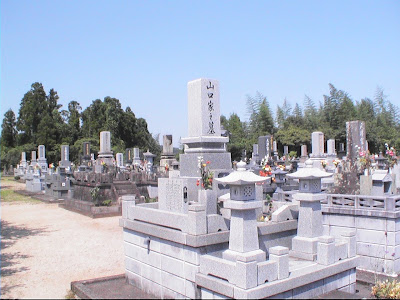
There was no one there, so I didn't stay long. I just took a couple pictures, and wandered over the grounds. The town graveyard was also located up on this hill.


I returned to the cycling road, and on the way back I saw a couple more waterwheels.
Most of these waterwheels don't serve any purpose as far as I could tell. A couple of them were used to irrigate the ground next to them, and the rest were just there for no reason at all.
However a waterwheel does evoke images of an idyllic countryside setting, and I'm just as much a sucker for this as anyone else. Listening to the sound of the wooden panels repeatedly hitting the water, and seeing the green fields are around, I felt so happy to be outside and enjoying this beautiful day.


I had now worked my way back to the Harajiri waterfall.
By this time, all the rescue work had finished, and I could wander around and take pictures a lot more freely.
There still a few police men walking about taking notes. And there was a woman with a microphone being filmed by a cameraman--I assumed this was the local news, although I never confirmed this.
I walked up by the top of the waterfall. Because there were still some police around I stayed on the main path and didn't wander over to the edge of the waterfall as I had done on both of my previous visits.
I also walked down to the base of the waterfall, and tried to get a good picture. However from the bottom, the entire waterfall proved to big to fit into just one frame.


Feeling like I had documented the waterfall experience as much as my equipment would allow me, I decided to drive down the road.
Shortly after the Harajiri waterfall was the Harajiri stone bridge, which I stopped the car to take some pictures of.


I then continued on down the road (route 7, I think) to see what else there was to see.)
I didn't find much, but the scenery was so beautiful it was again difficult to resist the urge to stop the car every 10 feet and take pictures.
There was some sort of fishing park by Shinnagase bridge. I stopped here briefly to take a couple pictures.


And then at another point there was such a nice view of the valley and the river going through it that I had to stop for more pictures and video tape.


I went through a tunnel and continued to drive through breathtaking scenery.
Eventually the road I was on appeared to come to an end. Or at least the main road looked like it branched into 3 smaller side streets. And I decided this would be a good place to turn around and come back.


In retrospect, I think if I had continued down this path it would have lead me to Kawakami valley, which is supposed to be quite beautiful and I'm sorry I missed out on it. But the street signs and the map wasn't very clear about this, so I missed it at the time. (Obviously when you go into a town cold, you don't always hit the high points as thoroughly as when you know what you're doing.)
I drove back and took the road in the other direction.
Eventually I ended up following signs up to see a some sort of Buddhist statue.
The statue was called (I think) Imayamamagaibutsu, and was located up on a mountain path. After I stopped the car, I picked up one of the free walking sticks, and followed the path indicated by the sign.
The statue itself wasn't very impressive, but at least it wasn't a very long hike to get there.
Once I went down the path, I got swarmed by the bugs again. I guess they're really out this time of year.
Again, they didn't bite me (for the most part) but they were a constant nuisance buzzing around my face.



Back in the car, and once again looking for things to see.
I followed the signs to see more Buddhist statues.
The Miyasako stone buddhist statues had been indicated on both the pamphlets and the road signs as tourist attractions. However the paths leading up to them were not kept up at all.
I was able to get to the eastern statue (Miyasako Higashi Seki Butsu) but the path leading to the western statue was completely overgrown with plants so that I couldn't get through.

The sign pointed to another path leading around, so I circled back and tried to take this one. I climbed up some stairs, but then the path was overgrown again and it was impossible to get through.
Around this time a Japanese farmer and his wife had come out to tend the neighboring rice fields. "Ah, trying to see the Buddhist statues, huh?" he asked. "The path is pretty bad, isn't it?"
"I couldn't get through," I answered. And he nodded knowingly.


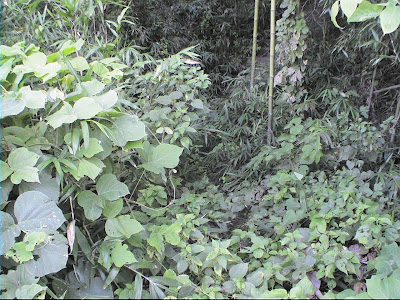
To be honest, I wasn't that upset about not seeing the statues. I had seen more than enough Buddhist images and stautes over my time in Japan. The only reason I went out of my way to see them in the first place was out of a sense of obligation, as I thought this was one of the town's major attractions. But if it's not important to them to keep the path walkable, it's not important for me to see the statue.
And that was more or less my day in Ogata. I spent some more time driving back and forth in my car after this, but didn't find anything else of much interest. And soon afterwards the sun started to set, and it was time to head home.
Ogata Links:
Eco-Walk and
Spring paths of Bungo. (Both of these posts are about the larger sicty of Bungo-Ono, but include lots on Ogata).
Harajiri Waterfall,
Tulip Festival Ogata City
Lots more articles and pictures of Harajiri waterfall on the web if anyone feels like doing a bit of digging, but these were just the first ones that popped up on a simple google search.
Update: According to the newspaper, the car had two people in it: a 90 year old father and his 65 year old sun. Both died in the accident.
Link of the Day
Chomsky: Understanding the Crisis-Markets, the State, and Hypocrisy
and
Once upon a time, the citizens of a large nation turned into monsters ...
and
American bankers: Fighting the good fight