I saw the Circle Theater production of this play. Click HERE for more information or to get your tickets.
I had never heard of this play before, although my parents say they saw it 25 years ago in London. According to Wikipedia, it dates back to the 1980s.
The production I saw was very high energy. The 3 actors were constantly running around and jumping and yelling, and I'm sure by the end they must have been absolutely exhausted. But when the premise of the play is that only 3 actors perform all of Shakespeare in 97 minutes, then I guess you expect the actors to get their work-out. To their credit, though, they looked like they were also having a ball doing it, so it's good they enjoy their work.
The play had a kind of maniac Marx Brothers type energy to it. There were lots of jokes packed into every minute. Some of them were funny, some of them weren't, but the jokes were flying out so fast that at least some of them were bound to land, and a number of them did.
The characterization seemed to me a bit inconsistent--the actors were constantly changing back and forth between who was the straight man and who was the buffoon. (An actor would appear to be highly knowledgably about Shakespeare one minute, and a complete ignoramus the next). But when you've only got 3 actors to play off, then I guess you need to switch things around a lot.
There were a lot of local references and topical references in the play that I saw, which couldn't have been part of the play in the 1980s. But according to Wikipedia:
The fourth wall is nonexistent in the performance, with the actors speaking directly to the audience during much of the play, and some scenes involve audience participation. The director and stage crew may also be directly involved in the performance and become characters themselves.
The script contains many humorous footnotes on the text that are often not included in the performance. However, improvisation plays an important role and it is normal for the actors to deviate from the script and have spontaneous conversations about the material with each other or the audience. It is also common for them to make references to pop culture or to talk about local people and places in the area where the play is being performed. Also, the authors' notes strongly encourage performers to update outdated references and jokes so that the material doesn't come off as out of touch. As a result, performances differ, even with the same cast.
As the above indicates, this is one of those plays that involves a lot of interaction with the audience. But in the age of television, that's what you want from a stage play, right? If all you wanted to do was to sit back and watch characters perform, you can do that at home with your TV.
And speaking of Wikipedia, the Wikipedia summary of the plot is pretty accurate. It's a very good summary of the play that I saw. If you're curious, you can read it. Or, if you want to avoid spoilers, don't read it, and go see the play for yourself.
Addendum: July 29, 2025
I'm not sure why I did this as a written review rather than a video review. I guess because it was a local performance, I thought it would confuse my audience on Youtube. But although the performance was local, the play itself has a long history, so I could have made a video talking about the play itself as well as the local performance.
This particular review I'll just let stand as it is. (i.e. I'm not going to give this the Scripted Review treatment and try to retroactively make a Youtube video out of it.) But going forward I'll do Youtube videos for any stage plays that I watch.
Addendum: March 14, 2026
Actually, on second thought, maybe I will keep these reviews of stage plays as written only. It feels a bit unnatural to put this stuff on Youtube.
Why I Saw This Movie
Following Richard II, this is the next movie in the BBC's adaptation (W) of Shakespeare's Henriad (W).
My History with this Play
This was assigned reading in one of my college literature courses. It made an impression on me, so I remember it well. More recently, I also used to have this play on audio book and (before my ipod erased it) became more familiar with this play by listening and re-listening to it numerous times. It's the Shakespeare play I know the best.
Positives and Negative * Positive: This is one of Shakespeare's best plays, so any adaptation of it has a lot going for it right off the bat just from the original source material.
* Positive: Related to the above point, as compared to it's predecessor Richard II, this play is generally a lot more watchable-- a lot more action, comedy and fast dialogue * Negative For some reason I'm not sure about, they didn't keep the actors consistent between this movie and Richard II--I would have thought the whole point of doing Shakespeare's Henriad as one coherent project would have been to keep the actors consistent from movie to movie.
* PositiveAlthough I'm somewhat disappointed they didn't keep the actor for Henry Bolingbroke consistent, Jeremy Irons does a great job in this.
* Negative One of the disadvantages of watching a Shakespeare play you're already familiar with is that you tend to be disappointed with the delivery of lines you already know--some of the lines which I remember as having a lot of dramatic force or humor on the audio book recording, got under-delivered in this movie--either mumbled, or stepped on.
* Negative: Related to the above point, the tavern scenes weren't quite as funny as they should have been, as a result of some of the punchlines being missed or under-delivered.
* Negative Related to the two above points: Falstaff was played a bit subdued in this adaptation, and didn't come out as the fully larger than life character I was hoping for.
* Positive But on the other hand, it's probably unfair to compare individual line readings from different adaptations--any adaptation will have to pick and choose which lines get the most dramatic force, and although this adaptation under-played some memorable lines, it did a good job with others.
* Positive Considering this was a made-for-TV movie with a made-for-TV budget, the battle scenes came off looking decently impressive.
* Negative Still, at the risk of being greedy, you can't help but wish that these battle scenes hadn't been on a made-for-TV budget, and had gotten the fully Hollywood movie treatment--alas!
The Review
There were a few missed opportunities in this adaptation--the tavern scenes weren't as rich or as funny as they could have been. But there were some successes as well. Jeremy Irons was brilliant as Henry IV, and the film's versions of his big confrontation with Prince Hal came through with full force.
Rating : 7 out of 10 Stars. (The original source material gets a solid 9, but I'm taking a couple points off for some missed opportunities in the adaptation.)
Links
For my take on other plays in the Shakespeare history saga, see my college paper on Henry IV part 2 here, and book review of Richard III here. Many of the same themes of Henry IV are in Oliver Stone's movie W. and (although I can't find the article now) I once saw an interview with Oliver Stone in which he claimed he deliberately modeled the beginning of W. on Henry IV , so here is my review of W.
External Links The AVclub's review here. I agree with them on some points, and disagree with them on some points, but the folks at the avclub can always be counted on to put in a good thoughtful review.
Why I Saw This Movie Ever since I was in college, and found out about Shakespeare's Henriad (W)--a series of Shakespeare plays that form one long interconnected history saga--I thought: "Wouldn't it be cool if someone did all these plays as one series of films," and then I came one day to find that the BBC actually was doing exactly this project (W).
My History With This Play * The memory is regrettably not so sharp on this point, but at least some of these scenes and dialogue is familiar--I may have read this in college. (At any rate, I definitely remember reading the sequel Henry IV Part 1 in college.)
Positives
* For us history geeks, there is the historical interest of Shakespeare's history sagas.
* As always when watching Shakespeare, the constant: "Oh, so that's where that quote comes from" moments.
* Something like this might be mostly broccoli [SEE HERE], but broccoli movies have their uses--we all have these classics we're meaning to get around to someday, and it's good to knock another one off your list
* Any Shakespeare adaptation by definition has to be a broccoli movie--you'll never get a popcorn movie out of Shakespeare--but that caveat aside, the directing, acting, and production values of this film are about as good as you could possibly hope for.
Negatives * Oh man, I had forgotten how talky Shakespeare is--for those of us interested in this story primarily because of the history, it takes forever to get to its point!
* Long
The Review
So, there's no getting around it, the expectations of the Elizabethan stage audiences are different than the expectations of modern movie audiences. Back in Shakespeare's day, characters were supposed to go off on long poetic monologues--it was how you filled time on the stage in the days before special effects. So be forewarned.
But the acting, directing, and general production values of this film are great. Even if it did drag a little bit into the long side.
Also for us history geeks, there is interest in seeing a key moment of England's history dramatized.
I know I've already complained about the movie being too long, but I confess being a little bit conflicted on this on--the completeist in me is upset that stuff got cut out of this adaptation, but the short attention span addled 21st century guy in me thought the movie was too long already. (This is a contradiction, but since most of us are just masses of contradictory thoughts and emotions anyway, I'm going to allow myself this.) I guess the best of both worlds would be for a complete unabridged film version of Richard II, but one which I didn't have to watch all in one sitting, and could break up over a couple nights.
Links
Ben Whishaw is perfectly cast as Richard II in this movie--I had previously enjoyed him as Q in Skyfall and Freddie Lyon from The Hour.
Watching Richard II, I was reminded of comments I had made reviewing the book Rubicon. To quote myself: "the ancient Romans put such great faith in their republican traditions, institutions and laws that many of them never seemed to realize that laws and constitutions do not enforce themselves. The Roman Senate never realized that whoever controls the largest army ultimately gets to decide the law. As long as the army’s leaders agreed to play by the republic’s rules, the republic could exist. But as soon as someone at the head of a powerful army decided they didn’t want to play by the rules anymore, then there was little the Senate could do about it."
Flip the politics from Republican government to Monarchical government, and this is exactly the tragedy of Richard II. Richard II had such faith in the system of monarchy that he never really realized that power does not necessarily go to the King, but to whoever has the largest army.
Ironically enough, even after Shakespeare's time, English kings continued to make this mistake. This was also the exact same mistake that got Charles I beheaded. (You have to wonder if Charles I ever read Richard II, and what he would have made of it.)
The BBC radio show This Sceptred Islementions this play as as performing a role in British history at one point. Supporters of the Earl of Essex (including Shakespeare's patron) paid to have this play performed during the Earl of Essex's planned revolt.
And actually, speaking of that same show, the very name, This Sceptred Isle, comes from a line in Shakespeare's Richard II.
Lastly, for my review of the Shakespeare play at the exact end of the history saga, see Richard III here.
7 out of 10. (I suppose whenever you attempt to rate Shakespeare, you're rating yourself more than you're rating the play--if I were a more intelligent person I'd give it 10 stars, but as a philistine I found it hard to sit through the whole thing, so I'm knocking 3 stars off on the "watchability" factor.)
This book has been making the rounds at my office lately. A co-worker passed it on to me with the words: “This is the best book I’ve read in years. Possibly, the best book I’ve ever read.”
That, you'll agree, is high praise indeed. I can’t go quite that far in my own recommendation. But I will say it was a very readable, and very enjoyable, little book.
Since I don’t know anything about the life of Shakespeare, I can’t really vouch for the accuracy of this book. I’ll leave that to other reviewers. What I can say is that this book is fun to read. It’s got the warm conversational tone you would expect from Bryson, plus the usual Bryson humour, but it is also packed full of interesting little tidbits of information about Shakespeare and the times he lives in.
The central conceit (or joke) of the book is that we know so little of Shakespeare’s life that it’s almost impossible to make a book out of it, but let’s try anyway. Bryson lays this out in the first chapter.
To answer the obvious question, this book was written not so much because the world needs another book on Shakespeare, as because this series does. [This book is part of the Harper Collins Series of Biographies "Eminent Lives" (W).] This idea is a simple one: to see how much of Shakespeare we can know, really know, from the record.
Which is one reason, of course, it’s so slender.
You wouldn’t think this would make much of a premise for a book, but Bryson pulls it off.
Bryson lays out the bare facts we know about Shakespeare, and then explains why we know what we know, and why it is that we don’t know much else.
In doing so, he frequently pokes fun of eccentric Shakespeare scholars, who have often spent years and gone to great lengths to search through thousands of 16th century documents just to establish the little that we do know about Shakespeare.
On the other hand, Bryson also makes fun of other Shakespeare biographers who fill in the historical gaps by sometimes making wild inferences about Shakespeare’s life based on questionable assumptions.
And along the way, Bryson drops in the few little facts we know about Shakespeare, and also talks a bit about the life and times Shakespeare lived in.
In doing so, Bryson is easily able to stretch out the facts into a very readable 195 pages.
What else is there really to say about this book?
...well, I guess if I were pressed, I could come up with a few notes and nitpicks.
* The section on Shakespeare’s vocabulary and his contributions to the English language is essentially a repeat of information Bryson has already included in his previous work The Mother Tongue. So if you’ve already read The Mother Tongue, it’s slightly tiresome to have to read this same information twice. However this makes up only a small section of the book, (only 6 pages, 108-114) so it’s forgivable.
* There were a few points in this book that left me mildly confused, and there are a few points I would have liked to learn more about.
Maybe it’s just me as a history buff, but I would have enjoyed more discussion about the politics and ideologies behind Shakespeare’s history plays. I’ve heard before that many of Shakespeare’s history plays were designed to reinforce the claims to the throne of Elizabeth I and James I respectively, but I don’t know as much about this as I would like. Bryson mentions in passing that Macbeth makes reference to the gunpowder plot, but he doesn’t give the actual line. I would have liked to read the actual lines.
Also I would have liked some clearer idea of how much we know of Shakespeare’s contemporaries. For example on page 194, Bryson mentions in passing that Ben Johnson kept private notebooks. How much can we know about Ben Johnson’s life through his private notebooks? How common a practice was this in the 17th century?
And there are various other questions that are still lingering in my mind after reading this book.
But on the whole, considering how easy this book is to read and how slender it is, you get a good education on Shakespeare for very little effort. You can't beat that.
Ever since the 1950s (or before?), Shakespeare has had a reputation for boring schoolchildren.
And yet, there’s a certain type of child (bookish, introverted, un-athletic, quiet, geeky) that is fascinated by stories, and is curious about the classics from a young age, even if they lack the ability to read them for themselves.
And that was me. I wasn’t a gifted youngster in terms of reading ability, but I was always fascinated by good stories, and from a young age I was aware that there were lots of good stories locked away in classic literature, and I was eager to get at them.
As a pre-adolescent, I became especially interested in Shakespeare. I discovered we had a number of similar interests: Greek mythology, Ancient Rome, history, and, of course, blood and violence.
Why the adolescent male mind is attracted to violent stories is a question I’ll have to leave for psychiatrists. But we are.
Like many a child before me (and probably many afterwards) I discovered that there was much more blood and violence in classic literature than in the R rated movies I wasn’t allowed to watch. Hence began my fascination with books like the Iliad, and the Odyssey.
And Shakespeare fit into this scheme as well. Shakespeare wasn’t as action packed as Homer, but he could be frighteningly gruesome. For example, when I stumbled upon “Titus Andronicus” (which I had mail ordered simply because of my interest in Roman history, not being aware what kind of story it was) I was, like any boy would be, both repelled by it and fascinated by it.
It was certainly more horrific than any of the horror movies I wasn’t allowed to watch at the time. (And if you don’t believe me, go and find a detailed plot summary of this play, and then ask yourself if this isn’t much more gruesome than anything “Friday the 13th” or “Nightmare on Elmstreet” can dish up.)
I remember gleefully recounting the details of the play to my mother in the car one afternoon, knowing that she might stop me from watching horror movies, but that she couldn’t really forbid me from reading Shakespeare.
However since I was a child of limited literary abilities, all of my fascination with Shakespeare was based purely on the stories. I had no interest in or patience with his word play, similes, puns, poetry, or iambic pentameter. I just wanted to find out what the story was.
Similarly, all of the symbolism, themes, character foils, and the like usually went right over my head unless they were explicitly pointed out by someone (a teacher, or the text notes.)
As you would expect given this, I rarely had the patience to actually sit through and read a Shakespeare play from beginning to end. Instead I would specifically look for editions of Shakespeare which were rich with long introductions, explanatory notes, and with plot summaries and analyses for each scene. I would read all of these instead, and only just skim the actual play itself.
For plays I was specifically interested in, like "Trolius and Cressida" (because of my interest in the Trojan War), or Titus Andronicus, (because of my fascination with the macabre, mentioned above) I tried several times to sit down and read them from cover to cover, but always gave up within the first few pages.
The only times I ever actually found the will power to sit down and read a Shakespeare play was when I had to, because someone else was testing me on it.
With this level of external motivation, I found I could quite happily read through “Julius Caesar” (10th grade English) and not only get through the whole thing, but more or less understand it.
The same with “Macbeth” (12th grade English). And King Henry IV Part 1 (British Literature class at Calvin College), followed by King Henry IV Part 2.
And then the Shakespeare class I took at Calvin. (Hamlet, King Lear, 12th Night, Midsummer Night’s Dream, the Tempest, Othello, Measure for Measure, Much Ado about Nothing). All of these I read because a teacher or professor made me read them. And all of them I ended up enjoying.
And yet I still never went on to read any plays on my own initiative.
…But I’ve always meant to.
This past year, I’ve found a new excuse.
I’ve given myself a bit of a crash course on British History. (For most of the year, until I recently found the audio book section in my local library, I’ve spent the entire year with just “This Sceptred Isle” (A), and “Monarchy” by David Starkey as the only selections on my ipod. And I listened to them over, and over, and over again. And now I finally know who all these medieval kings of England actually are.
Since I now had the historical background which I thought would help me appreciate Shakespeare’s history plays more, it seemed the perfect time to pick up Shakespeare again.
Short Disclaimer
A Japanese friend, who never really understood the appeal of Shakespeare, once cynically quoted to me the following line (apparently from a Japanese academic talking on Japanese TV): “There are so many books written about Shakespeare, that you could spend your whole life reading books of Shakespeare criticism, and never actually get around to reading Shakespeare himself.”
The scary part is—he wasn’t lying.
This makes it a bit intimidating to try and write anything new on the subject. But, since I’ve committed myself to this book review project, I’ve got to jot down at least a few thoughts.
As always, I’ll just write down what struck me about this book going through it as an average reader, and not worry if what I have to say is new or particularly insightful.
(For this reason, I have deliberately avoided consulting the critics, and have just written up my off-the-cuff impressions on the play.)
The Actual Review
This is the final play of a 4 part series detailing the Wars of the Roses. It is preceded by Henry VI part 1, Henry VI part 2, and Henry VI part 3. It is my understanding that many of the characters in this play make their first appearances in the earlier plays. And yet this is an independent work in its own right. Which is why I started with this play instead of the earlier ones. (Although now that I’ve finished this, I find myself interested in going back and reading the earlier plays.)
If you do jump directly into this play, it probably helps to know a little bit of the historical background behind the Wars of the Roses in order to understand who everyone is. But it’s probably nothing that some text notes or a good annotated version of the play can’t fix.
Having recently acquired some British history (see above) I felt like I understood pretty well what the historical background was, and who everyone was in this play. (At least as far as the main royal family anyway. I wasn’t so familiar with some of the various nobles and side players, but Shakespeare gets you up to speed pretty quickly.)
I was also able to catch a couple points where Shakespeare takes some liberties with history. (Historically there’s no proof that Richard, and not Edward, gave the order for Clarence’s death.)
[And actually, while I’m on the subject the last time I walked into my local bookstore there were about 4 or 5 revisionist histories of Richard III, all claiming he wasn’t such a bad guy after all and probably didn’t commit a lot of the murders attributed to him. But I’ll leave that aside.]
As with any historical novel (or historical play, or historical movie), a lot of the pleasure comes from seeing history come alive. Historical characters are fleshed out, made into people you care about, and get you emotionally involved in the story.
For example, it’s one thing to know the dry fact that Clarence was killed in the tower drowned in a tub of butt of marmsey. It’s a whole different level of emotional involvement to read him pleading with his murderer’s for his life.
Since this play takes place directly after the Yorkist victory in the War of the Roses, it’s interesting the way Shakespeare sets the play up as first two different factions (the Yorkists united against the one remaining Lancastrian, Margaret) and then later explores the Yorkist faction falling out among themselves.
The play also seems to have elements of the horror genre in it. Like many horror stories about ancient curses, Margaret (the last Lancastrian) pronounces curses on all the victorious Yorkists at the beginning of the play. At first they all laugh her off, but one by one, everyone she curses meets an untimely death. The inevitability of it makes it horrific. You can try and laugh off the curse, you can try and avoid it, you can try and repent of your evil ways, you can even try and run away, but sooner or later that curse will hunt you down and kill you.
The deaths are the result of Richard, of course, but it makes you wonder if Richard is actually doing the killing, or if he is just being used as the instrument of the curse.
The character of Richard, as Shakespeare, portrays him, is extremely good at lying. He always says one thing in private, and then swears up and down in public that his intention is just the opposite. It’s impossible to read this play and not think of modern politicians, which is perhaps why this play has remained so popular over the years.
That being said, given this play's reputation I was hoping for more of a psychological exploration about what makes a tyrant. And that we don’t get. Richard is evil just for the sake of being evil. (Supposedly he’s bitter at the whole world because of his physical deformity, but that level of motivation doesn’t rise much above a typical comic-book villain.)
Perhaps because of the fact that Richard was more of a plot device than an actual character, the ending of the play and his eventual defeat left me a feeling a little bit underwhelmed. I’m not sure exactly what kind of emotional conclusion I was hoping for from the play, but whatever it was I didn’t get it.
As far as readability: I thought it was pretty interesting. It’s got a high body count (which satisfies the macabre inside all of us), but because it has a high body count there are a lot of death speeches right before a character dies, and mourning speeches after a character is killed (which slows down the pace of the play a bit.)
And at the risk of sounding like my old English teacher, the verbal sparring between the characters is pretty interesting. There's a lot of wit on display in the antagonistic scenes as characters trade verbal barbs back and forth.
Anyways, for whatever it’s worth, those are my two cents on the most scrutinized playwright in English history.
In an effort to learn more about Japanese culture (and learn more Japanese language as a bonus) I thought I should probably work my way through some Anime series and bone up my otaku credentials.
Your average video rental store in Japan is made up of almost half anime series, so there's no lack of choices. What caught my eye about this series in particular was it was a familiar story. And plus Shoko and I have been having a lot of arguments lately about the merits of Shakespeare. (She doesn't think he's all that great). So I was curious to see what the Japanese Anime take would be. I was also curious to see how they would stretch Shakespeare's story over 12 DVDs.
The series opens with the little child Juliet watching her parents killed by the house of Montague. And then escaping out of a castle in the sky via a winged horse.
It was at this point that I began to suspect what I was watching was not the official Shakespeare version.
Indeed, this was an entirely new re-imagining of Shakespeare's story, where the creators apparently felt free to borrow whatever they liked from Shakespeare's story, and then add and remove elements at will. Many of the same characters, like Tybalt and Mercutio appear, but often in completely different roles. Shakespeare himself (or a thinly disguised caricature of him, a playwright named Will) becomes a character.
It's a bit jarring at first, but once you suppress your inner purist, it can be a lot of fun.
Will the young lovers meet with a happier end then they did in Shakespeare's tragedy? I guess you'll just have to watch the series and find out yourself. (Here's a hint though: remember it's a Japanese version of the story. Expect a big emphasis on duty and sacrifice near the end).
This anime series can probably be safely classified as "Shojo". That is, comic books or animation targeted at Junior high school or elementary school girls. This represents my first foray into the genre. And the big surprise is that it's not half bad.
I don't mean to be sexist here but...Well, I have always been (and my sisters and past girlfriends will vouch for this) eternally a 12 year old boy in terms of my entertainment choices. Action, superheroes, and giant monsters: Yes! Anything remotely emotional or feminine: No!
But I really enjoyed this series. The setting seems to be roughly 19th century Europe...taking place in a city in the sky with flying horses. It has a wonderful feel of a fairy tale.
There's plenty of action to spice things up. Juliet fights injustice in the town disguised in a mask as "The Red Wind", which gives the series something of the 1700's swashbuckling feel of the Scarlet Pimpernel series.
There's lots of subplots, narrow escapes, betrayals and intrigues between the two battling families.
The main story is of course the romance between Romeo and Juliet. And at times it does get a bit sappy, although more often it is likely to resemble a teenage romance a little too much. ("Oh my god! He actually likes me! What do I do? I better run away before I say something stupid!")
However, once Romeo and Juliet finally work up the courage to talk to each other and develop a relationship, their relationship progresses in a linear way from there. I can't help but feel that if this had been an American TV show the writers would have spun out the time by having them get together, and then break up, and then get back together again, and then break up again, and then develop feelings for other people, and then get sort of back together again, et cetera. (Shoko has been renting a lot of "Grey's Anatomy" and "The O.C." recently).
Every American who has ever commented on Shojo comic books or animation has with out fail said something like, "Aha! It is possible to make a comic book fantasy/ adventure story for girls that doesn't suck! Why can't the American comic book companies learn from this?"
...And yet at the risk of being repetitive, I can't help but ask the same question. What are you thinking, American comic books? Don't you realize girls represent half the population? Wouldn't you like to get just a little bit of that market?
Recently I've been probably spending more time than is good for me reading the musings of former comic book insider and female comic book geek "Occasional Superheroine". And one of her frequent complaints is the way American comic book companies completely write off or ignore female fans in an effort to make comic books pure male adolescent fantasy domain. I couldn't help but think of her blog as I watched this series.
As predicted, the Grand Rapids Press Public Pulse is beginning to get responses to my letter on Gerald Ford and East Timor. Yesterday had this gem:
Mr. Joel Swagman's Pulse letter on Jan. 10 "President Ford and East Timor" is a classic example of Shakespeare's account of what Marc Anthony stated at Caesar's Funeral "The evil that men do lives after them, the good is oft interred with their bones."
Actually, that's pretty mild, isn't it? It's hardly raking me over the coals. If this is the worst feedback I get, I'd say I'm doing pretty well. If memory serves, there was bloody hell the last time this issue was in the "Public Pulse". Not to mention all those weeks of criticism we got in the "Public Pulse" over the Rehnquist affair.
And yet, you still have to wonder what exactly this guy is smoking. The GR Press and the local media spend untold hours and pages praising Ford as the next candidate for sainthood. I get two paragraphs buried in the "Letters to the Editor" section (to my knowledge the only thing critical printed about Ford in any of the mainstream local media), and all of a sudden the demagogues have taken over and everything good about Ford has been forgotten?
....And speaking of demagogues, I'm not sure this guy gets Shakespeare. If you remember from the play, Marc Antony uses this phrase as a rhetorical trick to make the crowd forget what a tyrant Caesar had become, and shift the blame onto the assassins instead. It's not meant to be taken as a literal truism. In fact taken in context, you could say that Shakespeare was arguing the opposite: Beware of people who praise dead politicians too much and overlook their faults.
(Shakespeare's account wasn't historically accurate, but we'll leave that part alone for now.)
Useless Wikipedia Fact
The tannins in coffee may reduce the cariogenic potential of foods. In vitro experiments have shown that these polyphenolic compounds may interfere with glucosyltransferase activity of mutans streptococci, which may reduce plaque formation. In rat experiments, tea polyphenols reduced caries. [14
Link of the Day
"Mother Goose Goes to Hollywood" cartoon on youtube. Apparently this cartoon has been banned for racism, but I remember watching it when I was a little kid. It must have taken them a while. At any rate the impressions of 1930s Hollywood celebrities are worth watching
(Book Review)
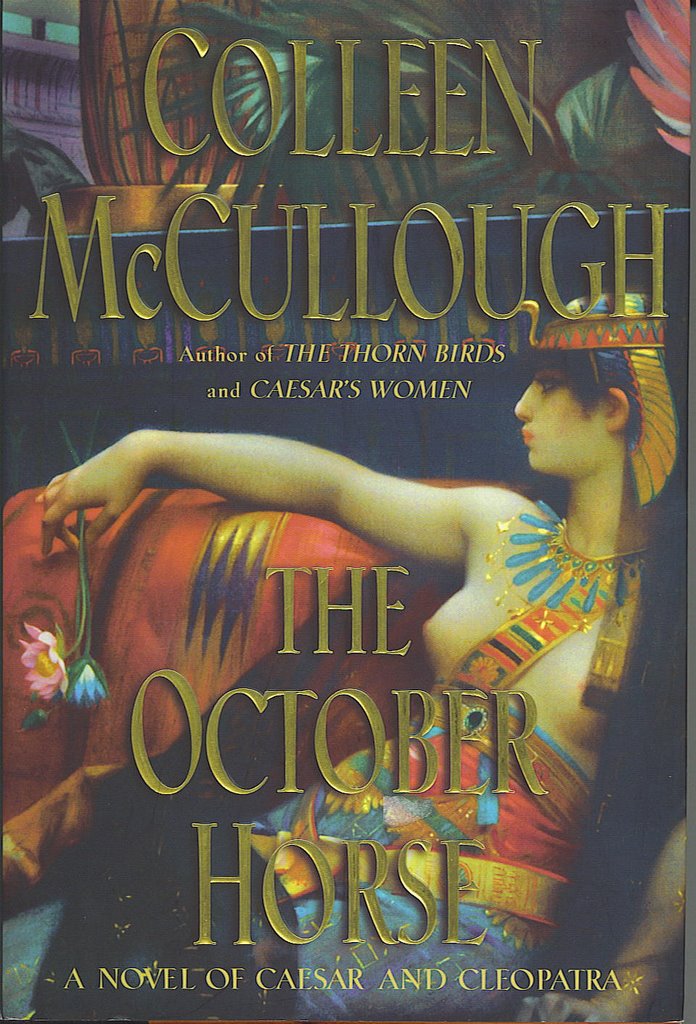
Now that I’ve read the last book in McCullough’s “Masters of Rome” series, I first want to say how much I’ve enjoyed this series. In my review of the previous book, I mentioned several quibbles I had, and I stand by those, but they are after all only quibbles. On the whole this is a fantastic series.
Granted it’s not for everyone. Hard as it may be to believe, there are some people who have no interest in history, and I imagine they would lose interest in this very fast. But if you have even the slightest interest in history, if you’ve ever enjoyed a good historical novel, I can’t recommend these books enough. They’re well written with vivid characters. You’ll learn a ton about Roman history, and you’ll have fun doing it. They are long books, but you don’t have to read them all at once. I took a 10 year break in between books 4 and 5 in the series, and had very little problem getting right back into it. Because these are historical novels, and not straight histories, the characters and events of the previous books remained vivid enough in my mind even after 10 years. Which is the beauty of learning history through novels. It sticks in your mind a lot longer.
My only complaint is that McCullough has ended the series here with the formation of the second Triumvirate. The true end of the Republic wasn’t until Augustus defeated Antony and assumed power. It would have been nice if she would have continued just a little farther to bring closure to her series on the fall of the Roman Republic. But I guess if we want to get technical about it, she really should have started the series 50 years earlier with the Gracchi brothers. (Actually according to Wikipedia, McCullough has relented to fan pressure, and is currently writing one last book in this series. So at least I have that to look forward to.)
Now onto the specifics of this particular volume:
Because this book deals with the assassination of Julius Caesar and the love life of Cleopatra, more so than any previous book in the series it deals with events already very familiar through Shakespeare and Hollywood. McCullough presents a different view of these events than the one we are accustomed to. She defends some of her choices in the afterward to her book.
For instance, Julius Caesar never utters the words “Et Tu, Brute?” According to ancient sources, Caesar was silent at his death. Cleopatra is not the exotic beauty she is often portrayed as in Hollywood, but an awkward gangly teenage girl. Marc Antony is depicted as originally being in on the plot to assassinate Caesar. Brutus and Cassius are not the charming men they appear as in Shakespeare, but men who are perfectly content to loot, pillage and burn Greece and Asia Minor in order to fund their war against Marc Antony.
I remember one of my Latin professors at Calvin once made a big deal of the fact that, contrary to popular conception, Brutus and Cassius were not in fact killed in retaliation for the murder of Julius Caesar. Rather after the assassination, a general amnesty was offered to all the conspirators. It was for other reasons that the uneasy peace collapsed and civil war began. The reasons for the collapse of peace can be pretty confusing, but McCullough does a good job of thoroughly covering this step by step in her book.