Showing posts with label Masters of Rome. Show all posts

Tuesday, September 27, 2016

The Brothers Gracchi by Extra History

(Review of a Youtube Series)


A few weeks back I gushed about how much great history stuff there is on the Internet nowadays, and how great this is for all us amateur history buffs.

The Extra History Youtube series is a perfect example of this.  Since I stumbled across it a couple months back, I have been loving this series.

If you haven't come across Extra History yet, you're in for a real treat:

For example, their animated history on Early Christian Schisms--absolutely fascinating.  (If you're wondering why a history series is diving into Christian schisms, it's because they take the same view that Paul Freedman takes in his history lectures on the later Roman Empire--it is impossible to understand the history of this period without understanding the religious quarrels that people were constantly fighting over during this time.)

Likewise, their history on Justinian and Theodora is also absolutely fascinating.  (History nerd that I am, I only recently learned that there was a time when Eastern Roman Empire had briefly reconquered Italy after the fall of Rome.  Again, I found this out through Paul Freedman's lectures.  But Paul Freedman didn't go into a lot of detail.  These Extra History youtube episodes give you a lot more interesting details about what the situation in Italy was like after the fall of Rome.)
And their series on the Crusades--again, absolutely fascinating.  (Every school child knows that the Crusades happened, but I never realized how bizarre the whole thing was until watching these videos.  These videos do an excellent job of breaking down step by step exactly how the crusades went down.)

And their video on the England South Sea Bubble is superb and so eerily modern.  The tale of corrupt bankers knowingly selling junk bonds and getting so greedy that they caused the whole national economy to crash is something that sounds a lot like recent events.  (I had known something about the South Sea Company crisis from This Sceptred Isle, but I had never known about it in so much detail, and these folks at Extra History take the time to go into the delicious detail.)

And their series on the first Opium War was also fascinating.

And I also loved the series on the beginning of World War I.  These guys go into such great detail on breaking down exactly all the bad decisions that lead to the War.

Their series on World War II is also really interesting.  (In my review of The World at War, I made the observation that I was struck by how much of World War II was a war for the control of oil.  From this I reasoned that we shouldn't out of hand dismiss the idea that modern wars are also motivated by the control of oil.  The folks at Extra History also emphasize how much of World War II was a fight over natural resources such as oil.)

So all of those series are great, and I recommend all of them.

But when the folks at Extra History did a series on the Gracchi Brothers, I thought I'd dedicate a whole blog post to how interesting I thought it was.

Purely the sake of self-indulgence of course.  I don't have anything new or intelligent to say about the video, or the Gracchi Brothers themselves.  I just want to talk about how I've always been interested in this period of Roman History

I'm going to do this in the form of bullet points--just listing of stray observations and stray reminisces:

stray observations and stray reminisces

* One of the reasons I'm dedicating a whole blog post to this is that the last 100 years of the Roman Republic has always been one of my pet interests.  (I've - mentioned  - this  - several  - times before on this blog).  The turmoil of the Gracchi Brothers is commonly seen as the beginning of this period.

* I hate to admit it, but most of my historical knowledge about this period comes from historical fiction.  Specifically Colleen McCullough's excellent The Masters of Rome series.
Colleen McCullough doesn't cover the Gracchi brothers--she starts her series just after the Gracchi Brothers, with the rise of Gaius Marius.
I've always thought it was a shame Colleen McCullough didn't start her series 50 years earlier with the Gracchi Brothers (as I've said before on this blog).  Nevertheless, her characters make frequent references back to the Gracchi Brothers throughout the series.  It is very apparent in the first couple books that all the turmoil that is happening is going on in the shadow of the Gracchi Brothers legacy.  And in the later books the granddaughter of Tiberius Gracchus, Fulvia (W), becomes a major character.
Robert Harris also refers back to the Gracchi legacy in his fictional novel about Cicero--Imperium.  (There's a scene where Cicero and his colleagues use the precedent created by Tiberius Gracchus to vote a political opponent out of office).

* I was chatting about this youtube series with a co-worker, and he recommended to me Dan Carlin's podcast series Death Throes of the Republic.  I had never heard of Dan Carlin before, but apparently I'm behind the times, because a bit of googling reveals he's extremely popular with history nerds everywhere.
My friend loaned me his copy of the Death Throes of the Republic series, and I'm loving it.  I'll be coming back with a separate review of that.

* Actually from Dan Carlin's podcast (review coming in the future) I learned something I had never realized before.  The Marcus Livius Drusus (W) who was the conservative opponent of Gaius Gracchus was the father of Marcus Livius Drusus (W) who was the liberal social reformer.  Interesting how different the politics of father and son were.
I know about Marcus Livius Drusus the younger because he was a major character in the first two books of Colleen McCullough's Master of Rome series.  Marcus Livius Drusus the younger was a campaigner to give Roman citizenship to the Italian allies, and he was eventually assassinated because of his work in this cause.
In the Extra History video series above, you can see that his father was the person who thwarted the exact same issue when it was brought up by Gaius Gracchus.
Dan Carlin points out the irony of this in the podcast.
(Update--Through an Internet search, I just realized that Colleen McCullough does address this issue in her books.  I've just come across a passage where the political legacy of Marcus Livius Drusus's father is addressed--LINK HERE.  This is just one of those little details I've forgotten in the 20 plus years since I read those books.  I'm probably long overdue for a re-read of this whole series if I can ever track those books down again.)

* I do have to admit, though, I am somewhat ashamed of how much of my knowledge of this period comes from historical fiction.  What kind of history geek do I think I am?  Inspired both by this series, and by Dan Carlin's podcasts, I've been trying recently to go to some of the original ancient sources for this period.  I've been trying to read The Civil Wars by Appian of Alexandria--if I ever finish it, I'll put up a book review on this blog.

* If you look at the Youtube comments for the video series, there's an interesting little debate going on.
The first video in the series sets the scene for the Gracchi brothers reforms by describing how the Roman rich were gobbling up more and more of the land and squeezing out the Roman middle class. The video further describes how the Roman Republic was in a crisis because the Republican institutions couldn't survive the demolition of its middle class.
Naturally, most of the people in the comments section were writing things like: "Oh wow!  This is so much like America today!"
Then, other people started accusing the video makers of editorializing the history.
Comments like this one:

guys, the parallels here with the usa are clearly done on purpose. It doesn't mean that your a genius if you saw it, it just means your not stupid
I've got to say, however, now that I've been reading Appian of Alexandria, it looks like a lot of the editorializing comes straight from the ancient sources.  In his brilliant account of this period, Appian does clearly lay out how the Roman rich were indeed squeezing the Roman middle class out of existence, and that this was resulting in a crisis.
I encourage everyone to read Appian for themselves and see how he frames the issue--LINK HERE.

* Both Dan Carlin and the Extra History video series above mention the irony of the Italian citizenship issue.  The Gracchi Brothers were champions of the Roman poor people, but they lost the support of the Roman poor when they tried to extend citizenship to the Italians.  (Marcus Livius Drusus the younger would have the same problem 50 years later).
The Roman poor and the disenfranchised Italians should have been natural allies--they were both getting screwed over by the Roman aristocracy.  But the Roman poor, miserable though they were, could at least look down on someone--they had citizenship, and the Italians didn't.  If citizenship were given to the Italians, then the Roman poor would have no one to look down on.
Both Dan Carlin and the Extra History video series hint that the aristocracy encouraged this feeling of resentment to prevent the Roman poor from uniting with the Italians.
It seems very similar to the way some politicians today encourage the American poor to resent the immigrants and ethnic minorities.

* Although the question hasn't come up in years, in my younger days I used to get asked occasionally why I had different views than the conservative community I grew up in.  (For example here).
 When I was in high school, reading about this period in Roman history was a big factor in my own political evolution from conservative to liberal.
I grew up in a community closely associated with the religious right, and during the 80s and 90s the Republican Party complained a lot about lazy poor people on welfare.  When I was 12, 13, 14, 15, 16 I identified with this rhetoric--even though I wasn't a taxpayer at the time, I absorbed the rhetoric, and I resented all the lazy poor people who were taking money away from decent hard working folk.
I started to change my views at about 17 or 18 and reading about Roman history was a big factor in that change.
I began to get the sense that throughout history, the poor were always being screwed over by the rich. This caused me to want to do what little I could to try to make it so future historians wouldn't say the same about our time.
I also started to realize that although the issues always seem very complicated at the time, with the benefit of historical hindsight, historians always seemed to take the side of the poor people.  (Even though the Gracchi Brothers were demonized by their political opponents during their own time, they've been remembered as heroes by the subsequent generations).
This caused me to think that when future historians wrote about our own era, those on the right side of history would be those working on the side of the poor.
I decided that, given the choice between either an overly generous welfare system or an overly harsh system, I wanted to support he overly generous system.  I'd rather have some people abuse the system than have some poor people left in need.
I mention this not to say that this was the correct way to view things, but just to say that this was my thinking at the time--this is what helped to jar me out of a Republican Party view of the world.  I now realize that this was an oversimplification of the issue--young people are probably prone to these type of oversimplifications--but it set me off down a certain course nonetheless.
Some 20 years later, I'm ashamed to say I've done very little to advance the causes that I chose to identify with, but examining my failures as a political activist will have to be another subject for another post.
Sunday, February 08, 2015

Rest in Peace Colleen McCullough


I felt a small tug of personal loss when author Colleen McCullough passed away last week. ....reads the Salon article I was browsing.

Wait, what!

Well, just as with Pete Seeger's death last year, I'm finding out about this belatedly. But let me chime in with my two cents nonetheless. Her epic Master's of Rome series is my favorite book series of all time. I read the first couple books in the series when I was 14, and in fact much of my understanding about ancient Roman history still comes from these books (for better or for worse).

The books have their flaws, to be sure. (I mention some of them in my review, others I'm aware of but never wrote down). But in terms of the epic ambition to write such a long section of history as a series of novels, it's impossible not to admire these books, for all their flaws.

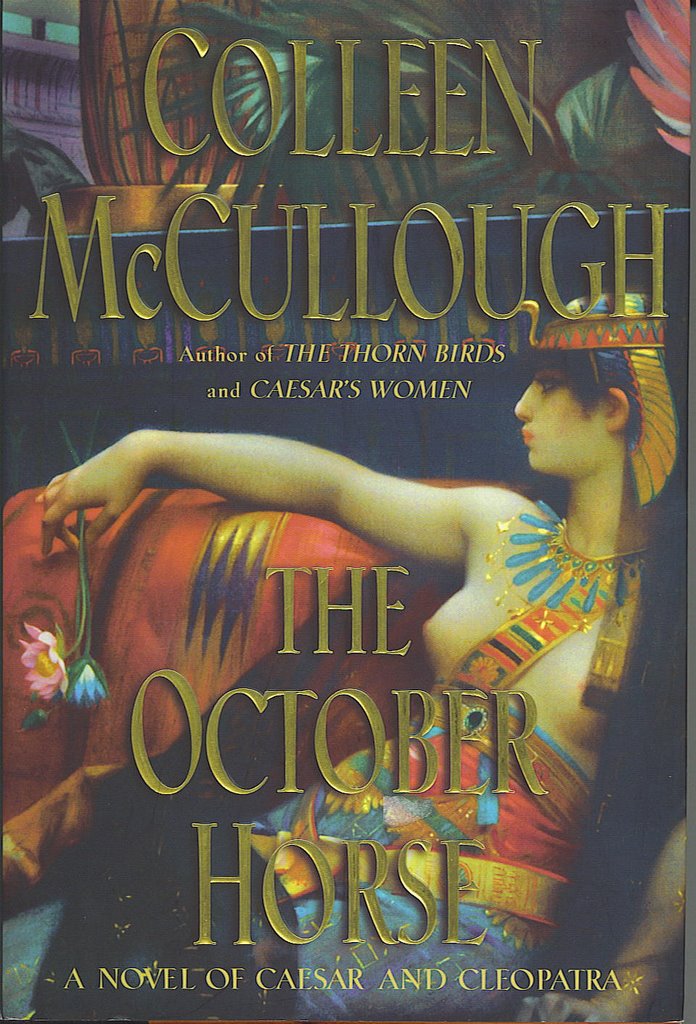
The first four books in the series I read as a youngster before I started blogging, but I reviewed the last two on this blog: Caesar and October Horse. (Actually since I read the "last book", a new final book in the series was published, which I still have to track down and read.)

I also mentioned my affection for this series in several other blog posts: here, here , here , here , here, and here .

Sunday, January 20, 2013

Television Addiction Part 3: Oh, the TV shows I Would Love to See Get Made

            (This is a continuation from the last post.  Go to the end of that post to see the justification for this one.)

            Now that Game of Thrones has proven complex fake history can be a ratings winner, here are some complex events from real history I would love to see turned into historical drama TV shows.

1.  War of the Roses –This one’s a no-brainer.  If we can do Game of Thrones, why not do War of the Roses?
2. Henry II and sons—This would be a great drama about the quarrels within a powerful family
3. End of the Roman Republic—  I know we just had the series Rome a few years ago, but I think it can be done better.  Rome just made a caricature out of a lot of the politics of the period, but I think it would be interesting to do a TV show that tried to get more in-depth.  Personally, I think Colleen McCullough’s Masters of Rome  series offers a great blueprint of how this can be done.  Someone should just adapt her series into a television show.
4.  French Revolution—Not every Revolution would lend itself to television, but I think the French Revolution would.  Although the Revolution went through various phases, I think during each of these phases the action was centralized in Paris, and although the people in power changed rapidly, at any given moment there were only a small group of people in control, often meeting in small rooms. 
5.  The Paris Commune  This one would be a little bit more tricky to pull off, because there wasn’t as much clear leadership and it might be harder to make a coherent plot around the events.  But I still think it could be done.
6.  The English Civil War—I always thought The Tudors was a bit of a waste.  Why focus on telling the stories of Kings when you can focus on democratic movements instead?  In reading about the Levellers I thought there was more than enough material here to get a TV show out of.  I would focus heavily on the Leveller movement, but include broader events in the English Civil War as a backdrop.
7. Gordon at Khartoum  You probably couldn’t get a full 6 seasons and a movie out of this story, but focusing on the developing crisis in Egypt and the Sudan, and then Gordon at Khartoum and the resulting political fallout for Gladstone, and then the avenging missions carried out by Wolseley, you could easily get maybe 1 or 2 seasons out of this story.  Just focus on the story laid out in Three Empires on the Nile  or The Scramble for Africa.  (The entire story of the Scramble for Africa is too big for a TV show, but it is possible to focus on this event as representative of a lot of the same issues going on elsewhere on the African continent during this time period.)
8. The King David Story –Actually what I’d really like to see is a television series that puts the whole Bible on TV (or the narrative parts of the Bible anyway.)  This may seem strange for me as an agnostic to dream about putting the Bible on TV, but actually I believe that if people actually knew what was in the Bible stories, it would create much more agnostics.  I know some Christians would argue the opposite, that knowing more about the Bible would actually bring people to faith.  So let’s run the experiment then.  We’d just film the Bible stories as they were written.  We wouldn’t make anything more bloody than it actually is, but we wouldn’t censor anything either.  Just a straight up adaptation of the Bible.  Christians would love it, and agnostics and atheists would also love it, so we would have a built in audience already.  And we would see what the reaction of the general public would be.
            Of course you could never show most of those Bible stories on network TV, so it would have to be on HBO or something, but let’s try it nonetheless.
            However, if I had to pick just one story, it would be the King David story.  Especially since I thought Kings did such a terrible job of adapting this story, I think it deserves another chance.
            Part of the problem with Kings is that they started too late.  Kings started with Saul and Samuel already past their prime, but to really get the whole narrative sweep of the story, you need to see not just Saul’s fall, but his rise as well (that makes him all the more of a tragic figure, and more interesting).  I would start from the very beginning of 1st Samuel, because Samuel’s story is important as well.
            Some of the stories would need a little bit of fine tuning to get rid of the various contradictions (the contradictions between Samuel 16 and 17, for example—or you could just leave the contradictions in and let people make their own decisions.) 
             I’d try and include everything and leave out as little as possible, and I think it would make great TV.
            And here’s another idea—because the numbers given for the reign of various Judges don’t add up with the total, some fundamentalists have tried to get around this by suggesting that some of the last few chapters in Judges overlapped with the time of Samuel and Eli [LINK HERE].  So if we started from the beginning of Samuel’s time, it might also be possible to justify shoe-horning the last few stories of Judges into the same narrative.  The story of Samson, for example, would make great TV (you could have young Samuel as an observer, to some of these events.)  And the last few chapters of Judges, 19-21, would also show how Israelite society was spinning out of control, and might provide some of the background needed to explain the transition to monarchy.  Plus, the stories of rape, and atrocities and civil war—the HBO audiences would just eat that stuff up!  This stuff was made for cable TV.

            Those are all my ideas at the moment.  If anyone has any more ideas for historical events you think would make great TV shows, leave them in the comments section.

Link of the Day
Noam Chomsky- What's the WTO?

Thursday, December 07, 2006

The October Horse by Colleen McCullough


(Book Review)
Now that I’ve read the last book in McCullough’s “Masters of Rome” series, I first want to say how much I’ve enjoyed this series. In my review of the previous book, I mentioned several quibbles I had, and I stand by those, but they are after all only quibbles. On the whole this is a fantastic series.

Granted it’s not for everyone. Hard as it may be to believe, there are some people who have no interest in history, and I imagine they would lose interest in this very fast. But if you have even the slightest interest in history, if you’ve ever enjoyed a good historical novel, I can’t recommend these books enough. They’re well written with vivid characters. You’ll learn a ton about Roman history, and you’ll have fun doing it. They are long books, but you don’t have to read them all at once. I took a 10 year break in between books 4 and 5 in the series, and had very little problem getting right back into it. Because these are historical novels, and not straight histories, the characters and events of the previous books remained vivid enough in my mind even after 10 years. Which is the beauty of learning history through novels. It sticks in your mind a lot longer.

My only complaint is that McCullough has ended the series here with the formation of the second Triumvirate. The true end of the Republic wasn’t until Augustus defeated Antony and assumed power. It would have been nice if she would have continued just a little farther to bring closure to her series on the fall of the Roman Republic. But I guess if we want to get technical about it, she really should have started the series 50 years earlier with the Gracchi brothers. (Actually according to Wikipedia, McCullough has relented to fan pressure, and is currently writing one last book in this series. So at least I have that to look forward to.)

Now onto the specifics of this particular volume:
Because this book deals with the assassination of Julius Caesar and the love life of Cleopatra, more so than any previous book in the series it deals with events already very familiar through Shakespeare and Hollywood. McCullough presents a different view of these events than the one we are accustomed to. She defends some of her choices in the afterward to her book.

For instance, Julius Caesar never utters the words “Et Tu, Brute?” According to ancient sources, Caesar was silent at his death. Cleopatra is not the exotic beauty she is often portrayed as in Hollywood, but an awkward gangly teenage girl. Marc Antony is depicted as originally being in on the plot to assassinate Caesar. Brutus and Cassius are not the charming men they appear as in Shakespeare, but men who are perfectly content to loot, pillage and burn Greece and Asia Minor in order to fund their war against Marc Antony.

I remember one of my Latin professors at Calvin once made a big deal of the fact that, contrary to popular conception, Brutus and Cassius were not in fact killed in retaliation for the murder of Julius Caesar. Rather after the assassination, a general amnesty was offered to all the conspirators. It was for other reasons that the uneasy peace collapsed and civil war began. The reasons for the collapse of peace can be pretty confusing, but McCullough does a good job of thoroughly covering this step by step in her book.

Useless Wikipedia Fact
"Julia" was written for John's mother Julia Lennon, who was struck by a car driven by a drunk policeman in 1958. It was also written for his wife Yoko Ono, whose first name, which literally means "child of the sea" in Japanese (洋子), is echoed in lyrics such as "Oceanchild, calls me."

Link of the Day
Antiwar Vietnam Vets Mentor Next Generation of Resisters
About 8,000 soldiers have gone AWOL since the 2003 invasion of Iraq, and many of them are looking to their predecessors for support.

The October Horse by Colleen McCullough: Book Review (Scripted)

Saturday, September 30, 2006

Caesar by Colleen McCullough

 (Book Review)

When Lucretius, Guam and I got together over the summer, I noticed Mr. Lucretius had begun working his way through McCullough’s “Masters of Rome” series. I myself had been obsessed with these books when I was in high school, and they had a big influence on my own writing at the time. (I was a bit of a geek in high school, but if you follow this blog, I’m sure you know that already.)

The first few weeks of my freshman year at Calvin, I spent a lot of time huddled away in my dorm room reading “Caesar’s Women” when I probably should have been out trying to meet new people or studying. But interests change quickly at that age, and by the time the next book in the series came out, I had decided I was now more interested in modern history than ancient history, and I never got around to reading it.

But, after talking to Lucretius and Guam about these books, my interest has been rekindled, and I've decided to pick up where I left off now ten years later. (Has it been that long already?)

When I was going through my Classical History phase, I read a lot of historical fiction: “Flames of Rome” by Paul Maier, “I, Claudius” by Robert Graves, “Julian” by Gore Vidal, etc. McCullough’s series is by far the best historical fiction I ever read, in part because unlike these other books she focuses on Republican Rome as opposed to Imperial Rome. Once the Emperor takes over, there’s not quite as much drama to write about because the big guy is in charge. But in the Republican Senate there are always a lot of egos clashing and sneaky political maneuvering, and McCullough makes full use of this. As one reviewer said of her, “Her characters could easily walk into Washington DC today.”

The last 50 years of the Republic, the focus of McCullough’s series, is the most interesting part of Roman history. Partly because so much was happening and things were falling apart at the seams. But also because so many legends occupied the world stage at the same time: Julius Caesar, Augustus Caesar, Pompey, Crassus, Cleopatra, Mark Antony, Cicero, Cato, Brutus, and others are all featured in “Caesar.”

Given how many gaps there are in world history, its also amazing how much we know about this period even two-thousand years later. McCullough’s series is to the best of my knowledge the most thorough fictional account of the last years of the Roman Republic, and yet even she has to severely cut and choose what she focuses on, as (she herself admits in her afterward.) “Caesar” covers the Gallic wars, the civil war between Caesar and Pompey, and the various political intrigues in Rome, each of which could easily have been a whole book in itself (or several books). Thus here, more so than in her other books, the editor's hand is very evident.

I was particularly disappointed that Clodius Publius and his reign of gang warfare was cut out. I've always thought this was one of the most fascinating aspects of Roman history (and one which I did my paper on at Calvin). Clodius's story gets set up very nicely in the previous book "Caesar's Women". But this book by all rights is the one in which he should have come to the forefront. Instead most of the gang violence, the intimidation of Pompey, and the recruitment of Milo to run a counter-gang, actually occurs between the two books, and is only recounted briefly by way of flashback. I was really disappointed.

But I suppose a historical geek reading a book like this is akin to a “Harry Potter” fan going to see the latest movie. No matter how good it is, you always walk out whining about how they cut out this or that part. After having done my high school paper on the Catiline conspiracy, I was disappointed with how brief a treatment that received when I read "Caesar's Women" ten years earlier.

And yet there are a number of things this book does do well. Clodius gets a nice death scene, and the trial of Milo is handled nicely. I also thought the political evolution of Curio and Mark Antony was done nicely. (Although I had been under the impression that they had begun to drift away from Clodius even before his death. McCullough portrays them as members of Clodius’s gang right until the end. Guam, Lucretius, either of you have any thoughts on this?)

I thought there was a very good portrayal of Quintuis Cicero. He’s one person I always thought got the short stick by historians. No one had really adequately explained to me where his loyalties lied if he was both Marcus Cicero’s brother and yet campaigned with Caesar in Gaul. McCullough does a good job on focusing on him as a man torn between family and political loyalties.

As in any good book, a number of these characters come into their own and seem to live lives outside the printed page (which I guess is essential in historical fiction, because all of these characters were actually living at one point). Cato comes off perfectly as the self-righteous moral ideologue, who could walk into any of today’s conservative organizations, (like maybe the Cato Institute, which is named after him). Cicero is a bloated windbag with a spine of jelly. And Mark Antony is great as a “Young Hal” type character from Shakespeare’s King Henry series; someone who is emerging from an irresponsible extended adolescence to take on serious political roles.

Every now and then though, I feel like McCullough has put too much of herself into the work. I don’t know her personally, but I can't help but feel a lot of the characters probably sound more like her than like themselves. Many of these characters sound more like old ladies than Roman Senators or Generals. Maybe this is partly due to the fact that McCullough is Australian, and the Queen’s English variant can sound effeminate to American ears. (“My dear Caesar, you simply won’t believe what is happening in Rome. Why everyone is rolling over the latest gossip concerning Cato....")

Also there’s a lot of big words in this book, and the result is all the characters come off sounding like librarians. When I was 15, I used to actually put Webster’s dictionary in my back pack so I could make sense of McCullough’s books when reading them after school. I’ve improved my literary skills to the point that I can read these books without rushing to the dictionary every two pages, but it does make the dialogue sound unnatural.

Even the passages where the characters are yelling obscenities at each other sound like a librarian trying to imagine what it would be like if men were swearing at each other. “I shit on your prick. I fart up your hairy nostrils.” Does anyone actually say this stuff? Maybe it’s an Australian thing. Or maybe McCullough knows something I don’t about the way the ancients insulted each other. But it sounds incredibly unnatural to me.

The character of young Octavius (the future Augustus Caesar) is absolutely terrible. Granted child prodigies are hard characters to write because they have to be both children and adult like, but McCullough completely blows this. It’s obviously not her strength. Way back at the beginning of this series the parts featuring Julius Caesar as a child were pretty bad as well, but McCullough has surpassed herself with Octavius.

The character of Caesar himself comes off as slightly larger than life for my tastes. He’s extremely confident in his success, and everyone who meets him is awed by him and concludes he can do no wrong. Of course with the benefit of history, we all know that Caesar will eventually win the struggle and become master of Rome, but people at the time didn't know it. When you’re actually living life, you have no idea what is around the next corner.

Along the same lines, there’s a lot of foreshadowing in this book I could have done without, such as Cato feeling in his bones that he won’t live to see Caesar die. Again, I suspect the actual Cato had no such premonition, but I guess when you write historical fiction, it is your privilege to re-imagine these scenes anyway you like.

This book, like the ones preceding it, is pro-Caesar. Wikipedia says of this series: The series has a thesis as Rome became more powerful within the Mediterranean world, the old ways of doing things -- through the deliberation of various interests, mainly aristocratic and mercantile -- became impossibly cumbersome. It became more and more difficult to govern an empire with institutions originally designed to administer a city-state. Certain wise leaders (such as Marius, and his nephew Caesar) tried to reform the old ways -- and to do so in a manner that would be consistent with Rome's basic character as a republic. But the conservatives (called the optimates by classical historians, though they themselves preferred the title boni or "good men") opposed reform so fiercely that they made inevitable the death of the Republic they claimed to cherish. The result was the birth of an imperial monarchy, and a radically different organization of power.
That’s over-stating it slightly. I think McCullough’s primary thesis is just to have fun re-imagining ancient Rome. Why else would she take so many digressions? But she is definitely pro-Caesar in her retelling.

And on the whole, I would agree with much of this. Caesar, like Napoleon, is a fascinating and controversial historical figure. Both Caesar and Napoleon instituted much needed liberal reforms, but did so at the expense of abolishing democratic institutions. (My German friend, after we made our peace, used to talk to me endlessly about how important Napoleon’s reforms were for Europe and for Germany). This allows the writer to paint the character as either a benevolent reformer or a dictator, and either interpretation has truth in it.

The only thing I’m slightly worried about is sometimes I feel McCullough is ignoring facts which don’t support her thesis. For example, I don’t remember her including the time during Caesar’s first consulship when he attempted to send Cato to jail simply for speaking out against him. But then again, it has been 10 years since I read the earlier books in this series. I might have to go back and review them before I say that with confidence.

Useless Wikipedia Fact
Julius Schwartz has said that when he became editor of the Batman series he was conscious of the inferences that could be drawn from Batman's living arrangements, and that because of this he and writer Bill Finger had Batman's butler Alfred killed and his role in the stories filled by Dick Grayson's Aunt Harriet, providing in effect a female chaperone at Wayne Manor. After the Batman television show debuted with Alfred as a recurring character, he was brought back to life in the strip in order to be consistent with the television version.

Link of the Day
More Japanese Music. A couple more fun songs by The Candies: "Yasashii Akuma"--my sweet little Devil. I thought this song was so funny. It always used to put me in a good mood when I heard it driving to school.
This song, "Ban Ban Ban" is actually originally by "The Spiders" (The Japanese version of the Monkeys), but the The Candies do a nice cover of it. They then go into a song by the Japanese band "Drifters" which has the same "Ban ban ban" chorus.
This was a favorite Karaoke song of mine because it was pretty easy to sing "Ban Ban ban ban ban ban ban". There was also a student of mine named "Ban" in the junior high school class, and I had to resist the urge to sing this song every time I called on her.

Caesar by Colleen McCullough: Book Review (Scripted)