Wednesday, February 02, 2022


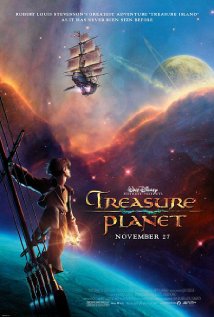
Treasure Planet: Movie Review (Scripted)


Video version of an old post (as I explained about HERE)
For the original post, see:

For the Avclub review I mentioned in the video, see: https://www.avclub.com/treasure-planet-1798198102

I enjoyed this video because it touched on a lot of themes I'm currently encountering in The Lord of the Rings  

FFS Week 1: The Seven Signs of Classical Fantasy!


On the racism question: I'm reading Lord of the Rings now and it strikes me that the Orcs are treated like the Amalekites--that is, killing them all to the last one is framed as an unquestioned good.  I go back and forth on whether this is something I should be bothered by, or whether this is just part of the genre
I've actually expressed concerns about this before.  In my review of The Hobbit, I mentioned
 From Chapter 18 (p.335)
"Then dismay fell on the Goblins and they fled in all directions. But weariness left their enemies with the coming of new hope, and they pursued them closely, and prevented most of them from escaping where they could. They drove many of them into the Running River, and such as fled south or west they hunted into the marshes about the Forest River; and there the greater part of the last fugitives perished, while those that came hardly to the Wood-elves’ realm were there slain, or drawn in to die deep in the trackless dark of Mirkwood. Songs have said that three parts of the goblin warriors of the North perished on that day, and the mountains had peace for many a year."
It's taken for granted throughout the whole book that killing a goblin is always good, but this passage about pursuing into the forest and swamp until they've all been slain reminds me a bit of the Old Testament injunction to hunt down and kill all Amalekites.  
Is this problematic morals, or is this okay because irredeemably evil monsters are just part of the fantasy genre?  I'm on the fence.
And in regards to what Steve said in his video about how the characters' race is usually used in place of characterization, In my review of  The Fellowship of the Ring, I said:
The character development in this book isn't great, is it?  I'm not entirely sure what the difference between Merry and Pippin is.  They seem pretty interchangeable.  I'm not sure if Legolas will get more developed as the series goes on, but he doesn't really seem to have much of a character in this book except as "elf".  Aragorn doesn't really have much of a character.  I mean, right on down the line, none of these characters really have that much of a personality to distinguish them from the rest of the crew.

Oh man, this episode was so good.  There was so much fascinating stuff in here.
It is, for better or for worse, an episode that needs to be listened to careful, because the politics of this whole thing are starting to get really confusing.  I did my normal thing where I listened to this podcast as I was puttering around on my computer and also on my exercise walk.  I think I absorbed most of it.
This episode covers a lot of ground.  (As usual with the episodes in this series, the title really only indicates a fraction of the content.  It is about the end of World War I, but it's also about 100 more things as well.)
I'll make some random observations below:
* The dissolution of the old empires at the end of World War I should almost have been its own episode.  As Mike Duncan says, this is the fulfillment of the Revolutions of 1848.  Since Mike Duncan devoted a whole season of Revolutions Podcast to 1848, I almost feel like he should have devoted a full episode to its fulfillment at the end of World War I.  And yet at the same time, I'm glad he didn't.  The narrative needs to keep moving.

* Interesting that the Treaty of Brest-Litovsk is now dead.  (I had always kind of wondered what had happened to this treaty after the end of World War I, but had never known for sure.)  This humiliating treaty is always emphasized in every history of the Russian Revolution, it had always seemed like such a big deal.  I had never realized it was only ever in effect for 8 months.  Kind of makes you think that all that emphasis is over-blown.

* Interesting also that now that Brest-Litovsk is dead, the Bolsheviks seem intent on re-conquering the Russian Empire.  Mike Duncan adds some nuance here by saying that there is a both an ideological explanation for this and a cynical explanation.
Although, something I remember from my college course on modern Chinese history is that the Chinese were very impressed by the Bolshevik willingness to renounce territory conquered under Tsarist imperialism.  This was something I remember the professor emphasizing in class, and also something I mentioned in my term paper: The Formation of the Chinese Communist Party.  To quote myself: 
It was the Russian Revolution that brought Marxism to the attention of China. Lenin’s twisting of Marx now allowed the theory to be applied to pre-industrial nations, and his writings on imperialism appealed to the Chinese, who were victims of imperialism. More importantly, the Chinese were impressed by the policies of the new Soviet Union (Schwartz 7-8). On July 25, 1919, the Soviet Union formally announced its plan to return the Chinese Eastern Railroad to the Chinese people, as well as giving up any concessions enjoyed by the Czarist government. The Soviets also pledged to help the Chinese in their struggle for freedom. Within less than a month, over thirty important Chinese organizations expressed thanks to the Soviet Union (Houn 16). In contrast, at the same time the Chinese experienced continued exploitation by the rest of the Western powers, most evident at the Paris Peace Conference. This caused many Chinese to become disillusioned with the capitalist powers (Houn 15).

Maybe Mike Duncan will get to this part later?  It looks like this happened in the summer of 1919, and at the moment he's still wrapping up the fall of 1918.

* Also interesting to hear Mike Duncan talk about how Bolshevism had some support among the leaders of the Western countries during this time.  This is not how the story is told in socialist circles.  (We're taught that the Western governments were controlled by the capitalists, who were against the Bolsheviks from day 1.)  But undoubtedly there were a lot of intellectuals who supported the Bolshevik cause in the early days, and I guess I can imagine there might have been some government officials among them.  Reading ahead a little bit, it doesn't look like the Red Scare started until 1919.  This is another thing I hope will get fully covered in future episodes.   (Emma Goldman and Alexander Berkman were deported back to Russia during this time, so I hope that gets covered as well--looking at Mike Duncan's bibliography, it looks like he's planning on covering this.)

* I am super psyched to hear that next week's episode is going to cover the Revolution in Germany.  I had been hoping that Mike Duncan would devote an episode to this.  As Mike Duncan mentions, what was going on in Germany is crucial to understanding what the Bolsheviks were thinking, so its fitting that it will get its own episode.  And besides that, it's just a really - fascinating - story.  Looking forward to next week.

Tuesday, February 01, 2022


Original tag by Tom LA Books: https://youtu.be/dhMwepFp9DQ
I was tagged by Dane Reads: https://youtu.be/8pzBVziBG-A
----------------------
QUESTIONS:
----------------------
1.“I just fell out of bed, found out what key I had dreamed it in… and I played it”, Paul McCartney (about “Yesterday”).  
A book that you dreamed about or that inspired one of your dreams. 

2.“Lucy in the Sky with Diamonds”, John Lennon  
A book that talks about drugs or that was written under the influence of drugs.

3.“We thought we'd be really big in Liverpool”, Ringo Starr.  
A book about someone who had far more success than what they expected, or a book that was much more successful than what the author expected.

4.“Sitting on a cornflake / waiting for the van to come”, John Lennon. 
A surreal book (or a book with some surreal elements) that you enjoyed. 

5. The White Album. 
A book you loved that:  a. has a minimalist cover, or b. is written in a minimalist style. 

6. "Little darling, it’s been a long cold lonely winter / Here comes the sun”, George Harrison.  
A book of poetry that you found uplifting.

7. A day in the life.
An experimental book that’s very uncommon for its content or format, and yet it works well.

8. "Over half of Americans who are 45 and older attribute the Beatles’ split to Yoko Ono".
A book about a woman (or, if you can’t think of one, a man) who is unjustly blamed or accused of something. 

9.“Limitless undying love which shines around me like a million suns / And calls me on and on across the universe “, John Lennon.   
A book that opened your mind and made you think of the universe in a new way, either physically or spiritually.

10. “Mother Mary comes to me, speaking words of wisdom, let it be”, Paul McCartney. 
A book that you found very powerful and moving despite its apparent simplicity.

I tag:
jim's books reading & stuff: https://www.youtube.com/c/jimholroyd

Links to my reviews of some of the books I mentioned: 


The Roots of French Imperialism in Eastern Asia by John F. Cady http://joelswagman.blogspot.com/2011/07/roots-of-french-imperialism-in-eastern.html


I got my information muddled about The Story of Ferdinand.  It was originally written in English by an American author.  See Wikipedia here: https://en.wikipedia.org/wiki/The_Story_of_Ferdinand

My tag playlist HERE:

Monday, January 31, 2022

L. Frank Baum - Little Wizard Stories of Oz [REVIEW/DISCUSSION]


Dane and I are doing this series as a buddy read.  For my own review of Little Wizard Stories of Oz see HERE.
started: The Scarecrow of Oz by L. Frank Baum (from The Complete Stories of Oz)

Tik-Tok of Oz by L. Frank Baum

Started: January 17, 2022
Finished: January 30, 2022

(This review is written using my new format for book reviews.) 

Background Information

Originally published in 1914, this is the 8th canonical book in the Land of Oz series.  (It's actually the 9th book in my collection, but Little Wizard Stories of Oz does not count as a canonical book.)  
The book was based on L. Frank Baum's stage play The Tik-Tok Man of OzThe Tik-Tok Man of Oz, in turn, was based mainly upon Ozma of Oz with elements borrowed from Dorothy and the Wizard in Oz and The Road to Oz.  Which accounts for a lot of repeated plot elements from those previous books.  But more on that below.

Plot Summary

 Plotwise, this book is a bit of a mess. Mari Ness identifies 5 different plots:
* Plot 1: Queen Ann's quest to conquer the land of Oz
* Plot 2: Shaggy Man's quest to rescue his brother
* Plot 3: The scheming machinations of the Nome King
* Plot 4: Betsy Bobbins (the Dorothy substitute) and her quest to find her way home
* Plot 5: The exile of the Rose Princess Ozga
To which I might even further add
* The romance of Files and Ozga
* The vengeance of Tititi-Hoochoo (the great Jinjin)
* Quox the dragon and his quest to redeem himself.

Also, as indicated above, a lot of plot is being recycled from previous books:
* Queen Ann's quest to conquer the land of Oz is reminiscent of Jinjur's quest to conquer Oz from The Marvelous Land of Oz.
* Having an army which consists all of officers, with only one private, is repeated from Ozma of Oz.
* Leading that army to try to conquer the Nome King's Kingdom is also repeated from Ozma of Oz.
* A little girl and an animal getting shipwrecked together in fairyland is repeated from Ozma of Oz.
* Trees that grow lunchboxes on their branches (complete with 3 course meals inside) is from Ozma of Oz
* A land of plants in which the new princess is plucked from the vine is repeated from Dorothy and the Wizard in Oz
* The Shaggy Man using his love magnet to make everyone love him is repeated from The Road to Oz.  Polychrome becoming lost after she fell off the rainbow is also repeated from The Road to Oz.
* Tik-Tok confronting the Nome King is reminiscent of Little Wizard Stories of Oz.

The Reading Experience/ Evaluation

Before beginning this book, I vaguely knew already that it would be based on a stage play and consist of recycled plots.  
I try not to read ahead too much in my Wikipedia research, but in this case, information about Tik-Tok of Oz was leaking into entries about previous books.  For example, the Wikipedia entry for book 3, Ozma of Oz, reads

L. Frank Baum revisited this story for the plot of his 1913 musical The Tik-Tok Man of Oz, starring James C. Morton and Fred Woodward. Aside from Tik-Tok, a princess named Ozma, and a visit to the Nome King's domain, the similarities between the book and the finished play were minimal, allowing Baum to re-adapt the latter as the eighth Oz book, Tik-Tok of Oz, in 1914.

So I had known this was coming.  
Therefore, whenever I encountered repeated plot elements, or continuity problems, I just thought to myself, "I bet this is because this story is being recycled from the stage play."  (And then, after I finished reading, I did - my - research and discovered I had been right.)

The fact that this story is recycling so many plot elements from the previous books takes the edge off of it a little bit.  (For example, I probably would have been more amused at the gag about an army which consists of all officers and one private if not for the fact that it's the exact same gag from Ozma of Oz.)  However the sheer amount of plot stuffed into this little book helps to keep it interesting.  On one hand, it's sloppy writing--L. Frank Baum is juggling more plots than he can handle, and he doesn't drops several off his balls.  But on the other hand, you can't really claim a book like this is boring.  It's got enough moving parts to keep you interested.  "Okay, where are we going with this part?" I was constantly asking myself.  "How is this going to tie back in to the other plots?"  Ordinarily Oz stories are largely plotless--they're just stories about journeying along the road and encountering strange things along the way. So at least this book is different.

What infuriates me, however, is the disregard for continuity, and the disrespect L. Frank Baum seems to hold his readers in.  I mean, I get it--I understand that this book doesn't entirely fit in with Oz continuity because it's based on a stage play.  But, come on L. Frank  Baum, the least you could do is rewrite some parts so that it makes sense.

For example, in this book, the Nome King's name is changed from Roquat (as it had been in the previous books) to Ruggedo.  The reason is that Ruggedo is the name from the stage play.  Now, to L. Frank Baum's credit, he does try to give an in-universe explanation for this.  From Chapter 6:
“That’s very kind of you, ma’am,” said Shaggy. "But unless I can find the underground cavern of Ruggedo, the Metal Monarch, I shall never find poor brother."
(This King was formerly named “Roquat,” but after he drank of the “Waters of Oblivion” he forgot his own name and had to take another.)
Okay, so fair enough.  Roquat did drink the Waters of Oblivion in book 6 The Emerald City of Oz, and completely lost his memory of who he was and everything that had happened to him.  So I guess this works as an explanation for the name change.  
But... then, just a few chapters later, in chapter 14, it's obvious that the Nome King has not forgotten everything.
“Why, they’ve been conquered before, if I remember aright,” answered Kaliko with a grin. “Once I saw you running from a little girl named Dorothy, and her friends, as if you were really afraid.”
“Well, I was afraid, that time,” admitted the Nome King, with a deep sigh, “for Dorothy had a Yellow Hen that laid eggs!”
The King shuddered as he said “eggs,” and Kaliko also shuddered, and so did the Long-Eared Hearer; for eggs are the only things that the nomes greatly dread. The reason for this is that eggs belong on the earth’s surface, where birds and fowl of all sorts live, and there is something about a hen’s egg, especially, that fills a nome with horror. If by chance the inside of an egg touches one of these underground people, he withers up and blows away and that is the end of him—unless he manages quickly to speak a magical word which only a few of the nomes know. Therefore Ruggedo and his followers had very good cause to shudder at the mere mention of eggs.
 Now, I've put up with a lot of continuity errors and retcons over the course of this series, and I've largely forgiven it because L. Frank Baum is making it all up as he goes along and the series is more about imagery than continuity anyway.  But, at what point do I start to feel like my goodwill is being taken advantage of?  I mean, here is a huge continuity problem not just between books (that I could kind of forgive) but within a single book.  Does L. Frank Baum care so little for the reader that he can't bother to smooth out these glaring problems?

I'm going to be continuing through this series (I've committed myself to finishing The Complete Stories of Oz), but my goodwill is rapidly diminishing.  

Despite this, however, there are some moments of humor and imagination which can make this book fun to read.

Links

The Wikipedia article for this book contains some interesting information.  They point out some of the more glaring continuity errors, for one thing: 
The book has several continuity errors with earlier books in the series, particularly The Road to Oz. Whereas Polychrome met the Shaggy Man in that book, this point is neglected by Baum in Tik-Tok. Also, whereas the Shaggy Man merely needs to carry the Love Magnet on his person for it to work in The Road to Oz, in this book it is necessary for him to remove it from his pocket and physically show it to those he wishes to love him.
(There are more errors to be found, but this is a good start).  Wikipedia also states that Tik-Tok of Oz was the first book in which the map of Oz and the surrounding countries was first published.  

Moving on to my next link, I've already mentioned Mari Ness's review, but it's worth reading in full: Falling Though Plots: Tik-Tok of Oz.  From Mari Ness, I picked up more background information, including the fact that the reason this book has Betsy Bobbin and her friend Hank the mule as the protagonists is because the stage rights to Dorothy and Toto were tied up in the other musical.  (As Mari Ness says, "like any characters copied from another source, they lose something in the copying.")

[Sidenote: according to the Oz Fandom wiki, the character of Ozga the Rose Princess was Ozma in the stage play, so this is presumably why the Rose Princess is a said to be a distant cousin of Ozma in the novel.]

Mari Ness also explains why Tik-Tok of Oz has kind of a romance going on between Ozga and Private Files: "for the first time ever in an Oz book, actual hints of a—gasp—romance.  (Based on his own interactions with children, Baum believed that most would be utterly bored by romantic stories, and thus deliberately kept his Oz books romance free. Stage musicals, however, were a completely different thing.  Early 20th century musicals demanded a romantic couple..."

And finally, after dutifully listing out all the many faults of Tik-Tok of Oz, Mari Ness explains why the book still has some charm: "But despite these flaws, Tik-Tok still contains magical moments: the lands of the great Jinjin, where great fairy kings and queens bow down to a Private Citizen; the grumpy yet resigned dragon, defending the delicious smell of brimstone; the laughing Polychrome, the marvelous Metal Forest..."  I'm in agreement here.  These are all great parts of the book.  It's not completely without its charm, despite its frustrations.

Last but not least, I'm doing this series as Buddy Reads with Dane Cobain.  His written review is HERE.
By this point in the series, Baum has set a formula that he sticks to, but the good news is that he’s still able to come up with a few different tweaks that can keep things fresh. It was also good to see some new characters again, but we also got to see a lot of friends, including the titular character.
I also felt as though there were fewer inconsistencies here, something that’s plagued the Oz books since the second one. It’s as though Baum immediately forgot what he wrote in his books as soon as he sent them off to the publisher. There was even quite a clever piece of retconning in which a character’s name changed but it was explained by a previous plot point.

And his video review is here: L. Frank Baum - TikTok of Oz [REVIEW/DISCUSSION]


Extended Quotation

From Chapter 3:
“The Rak!” shouted Private Files, and with a howl of despair the sixteen officers fell to the ground, writhing and moaning in anguish. Queen Ann sat down upon a rock and faced the cloud more bravely, although her heart was beating fast. As for Files, he calmly loaded his gun and stood ready to fight the foe, as a soldier should.
They were now in absolute darkness, for the cloud which covered the sky and the setting sun was black as ink. Then through the gloom appeared two round, glowing balls of red, and Files at once decided these must be the monster’s eyes.
He raised his gun, took aim and fired.
There were several bullets in the gun, all gathered from an excellent bullet-tree in Oogaboo, and they were big and hard. They flew toward the monster and struck it, and with a wild, weird cry the Rak came fluttering down and its huge body fell plump upon the forms of the sixteen officers, who thereupon screamed louder than before.
“Badness me!” moaned the Rak. “See what you’ve done with that dangerous gun of yours!”
“I can’t see,” replied Files, “for the cloud formed by your breath darkens my sight!”
“Don’t tell me it was an accident,” continued the Rak, reproachfully, as it still flapped its wings in a helpless manner. “Don’t claim you didn’t know the gun was loaded, I beg of you!”
“I don’t intend to,” replied Files. “Did the bullets hurt you very badly?”
“One has broken my jaw, so that I can’t open my mouth. You will notice that my voice sounds rather harsh and husky, because I have to talk with my teeth set close together. Another bullet broke my left wing, so that I can’t fly; and still another broke my right leg, so that I can’t walk. It was the most careless shot I ever heard of!”
“Can’t you manage to lift your body off from my commanding officers?” inquired Files. “From their cries I’m afraid your great weight is crushing them.”
“I hope it is,” growled the Rak. “I want to crush them, if possible, for I have a bad disposition. If only I could open my mouth, I’d eat all of you, although my appetite is poorly this warm weather.”
With this the Rak began to roll its immense body sidewise, so as to crush the officers more easily; but in doing this it rolled completely off from them and the entire sixteen scrambled to their feet and made off as fast as they could run.
Private Files could not see them go but he knew from the sound of their voices that they had escaped, so he ceased to worry about them.
“Pardon me if I now bid you good-bye,” he said to the Rak. “The parting is caused by our desire to continue our journey. If you die, do not blame me, for I was obliged to shoot you as a matter of self-protection.”
“I shall not die,” answered the monster, “for I bear a charmed life. But I beg you not to leave me!”
“Why not?” asked Files.
“Because my broken jaw will heal in about an hour, and then I shall be able to eat you. My wing will heal in a day and my leg will heal in a week, when I shall be as well as ever. Having shot me, and so caused me all this annoyance, it is only fair and just that you remain here and allow me to eat you as soon as I can open my jaws.”
“I beg to differ with you,” returned the soldier firmly. "I have made an engagement with Queen Ann of Oogaboo to help her conquer the world, and I cannot break my word for the sake of being eaten by a Rak."
“Oh; that’s different,” said the monster. “If you’ve an engagement, don’t let me detain you.”
(***ENDQUOTE***)

Dane also mentions this quote in his review. (start listening from 3:24 for him recounting the section with the Rak), and when I heard him read it out-loud, I thought to myself, "Yeah, I'd almost forgotten about that, but that is one of the funnier parts of the book."
Although, if I wanted to complain about everything, I could say that like much of this book it is somewhat derivative of an earlier scene from an earlier Oz book--I'm thinking of the scene with the dragonettes in Dorothy and the Wizard in Oz when the dragonettes complain that it is unfair for Dorothy and her friends to leave before they have a chance to eat them.  

So, as I noted above, parts of this book seriously annoyed me.  Other parts of this book I found interesting to read.  So, I think I'm going to split the difference, and give it 4 out of 10 stars.  (That's probably being a little bit too generous, but oh well.)

January 23, 2022 p.776-788

Video Review (Playlist HERE)


Another Steve Donoghue Q&A.  
The whole thing is fun to listen to: Part 1, Part 2, Part 3

My question: Historical rivalries--Who are you more sympathetic to?  Gladstone or Disraeli?  Jefferson or Hamilton?  Edmund Burke or Thomas Paine?

Steve Answers it at 4:03:


It's not much of an answer, but this is all part of the fun of a Steve Donoghue Q&A.  Some questions catch his interest, other questions he just rushes through.  You never know what kind of an answer you're going to get.

For my other forays into Steve Donoghue's Q&As (the ones I've blogged about anyway), see HEREHEREHEREHERE, HERE and HERE.

Sunday, January 30, 2022

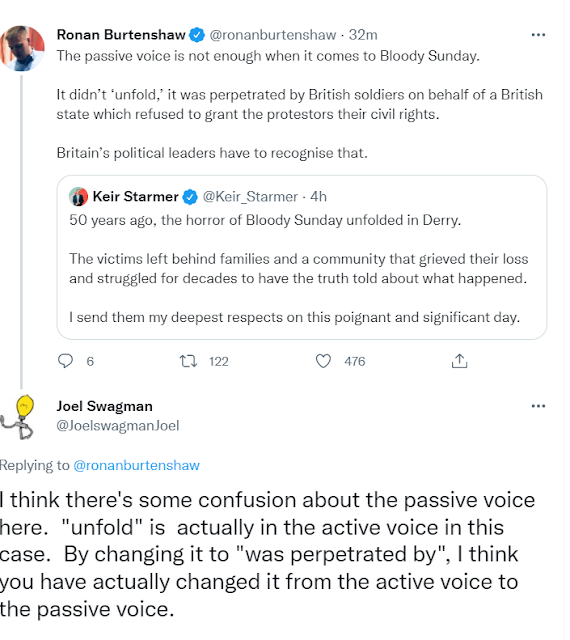
I probably should have left this alone.  But for some reason, I just couldn't help myself.


Finished: Tik-Tok of Oz by L. Frank Baum (I'll try to post a review tomorrow)