Sunday, January 31, 2010

Mie / 三重

(Better Know a City)

[Editors note: Those of you with a quick eye will notice that there is a 6 month time delay between the date this took place (August 31) and the posting of this entry. The past few months I've gotten behind on my blogging as other pressures took over. (It's also fair to say I got a bit burned out on writing these "Better Know a City" posts.) I'll be trying to get caught up on this in the next few days. I've got 3 more of these coming: one additional entry (Nakatsue), and then 2 supplements on cities I've already done (Yufuin, and Nakatsu)]

Monday, August 31, 2009

Crossing into Mie town, the first stop was the tourist rest area (michi no eki in Japanese).


From the rest area is a great view of a valley down below, called "Enaido". I left the car parked for a while and walked down the road to get some pictures of the valley.

The morning was cloudy and even a bit rainy, but I had decided to go out anyway. And fortunately by afternoon everything had cleared up, but you can still see the overcast look in these morning pictures.


I went into the store and asked for some maps of Mie town. They gave me some maps of the whole Bungo-One region. I would have preferred a map just on Mie Town, but apparently since the town mergers they don't make those anymore.

Next I went down to the restaurant.
Since it was still early in the morning, I was the only customer and the staff was in the back chatting to each other.
In this case, the proper thing to do is to yell out in Japanese a loud "Sumimasen!" (Excuse me!). But even after all my years in Japan I had never gotten comfortable with yelling out at strangers. So I just poked my head over the counter and attempted to quietly get there attention.

I must have startled them, because one of them let out a scream, followed by a bit of deep breathing after she tried to recover from the shock I gave her.
I ordered the coffee and vegetable sandwiches (which turned out to be just basically egg salad sandwiches), and then sat down to read my book a bit and study my maps.

After the rest area, I drove down into central Mie.
I was surprised by how big of a downtown area Mie had. Somehow, probably from listening to Mie JETS complaining, I had gotten it into my head that Mie was really out in the middle of nowhere. But by Oita Prefecture standards they really a decent down town. There were several chain restaurants and burger places, shopping stores, and even an internet cafe.

I stopped by Mie's town hall to see if I could find any better town maps (no luck). And I also walked by the Eitopia Ono-which was on my map, but it turned out to be just a local cultural center (and it was closed on Mondays besides). I walked around the river for a bit, and then got back in my car and drove on.


Perhaps Mie's most famous attraction is the Inazumi Cave. (Although on the English signs it's often referred to as Inazumi Grotto. I'm not entirely sure what the difference between a cave and a Grotto is.)

Even once you drive all the way down to Mie, the cave is still another 13 kilometers from the center of town. So you have to drive down a long and windy mountain road before you get to it, which is annoying if your the impatient type.
But one the other hand, this is the kind of place you would want to be remote. The atmosphere would be completely spoiled if it was right off the expressway exit.

The drive is fairly pleasant as well. It follows the river through the mountain valley, and there are several little scenic points to stop at along the way.

The signs indicate that most of these places are popular for viewing fireflies, but the firefly season was now over. (Japanese fireflies seem to be a lot more delicate than their North American counterparts. You can only view them for a couple weeks in the spring, and even then only near water. I'm not sure why there so different than the ones in we have in Michigan, but since everything in Japan is seasonal and only blooms for a short time, the short lifespan of the fireflies somehow seems very Japanese.

I stopped first by Hakusangawakasen Park, which was a small little parking lot by the river.


A little further up the river was another small parking lot by Hakusan Keikoku Valley, where you could view some interesting cliff formations called Hogeiwa, along the Nakatsumuregawa River.


After this I stopped the car one more time (it wasn't an official designated site, but the water just looked pretty cool so I wanted to take a picture.)


And then finally I arrived at Inazumi Cave.

I've had actually been to Inazumi cave before way back in the summer of 2002.
My girlfriend and I were driving down to see Harajiri Waterfall in Ogata town. On the way, she wanted to stop by this cave.

I was really amazed by it.
The concept of a cave to begin with is one that is always fascinating to us Midwestern Americans, who have nothing like this in our hometowns.
But there was a river running through it, and several mini lakes you could see. And I remember being amazed at how perfectly clear the water was, even though it was in a cave.

I tried several times to return to this place. When Brett visited me in Japan, I made an attempt to return to the same cave, but instead we ended up following the map to a completely different cave. And when Amy and I drove through the South of Oita, we also ended up at another cave.

There are apparently several caves in southern Oita. And I never know where I'm going when I drive through the south part of the prefecture, so I managed to end up at a different cave each time. I don't know the southern half of Oita prefecture as well as I know the northern parts.

However, after arriving at this cave, it is unmistakably the same one I was so amazed by 7 years ago.

The ticket to enter the cave was 1,200 yen, which was a bit steep, but it came with a brochure and also access to the ground outside the cave.


In the gardens outside the cave there were an assortment of attractions. Most prominent was the giant statue Buddha. (This thing was pretty huge. You could see it from the road.) There were a series of smaller Buddhas around it.

There were also some geese you could feed. And a couple of small waterfalls.

And, somewhat out of place, was a little museum featuring all sorts of collectibles and other knick-knacks from the Showa Era.

After wandering around the gardens, I set off to the explore the caves.
After going through the entrance, the cave branched out into two parts. The signs indicated that you were supposed to down the left path first, so I followed that.

The floor of the cave had been concreted over in many places to create a smooth path. This got me thinking about how much other human tinkering had been done in this cave. It took the romance off the area a little bit, but in Japan the idea of a pristine natural environment has never had the same importance as in the West.

The roof of the cave was covered with stalactites dripping down water. (Like every other person, I can never remember the difference between stalactite and stalagmites either, but I looked it up online just now. Stalactites are the ones that hang down.)

It was never a downpour, but there was enough dripping to make me worried about my video camera. But absolutely everyone else I saw in this cave also had a video camera out, so I figured it was probably all right.

The cave was very nice and cool. (The signs advertised the fact that it stayed at 16 degrees Celsius all year round.) Which was very pleasant, because although the morning had started out cool and rainy, by the afternoon the air had become very warm and sticky.

There was no circular route, so once I got to the end of one wing, I had to retrace my steps all the way back to the beginning before checking out the second wing.

The second wing was filled with underground lakes and rivers. At times the path was a grating below which the water flowed.
The water was amazingly crystal clear. And sometimes it was even populated by small fish.
It was dark in the cave of course, but they had done a good job of illuminating the water with natural lights.

Unfortunately, my rather primitive camera and video were not up to the task of photographing the cave. I couldn't get either of them to really focus in the dark, and my pictures and video reflect that.

Somewhere I'm sure someone has got some professional quality photos posted of this cave, but for my post you'll just have to make do with what you see here.


After I had gone back and forth and thoroughly explored Inazumi cave, I got back in my car and continued on to see what else was down the road.

I drove down for a while, but when the road started to get a little bit sketchy I turned around and headed back.
I was later to regret doing this, because I later saw a map that indicated if I had kept going I would have seen some waterfalls a little further on. But I had no way of knowing this at the time, and there were no detailed pocket maps of Mie town to be found.

So, I headed back.

I drove back down the same road along the same Nakatsumuregawa River, but I saw a lot more people out swimming on the way back. Now that the day had turned into a hot sticky afternoon, I guess everyone was out enjoying the pool.

I even saw what looked to be a man skinny dipping in one part of the river. I can't be sure because I drove by quickly, but it certainly seemed that way.

I stopped the car at one point to check out a little swimming hole I had missed the first time.
As you often see in the countryside, a concrete box had been around a little section of the river to create a safe swimming area for kids.
A bit further down the river was a more natural pool, a deep area between a set of rocks. There were a bunch of junior high school boys jumping into the river from the rocks.
It was hot and sticky, and I was tempted to go for a swim with them, but in the end I decided my presence there might spoil it for them. And since today was the last day of summer vacation, I decided to just let them have their fun. So I walked around, took a couple pictures, and moved on.


Once I got back to the main road, I followed the 502 out west to see what I could find, but didn't find anything until the town boarder. Then I turned back and followed the 326 down south to see where that would go.

I past a couple temples by the side of the road. And there was a huge doll statue on one of the mountains that I drove past, but I didn't see any parking for it, so I just kept driving.

I went across a bridge, and then stopped the car at the parking lot afterwards. There was a map, and I tried to figure out what to see next.

As long as the car was stopped, I walked back across the bridge to get another picture.


I decided to follow the signs out to see the Mikuni mountain pass, just because it was indicated as a destination by the signs. I didn't really know what it was, and I was hoping that it wouldn't involve too much hiking on this August day.

I got back in the car and started driving out towards it, but sound found myself winding up a narrow mountain road. I was worried I would spend a lot of time driving through these narrow mountain roads, and then there would be nothing at the end of it. (That's what usually happens out here in the countryside).
Then the road was blocked by a fallen tree, and I decided that this was my sign that I wasn't meant to go to Mikuni mountain pass anyway. I turned around and headed back.

I went back down the same road. This time I decided I wanted to stop and see what that big doll statue was supposed to be.
I still didn't see any parking lots, so when there was a bit of shoulder on the road I just pulled over and stopped the car there, and then walked all the way down.

The road itself was raised up on pillars at points as it connected between the two mountains. Walking down it you could get a good view of the valley down below, and I tried to take some photos.
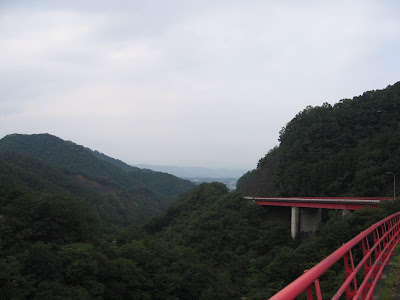


Eventually I got to where I could see the side of the big doll statue. I wanted to get a photo from the front, so I spent another 15 minutes or so walking along the road until I got a good view of the front of the statue.


From here there was a side road going down into the valley, so I went down to explore it more.


There was a temple and park down below. And it looked like at one point this had been a major tourist attraction for the area, but now it was mostly abandoned. The huge parking lot was completely empty, and many of the buildings were closed down.


You could still go into one of the temples, and view several rows of Buddhas.


After this, I hiked back up onto the main road and began the long walk to the car.

Altogether, including walking back and forth from my car, this little stop had taken over an hour, and it was heading onto evening already.

On the way back, I made one more stop at a temple, because it was indicated as a sight of attraction. Behind the temple there was a little garden, including a hill you could climb up and get a bit of a view.


There was also a bit of a cemetary there, including grave stones marked for beloved pets, which I've never seen at a Japanese temple before.


I was feeling pretty tired at this point, so even though the daylight was fading fast I decided to stop in the local Joyfull to get something to eat and recharge my batteries. Before going into the Joyfull, I stopped briefly to video tape the down town area.


By the time I left the Joyfull, the light was fading fast. There were a few more things left I hoped to see, so I tried to make fast work of it.

I swung by an old stone bridge indicated on the tourist maps, and took some pictures of it.


Next, I followed the signs up to see some stone Buddhas.
There was a brief hike up the mountain, so I grabbed one of the free walking sticks and started out.

The path was roped off at one point, with a sign saying danger, but as there was nobody around to enforce this I decided to just step over the rope.
The danger turned out to be a fallen tree in the path, which I was able to step around very easily. Although it turned out that the stone steps would have taken me up to the top of the hill anyway, so my stepping into the forbidden area had been completely unnecessary.

It was now just that twilight hour where you can still see everything perfectly, but where taking pictures becomes a bit of an issue. And so it was here with me. I was able to take a picture using the flash, but it doesn't show up very well.


I tried to squeeze one last stop in before leaving-some sort of big rock with letters written on it. By this time, however, it really was dark, and I couldn't get the camera to focus at all.


With that, the day had come to an end, and I left Mie to head back home.

Mie Links:
Inazumi suichu Limestone Cave,
Spring Paths of Bungo (includes bit on Inazumi Limestone Underwater Cave),

Link of the Day
Noam Chomsky On Corporate Propaganda

Friday, January 29, 2010

Chicago 10

(Movie Review)

This is another movie I've been wanting to see for a while, but had to wait until I was back in America. (Unfortunately it never made it to the Japanese video stores).

And, although one always hesitates to admit publicly how much of a geek one really is, I am well acquainted with subject material.

Being a history geek, and having an interest in radical politics, I've read a lot about this trial. In fact, back in my college days the Calvin library had (presumably still has)a book containing the entire transcripts of this trail, and I read through most of it.

I've also seen dramatic presentations of this trail in the past. Which is no surprise as this trial has been dramatized many times in the past, and I'm sure will be dramatized many times in the future.
Once I sat through a TV movie based off of the trial transcripts. (Again this was back in my college days). Although I couldn't tell you now who made it, or what it was called, I remember finding it very interesting at the time.
"Steal This Movie!" (W) also comes to mind as another film that dealt with this subject.
And various other documentaries I've caught on TV or on video over the years.

I guess all this raises the question: why sit through it again?
To which I don't really have a good answer, other than that I love watching historical documentaries, and often this love will cause me to sit through material I'm already familiar with.
Also, it's always interesting to see how a new movie handles familiar material.

So, right, onto the review.

As you probably already know, much of this movie is animated.
That struck me as an odd choice when I saw the previews, but now that I've watched the movie I can understand why they did that. It allows them to mix in re-created animated scenes with archival footage relatively seamlessly, and still keep the same look for each figure.
In this respect the film is much more of a documentary than anything else. The court room scenes are all re-created, but half the movie (or more) is made up of archival footage.

Making use of the archival footage, the film seeks to document both the trial and demonstrations at the Chicago Democratic National Convention that resulted in the conspiracy trial.

In doing so, the film bites off a bit more than it can properly chew.
Most documentaries will focus on either the demonstrations or the trial. For example, the TV movie I remember seeing back in college focused all 2 hours only on what actually happened inside the courtroom.

Certainly one can understand the impulse to try and put them together (the story of one is not really complete without the story of the other). But in this case the result is that neither one is dealt with adequately. And there are all sorts of gaps in the narrative.

Well, perhaps at this point I should remind myself that the purpose of historical movies is to introduce people to the topic, and try to get them interested in it so they can continue learning on their own. It's impossible to fit everything into 2 hours anyway.

That being said, here are some of the gaps I noticed in the film:
The entire film revolves around protesting the Vietnam War, and yet the film never includes any of the reasons why people would be against the War.
When the war was actually going on, the consciousness about what was actually happening was pretty high. In the years since, younger generations have been raised on a sort of white washed version of Vietnam, which omits a lot of the uglier details like the the carpet bombings of civilian populations, children being burned with Napalm, villages being massacred, et cetera.
To get into all of that would have been a subject too vast for a 2 hour film, but they might have at least touched on it. Given it, say 5 or 10 minutes. Without this background, it's a little hard to understand why emotions were running so high in the first place.
Instead the war itself becomes almost a side issue, and the movie becomes a commentary only on the freedom to protest. (Which I guess is still a noble enough theme in and of itself)

Another noticeable gap is that the film never explains the significance of any of the players. Most of the members of the Chicago 8 were already celebrities in their own right before the trial even started. If the purpose of this film is to introduce a new generation to history, some of this might have been touched on.

The courtroom trial scenes themselves contain many omissions. Again, it's impossible to do everything in 2 hours, but I thought the testimony of Mayor Richard Daley at least would have been worth including.

With all the stuff they cut out, I'm a little bit confused about some of the stuff they left in. It sometimes seemed a bit random.
As did the ending of this movie. It just ended very abruptly.
Anyone interested in getting the full story of the trial would do well to read a book, or check out the actual transcripts (link here).
If you click on the link, you'll notice first of all that the witness list for the trial reads like a "who's who" of the 60s. All sorts of celebrities showed up to testify. (Something not really included in the movie).
And if you read the actual transcripts of some of these witnesses, you see a whole lot of interesting dialogue and disruptions also not included in the movie.

All that being said, not a bad little movie. Some parts of it were very well cut together, and generally they did a good job of keeping the energy up with a high adrenaline soundtrack. Hopefully this high energy will catch the interest of younger people, and make history seem more exciting to them.

Final comment: When a film like this gets an "R" rating, it really does make you wonder if the MPAA rating system is broken. Especially with all the really violent PG-13 movies out there ("Die Hard" comes to mind).
Seriously, if "Die Hard" gets PG-13, but a movie about people peacefully protesting against a war gets rated R because of a few 4 letter words, what does that say about our culture?

I'm not sure if any one still pays attention to these rating systems or not, but I can only hope that no one was stopped from seeing this movie because of a bonehead move by the MPAA.

Link of the Day
Noam Chomsky on the Role of the Educational System

Chicago 10: Movie Review (Scripted)

Friday, January 22, 2010

Pan's Labyrinth

(Movie Review)

This is a movie that's been on my list for sometime. It's been highly recommended to me by just about everyone I know. And I also enjoyed "Hellboy" and "Hellboy 2" by the same director.

I waited to see this movie, because I wanted to watch it on a DVD that had English subtitles. All the DVDs in Japan only had Japanese subtitles, making it hard to watch foreign films.

Not that I couldn't have struggled through. I've watched foreign films like "Black Book" or "Sophie Scholl: The Final Days" in Japanese. But I wouldn't have enjoyed it as much. So I waited until I was back in the US to see this one.

(Sorry, I know my linguistic difficulties in watching these films is of interest to no one but myself. Onto the review).

Like I said, this film has been highly praised by just about everyone I know, including friends much smarter than me whose opinions I greatly respect. Bork, for instance, recommended this film to me. And I understand Phil thinks highly enough of it that he even shows it to his Freshman English class.
Not to mention all the professional movie critics who have lavishly praised this film.

So there's not a lot for me to add here. It is a great film. The fantasy parts of it are beautifully done, and draw you completely into the fairy-tale world.

The historical parts of it are also very well done. As a history geek, the Spanish Civil War is an area - of - interest - to - me. But actually this film takes place in 1944, after the Civil War is over, and the Spanish Maquis is left fighting the fascist forces.

I knew nothing about the Spanish Maquis before seeing this film, but after watching the film my interest was sparked and afterwards I spent some time reading up on them via wikipedia (article here) and some other interenet sources.
And that's really what a good historical movie should do. They can't teach you a lot in 2 hours, but they can excite your interest and cause you to want to learn more on your own.

Finally, this film is quite powerful emotionally without ever resorting to sappiness.
A common complaint I have against a lot of Hollywood movies is that they work too hard to try and manipulate my emotions, but in this case everything comes naturally from the story.

So, yeah, it's a great film, just like everyone told me it would be. Not a lot to add here.

....Well, alright, if you want to get greedy, I guess you could lament that the story doesn't do more.
The idea of mixing in fantasy elements into a historical narrative is genius. (I'm sure there's a technical literary type word for this type of genre, but I don't know what it is.)
However, both stories in and of themselves are pretty thin. I'm not sure if the historical part of the movie is meant as a padding for the fantasy section, or the fantasy part is meant to pad out the historical sections. But there were times I wished the story had more meat to it.
The fantasy elements had a lot of great visuals, but the actual story was lacking.

I know it's easier to criticize than to create. Especially when you're juggling two difficult genres, I'm sure it's difficult to strike the right balance. But if I was going to be greedy, this is what I would ask for.

Link of the Day
Noam Chomsky on the United States Healthcare System

Pan's Labyrinth: Movie Review (Scripted)

Friday, January 15, 2010

Inglourious Basterds

(Movie Reviews)

I once had an English professor at Calvin who was always complaining about violence in movies. He would go off for rants about the subject in the middle of his lectures, and was one of those people who was convinced that most of society's problems could be traced back to Hollywood's influence.

You can imagine how surprised I was when I found out he was a big fan of "Pulp Fiction."

"I once saw a movie," he said to the class, "that I almost walked out of. I thought it was violent, I thought it was crude, I thought it was tasteless. And then, halfway through I realized it was a satire. And I had a great time after that."

This raises the question: when reviewing a Tarantino movie, how much of the subject material is Tarantino morally responsible for, and how much of this can be written off as just a satire/ homage to other movies?

For example there is a lot of stuff in this movie that should give us pause. It takes one of the greatest atrocities in human history, and exploits it to tell a trashy fiction story.
It also has a strong revenge theme, and (like a lot of Tarantino's work) features more than a little bit of sadism.

But then again, this material doesn't necessarily represent Tarantino's own views. This is his homage to all the Nazi-exploitation films that have come before him.
He's the dedicated scholar of pop culture and pulp fiction, and he knows that over the past 70 years, few subjects have been exploited more than Nazi Germany and World War II movies. In retrospect, it was just a matter of time until he worked his way around to it.

In particular I noticed that the ending climax was drawn straight from "The Dirty Dozen" (a film which was itself accused of sadism back in its time). And so while the casual sadism of the movie repulsed me a little, I've decided to write it off as Tarantino responding to the culture, and not creating it.

With that elephant out of the way, let's get into the entertainment value of the film.

I rented this film with my brother-in-law, and on the drive back home we discussed our views on Tarantino: which of his movies we liked, and which of his movies we didn't like.

"You know," I said, "Some of his movies on repeated viewing I've decided aren't all that great. But the first time watching any of his films I'm always on the edge of my seat the whole time, because you feel like he's crazy enough to do anything. So you never know what's going to happen next, and that makes the whole movie really suspenseful."

I suspect this is true for most people.

And Tarantino has apparently realized he has this power. He takes advantage of it by mercilessly drawing out every scene, knowing he has the power to do this and still keep you on the edge of your seats. And so, as in every Tarantino movie, the conversation lingers. It wanders. It goes off on unrelated tangents. It does anything but get to the point. And yet you watch it fascinated.

He does, however, somewhat overplay his hand in this movie. The long drawn out scenes that are so fascinating at the beginning of the movie start to wear on you towards the end. Halfway through my brother-in-law and I both agreed that, although we didn't know where the movie was going, we both thought it should get there soon.
The opening scenes of this movie are brilliant, but in my humble opinion, it would have been better if this movie had started to gradually gain momentum throughout, so that each scene was a little faster paced than the last.

As it is, the key to sitting through this movie is to just know ahead of time that it's extremely slow paced, and try and go into it with the appropriate level of patience. (As with "Jackie Brown".)

But say what you want about Tarantino, the good thing about his movies is that they are always something fresh and different.
If you waste too much of your life watching movies (as I do), you're probably sick of the same old-same old formulaic Hollywood and plot structure. There's none of that here, and as a result the movie felt fresh and new. I'm not sure I'd want to re-watch it again anytime soon, but I can't remember the last time I enjoyed a new movie as much as I enjoyed this one.

Perhaps Tarantino's exalted reputation for genius is simply an over-reaction based on the delight people get from something new and different.
(No, actually on second thought it can't be that simple. If that were true, than all the Tarantino imitators in the late 90s would have been just as successful as he was).

While on the subject of Tarantino, my past related posts: Kill Bill, Kill Bill update, and Kill Bill 2.

Link of the Day
Anarchism 101 with Noam Chomsky

Inglourious Basterds: Movie Review (Scripted)

Friday, January 08, 2010

Captain Sir Richard Francis Burton by Edward Rice

(Book Review)

A couple summers ago, not long after I wrote my blog post on "Riverworld", I was out grabbing a bite to eat with the Bear, and we got onto the subject again. "Look, I know everyone gives me a hard time about those books," he said. "But I defend them on these lines: if it wasn't for 'The Riverworld' series, I would never have found out who Richard Burton was. And Richard Burton was one cool cat."

I had never heard of Richard Burton, and admitted such. Where upon the Bear launched into all the cool things Richard Burton had done. "He was absolutely amazing. He was an explorer and secret agent. He was one of the first Westerners to enter Mecca and write about it. He helped to discover the source of the Nile River..." Et cetera.

So, last summer when I was at the Oita International Center, I found this book in their library. And of course I was immediately reminded of what the Bear had told me. And I thought: Yeah, might as well check it out. He sounded like an interesting guy from what the Bear said. And besides, it fits into my reading project on 19th Century European history (kind of. Even though Burton spent most of his life away from Europe, he was always connected with the British Empire and it's Imperial ambitions.)

Now again, I had never even heard of Richard Burton until the Bear mentioned him to me. But as I read this book and learned about his impact on history and literature, I started to wonder why I hadn't heard of him before. He's one of those names that you've never heard of before, but you probably should have.

For example, Richard Burton was one of the main people responsible for introducing the West to such Eastern classics as "Arabian Nights" and "Kama Sutra". He is also responsible for words like ESP and safari.

The scope of his life is pretty amazing. Doing some internet research on the guy, it seems everyone who writes anything about Burton invariably has to say, "It's so amazing how much adventure and travelling he crammed into his life." In fact I feel like it's a cliche to even mention it, but what review would be complete without running down briefly through his exotic adventures.

After a childhood spent wandering around Europe, Burton wet out to join the British army in India, where he learned the languages and culture, and participated in the various Indian and Afghan wars. He converted to Islam and made a pilgrimage to Mecca. He went on two expeditions to seek the source of the Nile river. He travelled America and wrote about the Mormons and the American West. He participated in the Crimean War. He was a British consular in Brazil, in Fernando Po, in Damascus, and in Trieste.

Before I started this book, I wondered if I might feel an affinity with Burton. (After all, I was exploring my little area of Japan with my "Better Know a City" Project). But in fact it was almost a bit depressing for me to realize how many languages Burton had mastered, and how many adventures he had had, before he even reached 25. But I suppose it's always bad to compare yourself with an historical figure.

Because Burton's story touches so many areas of the globe, as you read about his life you get to learn a lot about the history and culture of many different areas. For example you get to learn a bit about the history of the Crimean War when Burton participates in that. You also learn about what 19th century Palestine was like when Burton is the Consular in Damascus. When Burton goes to Brazil, you learn about the war between Brazil and Paraguay (W). (I had never heard of this war before, but it sounds pretty horrific. Paraguay lost 80 percent of its population during the war).
The search for the source of the Nile River also takes up a large portion of this book, and it was also very fascinating. I never thought before of how difficult it was to track down and locate the source. (It doesn't seem like it would be that difficult. You just follow the river upstream. And yet this book documents all the trouble the Burton and his friends had finding it.) I also found the description of Lake Victoria in Africa, one of the world's largest freshwater lakes, and its discovery fascinating.

It's both a good and bad thing. All of this was really interesting, but sometimes I felt like I was getting bombarded with information as I chugged my way through this book. Burton travels to so many places, and has so many interests, that sometimes I felt like I was swimming in information about Indian snake cults, Islamic mysticism, Afghanistan warlords, and others, when all I really wanted was for the story to get moving again.

When the narrative does eventually pick up again, what makes Burton's story more interesting is that he was connected to the geo-politics of the time. This isn't just a story about a loner hacking his way through the jungle, but on many of his missions Burton was working as an agent for the British government. The author Edward Rice writes a lot about "the great game" in which Britain and Russia vied for control of the middle east, and secret agents from both countries wandered the region supporting friendly governments or trying to upset rival ones.

Which brings me to one last sidenote.
This book was published in 1990. Since that time, recent events have increased the relevance of some of its subjects.
For example, the feud between Sunni and Shi'a Muslims. Also the waring factions in Afghanistan, and the British attempt to control them.
For this reason the book has a lot more relevance now, and is worth picking up to get some historical perspective. Neither of these subjects are the main focus of the book, but they're both important parts of the story, and intersect with Burton's life.

Link of the Day
Noam Chomsky: Solutions for Central America

Captain Sir Richard Francis Burton by Edward Rice: Book Review (Scripted)

Friday, January 01, 2010

Me Talk Pretty One Day by David Sedaris

(Book Review)

I'm currently getting ready for a course in "Applied Linguistics" I hope to do next year. And I've been thinking of what I can read up on to prepare.

The field of linguistics intimidates me a little bit, so I was trying to develop a reading list that would slowly ease me into it as painlessly as possible.
I remembered my sister talking about this book a year or so ago at the family dinner table. She described David Sedaris humorous struggles with his speech impediment as a child, and as an adult his struggles to learn the French language.
Her description of it sounded pretty interesting, and the themes of the book sounded like they were related to language acquisition. So I decided to put this at the beginning of my reading list.

My co-worker, who is also preparing to enter a similar program, and I had a conversation about what we were doing to prepare for the course, and when I mentioned I was planning on reading this book, he didn't understand. "You should be reading textbooks on applied linguistics," he said. "That book's not going to help you at all."

I tried to explain that the idea was to ease myself into it, but he still thought I was nuts.

And in truth, after reading this book I can safely say he was right. None of it was really of any value. But it was a very pleasant read nonetheless, so I'm not complaining.

The book is 272 pages long. Of this, only about 10 pages or so are related to studying a foreign language. The rest are just humorous essays on a variety of topics.

Apparently each of the chapters in this book was originally published as a seperate magazine story, and then later compiled into one book. And it reads like the hodge podge that it is. The jumps between chapters are a bit jarring.

Although David Sedaris has a reputation as a great humorist, I've got to say I found some of these chapters were just so-so. Some of them are better than others however. When he's on, he's really on. But much of the book is filler. It's not quite laugh out loud funny, but more mildly amusing.

However what saves the book is that even when Sedaris isn't quite hitting all the laugh marks, he never gets boring. You get drawn into all his stories, and find yourself smiling a little bit at the bizarreness which is just everyday life. When he describes all the wackiness of his family, you think to yourself, "Hmmm, I guess every family has its quirks."
When he describes his career as a drugged out want to be artist, you think, "Hey, he's even more screwed up than I am."
When he describes all the menial jobs he's worked over the years, and all the humiliations they entailed, you think to yourself, "glad I'm not the only one."

It is for this reason that, in my opinion, the book loses a lot when you find out many of these stories aren't entirely truthful. I first heard about this through Whisky Prajer's blog a couple years back (link here). He in turn links to the Slate article about the controversy (link here)which was inspired by Alex Heard's article in the New Republic (link here).

All of these links touch on the question of how much leverage a humorist should be allowed. It's something I go back and forth on to be honest, and it's probably not a question that can be definitively answered. I'll just say that for me, the stories in this book were interesting in direct proportion to how much I believed they were based on reality. Some authors can tell you stories you know are complete fantasy (Terry Pratchett comes to mind) and still get you to laugh. David Sedaris's stories, on the other hand, seem to lose a lot if you find out they're mostly imagined.

Anyway, leaving that aside and moving onto other parts of the book...

The second half of the book was written while Sedaris was in France, and is mostly about his observations of French life, cultural clashes, and his struggles to learn the French language.

As someone who has spent a lot of time in a foreign country, I could identify with some of it.

For example, like Sedaris I also enrolled in a language school with other international students (in my case they were mostly Chinese and other Asian students). And like the school mentioned in Sedaris's book, we all communicated to each other through a language that was native to none of us (Japanese in our case, instead of French). And like Sedaris, I felt slightly out of place because I was a lot older than the other students. (He was 40, attending a class filled with 18 and 19 year olds. I wasn't quite that old, but I was 30 when I was attending a class filled mostly with people 10 years younger than me.)

And even though none of my teachers were as terrible as his was (assuming his description wasn't another exaggeration) I can also attest to the overwhelming sense of accomplishment you feel when you realize you are understanding perfectly everything the teacher says, even if your language skills aren't good enough to reply to it yet.

(I could go on listing little things in his book I identified with, but you get the point. And perhaps I'm bordering on arrogance a little here, as if David Sedaris and I are the only ones who ever had an overseas experience. In this day and age probably most middle class Americans have either studied or taught abroad at one point in their lives So perhaps most of us have our own points of identification with the language and cultural struggles he describes.)

I also enjoyed Sedaris's description of American exceptionalism, and why it sometimes fails to impress other countries. "Every day we're told that we live in the greatest country on earth. And it's always stated as an undeniable fact: Leos are born between July 23 and August 22, fitted queen-size sheets measure sixty by eighty inches, and America is the greatest country on earth. Having grown up with this in our ears, it's startling to realize that other countries have nationalistic slogans of their own, none of which are 'We're number two!'" (from page 157).

...As I mentioned before, this book touches a wide variety of topics, so it's difficult to summarize everything. I'll just close on one more little tidbit of information I found interesting. I found out from this book that the song "I'd Like to Teach the World to Sing (In Perfect Harmony)", which I remember as a classic from my childhood, and which I always thought was an established American folk song, started life as a Coca-Cola jingle in the 1970s--(wikipedia article here). Well, you learn something new everyday I guess.

Link of the Day
Chomsky on HARDtalk, Nov. 09

Me Talk Pretty One Day by David Sedaris: Book Review (Scripted)

Friday, December 25, 2009

The True Meaning of Christmas

You know, with all the commercialism of the holidays, sometimes I fear that the true meaning of Christmas gets forgotten. So it's good to take time out from our busy holiday season, and remember why we celebrate on Christmas day.

So gather around children, and I'll tell you the story of the very first Christmas.
You see kids, even after Christianity was declared the official religion of the Roman Empire, people still wanted to celebrate the pagan holidays around the Winter Solstice. And can you blame them? It was just too much fun. The gift-giving, the tree decorating, the festivals of lights, and the coming together of families for the holiday season.

Since the Church wasn't successful at entirely banning these activities, they decided to co-opt them by creating a Christian holiday at the same time. And so, on December 25th each year, the Church decided to celebrate the birth of Jesus Christ. Even though nobody really knew the exact date that Christ was born. And even though birthday celebrations were not a part of Christian or Jewish cultures at the time.

And so, Christmas was created. And it took all the best parts of all the other winter festivals. For example, gift giving was taken from the Roman holiday Saturnalia. The green colors and lights come from the Roman New Year. The Christmas tree and Yule log both come from Druid celebrations in the Winter Solstice, and pre-date Christmas by centuries.

Centuries later, the Christians then decided to become really thin skinned about this holiday. They would complain whenever shops didn't say, "Merry Christmas" loudly enough, and they decided that this time of year it was their right to shove their religion down everyone's throats, because they thought they had created the whole idea of a winter festival.

So please, as we all become busy in the holiday hustle and bustle, take some time out of your day to remember the true meaning of Christmas, and the reason for the season. And don't worry. Although it appears that the days may be getting shorter and shorter, with enough lights and greenery I'm sure we can propitiate the sun god.

*********************************************

If I was ever going to write a children's book explaining the meaning of Christmas, I imagine it would go something like that.

If this sounds a bit cranky, then maybe I've been paying too much attention to the religious right commentators this month (I've been able to track them through the magic of the internet). And I saw one too many comments on Facebook asking everyone not to forget the real reason we celebrate Christmas.

Although I often blog about how much I hate Christmas, I guess I don't really hate it all that much per se. The time spent with family is something I enjoy, and something I really miss over here in Japan.

In fact, as the history indicates, perhaps every culture does need some sort of Winter festival to get us through the dark cold days. In Japan, for example, the main winter celebration is New Year's, which takes on all the significance here that Christmas does in the West.

But man, what really burns my buttons is the cultural war aspect of the holiday season (as I've blogged about before). This is the time of year when certain people feel that not quite enough attention has been paid to their particular brand of religion, and they get really whiny and touchy about it.

You know, even growing up in the church, I always thought that Christmas was kind of a cruel bait and switch. They bait you by getting you really excited about the decorations, the food, the presents, the school holidays, and cookies, et cetera. And then you get dragged into Church, where you're told you should feel guilty because you've been focusing too much on these things, and you haven't been thinking about "the true meaning of Christmas."
So, wanting to be a good little kid, you try and direct your thoughts in the appropriate direction, and meditate on the Christmas story and the little baby in the manger. But then the following Sunday, you are reminded that you haven't been focusing enough on "the true meaning of Christmas". So you try even harder to focus on the story of the baby in the manger. But then the following advent Sunday...
Well, you get the idea. How much is it possible to focus on this one story throughout the whole month? I mean, what do they expect from these little kids. We get it already, we're focusing on Jesus's birth, lay off a little bit.

Well, what would religion be without some guilt over not being quite pious enough.
But this is all within the Church. When the Church goes on the attack against secularists, that's when it really gets ugly.
And that's when it becomes part of the culture wars to even try and acknowledge in public that not everyone who celebrates Christmas is a Christian, or that other faiths have different holidays during this season.

Since I waited until Christmas day to post this, I guess I missed the entire Christmas season. But keep it in the back of your mind for next year. When someone tells you to remember the true meaning of Christmas, feel free to give them a little history lesson.

Link of the Day
Class War Driving People From Defiance to Compliance

Friday, December 18, 2009

Religulous

(Movie Review)

This is one of those movies I knew I had to see eventually. It was recommended to me by a number of people, and it seems to always pop up in any bar-room discussion about religion. (Bork also wrote a few words about it on his blog--link here).

It has not, as of yet, hit the video stores in Japan. Possibly it never will. But I was feeling in a movie watching mood the other day, so I did what you always do when you can't find a movie in the video store--I watched a copy on-line. Full movie is available here on youtube--at least at the time of this linking.

As always, when reviewing a movie like this that everyone else has already seen and written about, I'm not going to find much new to say here. But for what it's worth, here is my own personal reaction.
I like Bill Maher. I don't always agree with him 100% of the time (he has some libertarian leanings which tweak my leftist sensibilities), but I agree with him most of the time. And I think he possesses that rare combination of being funny, witty, and intelligent. Although I've been removed from American TV for most of the past 10 years, Maher is somebody I've followed through the internet and youtube.

Therefore, one has high expectations for a movie which matches Maher's humor and wit to a juicy philosophical topic like religion. Sit back, pour out the lattes, and let the pondering begin.

However, instead of a well structured discussion, the movie's structure seems to throw everything at the wall, and see what sticks.

A quick five minutes over here to laugh at some rednecks in a rural church, another 2 minutes over here to laugh at the guy who believes Jonah actually survived inside the whale, 2 minutes to laugh at Scientology, a quick few jabs at the Mormons, over to the orthodox Jew, the Cannabis Ministry in Amsterdam, et cetera.

The movie's focus might have been improved if Maher had limited himself to one of these topics. The obvious choice would be the dominant form of of religion in America: mainstream Protestantism. Of course then the Christians would have whined about how he was picking on them, but those people are never happy. (Having grown up in protestant circles, I'm well aware of the fact that these people have a big persecution complex, despite the fact that they represent the dominant philosophy in American culture.)

The problem with criticizing religion in broad strokes (as I mentioned in my review of Dawkin's book) is that religion in all it's various forms is too much of a moving target. You can go over and have a few laughs about the die hard creationists, but that ignores all the more moderate Christians who believe in evolution.
Christopher Hitchens (if you watch his various videos on line, as I do) will occasionally mention this in the talks he gives. "After debating several Christians about my book, I realize I should really have written a different book for every single religious person out there, because no two of them seem to believe exactly the same thing." (Paraphrasing-but something close to that).

However perhaps here is where the title of this movie comes into play. Dawkins and Hitchens are both hard core atheists who scoff at any faith of any kind. Maher is more of an agnostic, who goes after organized religion.

Human beings are essentially rational creatures, and if left to themselves they will look for ways to make their own religion as rational as possible. Thus the various moderate intellectuals within each particular faith can occasionally make some degree of sense.
But if you look at any organized structural institution of religion, you can find plenty that is ridiculous. Organized religion is filled with people who claim to speak for God, and tell you that they know with certainty what God wants and doesn't want. Any organized system of religion which seeks to recruit other people into a belief in something inherently irrational is ridiculous.
Faith in a God may not be so crazy, but when institutions extrapolate this to believe that they alone have insight into the mind of God, and have the power to create rules on every aspect of human behavior and sexuality, and then try and press these rules on everyone else, then you have a subject ripe for satire.

So if it seems that Maher is just going after the low hanging fruit by laughing at the fundamentalists, that's what I would say in his defense.

Most of the movie is not so much a well built argument as just Maher laughing at religious people. But with a subject like religious fundamentalism, perhaps the only thing left to do is just to hold it up to ridicule and laugh at it. It's not like you're going to have a logical discussion with these people based on rational thought and the scientific evidence.

Still, one can't help wishing the film had more to offer. As entertaining as it was to see Bill Maher travel the world to laugh at what people believed, it wasn't enough material to justify a full length film. That, and I'm not sure Maher brought in anything new or noteworthy to the discussion. He's hardly the first comedian to attack religious dogma, and he doesn't have a lot of groundbreaking material. Lots of times he will simply listen to what someone believes and then respond with, "Oh come on, you don't really believe that do you?" And then he'll chuckle a bit, and we cut to the next scene. Admittedly, this simple laughing at religion does a lot to deflate it, or highlight the ridiculousness of it, but the audience has a right to expect more.

This film will no doubt tweak the noses of a lot of religious people, and give them something new to complain about, but it doesn't make you think about anything you haven't thought about before.

One wishes he would have narrowed his focus, or squared off against someone capable of going toe to toe with him and forcing him to expand his arguments--because if you watch his show, he's a smart guy. But he almost needs someone to challenge him to bring out all his wit to the fullest potential.
I also suspect that some of these conversations might have existed at one point, but have been left on the cutting room floor. Maher at times appears to be talking with intelligent people, but only small sound bites from these conversations appear in the film. If so, it is a pity the editing couldn't have been better.

...Well, as you can tell, I've got mixed feelings about this movie. I appreciate what it tried to do, I wish it had done a better job of doing it.
The best thing I can say for this film is the speech at the end, when Bill Maher tried to tied all the themes of the movie together. To get the full effect it should probably be watched with the visuals intercut to illustrate the various points. But I thought it was still good enough to justify reprinting here in it's entirety.

"Plain fact is religion must die for mankind to live. The hour is getting very late to be able to indulge in having key decisions made by religious people. By irrationalists, by those who would steer the ship of state not by a compass, but by the equivalent of reading the entrails of a chicken. George Bush prayed a lot about Iraq, but he didn't learn a lot about it.
Faith means making a virtue out of not thinking. It's nothing to brag about. And those who preach faith, and enable and elevate it are intellectual slaveholders, keeping mankind in a bondage to fantasy and nonsense that has spawned and justified so much lunacy and destruction.
Religion is dangerous because it allows human beings who don't have all the answers to think that they do. Most people would think it's wonderful when someone says, "I'm willing, Lord! I'll do whatever you want me to do!" Except that since there are no gods actually talking to us, that void is filled in by people with their own corruptions and limitations and agendas.
And anyone who tells you they know, they just know, what happens when you die, I promise you, you don't. How can I be so sure? Because I don't know, and you do not possess mental powers that I do not.
The only appropriate attitude for man to have about the big questions is not the arrogant certitude that is the hallmark of religion, but doubt. Doubt is humble, and that's what man needs to be, considering that human history is just a litany of getting shit dead wrong. This is why rational people, anti-religionists, must end their timidity and come out of the closet and assert themselves. And those who consider themselves only moderately religious really need to look in the mirror and realize that the solace and comfort that religion brings you comes at a horrible price.
If you belonged to a political party or a social club that was tied to as much bigotry, misogyny, homophobia, violence, and sheer ignorance as religion is, you'd resign in protest. To do otherwise is to be an enabler, a mafia wife, for the true devils of extremism that draw their legitimacy from the billions of their fellow travelers. If the world does come to an end here, or wherever, or if it limps into the future, decimated by the effects of religion-inspired nuclear terrorism, let's remember what the real problem was. We learned how to precipitate mass death before we got past the neurological disorder of wishing for it. That's it. Grow up or die."


I'd agree with a lot of that. But let me just add this note.

Part of the arrogance of religion is the idea that everyone who doesn't believe the same thing as you is going directly to hell. It doesn't matter if they're intentions or actions are good, if their doctrines of faith are misguided then they're eternally damned.

There's perhaps a parallel to this among the new atheists. Anyone who doesn't share exactly the same intellectual outlook they do is not only misguided, but evil.
(And here I'm addressing only to Maher, but also Dawkins, Christopher Hitchens, and Penn Jillette, all of whom accuse religious moderates as being just as bad as religious extremists.)

Joining a religion isn't the same as joining a political party. Most of us don't join a religion, we are born into it. People struggle with it their whole lives. Some people grow out of it, but some people are never able to completely break from it. But all of us humans are stumbling around in the dark, confused about the meaning of life, and most of us are trying our best to do good.

Every religion has violent elements and peaceful elements. If someone takes the religion that they have inherited, and seeks to remove the violent elements and instead make it into a peaceful philosophy, I have no problem with them. If they are using their religion to try and make the world a better place, and as long as they don't force it onto other people, I'm on their side.

I believe the good a person does in this world outweighs their intellectual beliefs about the nature of the universe. Ultimately, I would feel much more comfortable around a liberation theologian than I would around a fascist agnostic, even if I believe the liberation theologian is misguided in their view of cosmos.

So I wish Maher and his friends would lay off the moderates. But I do believe they are right on the bigger point. When people try to force their religion on us, or when they use their religion to justify violence (whether it be the Islamic Jihadists or the Christian Just War Theory) then we need to push back hard.

Link of the Day
When Elites Fail

Thursday, December 03, 2009

Harry Potter and the Half Blood Prince

(Movie Review

Before I get started, quick recap of my Harry Potter related blogging to date.
Book Reviews:
* Harry Potter and the Goblet of Fire,
* Harry Potter and the Order of the Phoenix ,
* Harry Potter and the Half-Blood Prince, and
* Harry Potter and the Deathly Hallows
(The first 3 books in the series I read (or listened to rather) before I had started up my book review project.)

Previous Movie Reviews:
* A review of "Harry Potter and the Order of the Phoenix" here,
* Some thoughts on the Goblet of Fire here,
* A brief mention of "The Prisoner of Azkaban" here,
and everything else was before I started regularly reviewing movies on this blog.

Although now that I've gone to the trouble of linking to all my past reviews, I have to admit upon re-reading them that none of them are really all that great. Well, they were first impressions, straight off the cuff, and you can take them for what they are worth. As with this review. 

At the risk of repeating myself too much from my previous reviews, the whole "Harry Potter" franchise is a bit of an interesting cultural phenomenon.
The movies make enormously huge money for the Hollywood studios, (this one broke records (W)). Which is quite a feat when you consider that none of the movies are really all that good--at least standing alone.

Don't misunderstand me, they're very faithful adaptations of the books, and act as a nice tribute to them. But if you compare them to block-buster movies of the past, "Star Wars" or "Indiana Jones" or what have you, then it's obvious by comparison that in the Harry Potter movies the pacing is all wrong, the plot isn't streamlined enough, and the climaxes are in all the wrong places.

The experience of watching these movies is a lot different than, say, "Star Wars", which was deliberately designed as a tour-de-force of cinematic story telling.

In other words, these are movies that are based on books, and they feel like movies that are based on books. But even though they're not great movies, the books have become such a cultural phenomenon that even non Harry Potter fans feel obliged to see the movie just to find out what all the fuss is about.
 As I did with the first 4 movies, until I finally got curious enough to check out the books.

So the buzz from the books brings people to the movies, the movies convert new people to the books, the buzz behind the books gets greater, and the cycle continues. 

[Speaking of the books, I've been re-listening to a couple of Harry Potter audio books this past week. It strikes me that the brilliance of this series is that takes many elements usually reserved for adult literature and makes them accessible for younger readers, such as careful plotting, character development, and an eye for detail. And perhaps most importantly, conversations that flow naturally, and the major plot points of the story are always revealed in dialogue rather told through the narrators voice. This is a big difference than a lot of the children's books I remember from my youth, where the narrator's omnipresent voice always directed everything. Of course the movie doesn't have the luxury of spending time on all these things.]

All that being said, I liked this movie. It did a good job of condensing the story, and bringing it to the screen.

At 2 and a half hours, it felt a little long to sit through, and yet when it ended I couldn't help but feel sorry for all the things they cut out. (Well, such is always the case with movies based on books.)

For example:
These Harry Potter movies have assembled a very impressive cast of actors, it's a shame that as the story progresses each of them get so little screen time. The child actors who portray the Hogwarts students (now almost all grown into adults, but still passable as teenagers) do such a good job, but many of them have just been reduced to brief cameos as the story progresses.

The adult actors are even more brilliant, and even more criminally underused. Alan Rickman is perfect as Snape (and in fact, I believe he manages to bring more life to the character than is in the book) but it seems that in the past few movies we only get to see brief glimpses of him, even as he becomes more and more important to the plot.
Robbie Coltran, Ralph Fiennes, Helen Bonham Carter, and so on, all do such a great job it's a pity we get to see so little of them.

As for the plot and pacing:
The beginning of this movie did a good job of setting the tone, reintroducing us to all the characters, and establishing the story. Even though they had a lot of material to cover, they did this in a way that didn't feel rushed.

Unfortunately, it's the end of the movie that suffers as a result of this, where key plot points that should have had a more dramatic reveal are just rushed through. (I know movies are written in advance and then typically shot out of order, but one almost gets the impression watching this thing of the production staff saying "Oh no, we only have 30 minutes left to conclude this thing. Quick, rush through everything else!")

There were also a few missed notes. 
The destruction of the bridge at the beginning of the movie was an event whose significance was explained in the book, but not in the movie. In the movie we just see the bridge being destroyed, and then it's on to the next scene. I know this provided a bit of excitement for the opening, but it's probably something they should have cut out since it had no relation to the rest of the movie. 

Other events are underplayed.
The identity of the "Half Blood Prince" was a reveal that was a dramatic point in the book, but ended up being just mentioned in an off hand way at the end of the movie.

The action sequences in these Harry Potter movies always seem to suffer a bit, and in the last couple movies at least have just consisted of people firing wands back and forth at each other. I know it's a movie about wizards, but with a little bit of creativity in the choreographing I think they could have made these a lot more exciting. The battle between Harry and Malfoy in the bathroom, for example, was rather lackluster. Along the same lines, the ending of this scene, in which Harry, experimenting with a new spell, horribly injured Malfoy, was a dramatic point in the book, but seemed underplayed in the movie.

The climax of this movie is a rather bizarre scene in which Dumbledore has to drink an entire potion. It is straight out of the book, but the first time I read the book I remember thinking, "That's a bit of an odd scene. It may work in a book, but it's going to seem strange in a movie. They should probably try and down play this when they film it."

On the other hand, the book describes a huge battle at the end which the movie completely cuts out. 
I know these movies have a lot of ground to cover, but you would think a movie that is aiming for a summer block-buster crowd would want to include more of these spectacular action sequences, not cut them out. 

I suppose it's to the credit of the story telling power that these Harry Potter movies have turned into such a huge franchise without even needing a big action finish at the end. But personally, I felt the ending was a bit boring, and I would have gladly put up with another 10 minutes or so to get a better climax.

Link of the Day