What do you think? Can I claim any credit for this one?
For my reviews of Terry Pratchett's Discworld, see HERE.
For my review of the book in question specifically, Monstrous Regiment, see HERE.
The video also talks about Neil Gaiman's collaboration with Terry Pratchett, so for my review of that book (Good Omens by Terry Pratchett and Neil Gaiman) see HERE.
Saturday, July 31, 2021
Just tweeted this out a couple hours ago, and already it's my most liked tweet of all time. Granted that's a low bar. This one is 37 likes so far and counting, which is more love than I've ever gotten on Twitter since joining in 2014.
Shaun, I think this calls for a full length Terry Pratchett video essay.
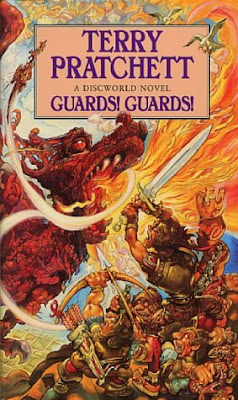
As I mentioned before, one of the interesting things about reading these books out of order is you start to see the pieces gradually fall in together. This is the 9th book in the series, and the one that is responsible for introducing the “Night Watch” of Ankh Morpork. And the characters of the “Night Watch”, go on to pop up in just about every subsequent book since, so it was interesting to see how they got started.
I was once talking to someone in a bar in Japan, and they said “Guards! Guards!” was the funniest book they've ever read.
---I’m not sure I’d go quite that far myself. I’m not sure I’d even say it was the funniest book in the Discworld series. (I mean it’s good, but there are a lot of funny books in the Discworld series). But it was a very entertaining read.
It also managed to make a few insightful comments about human nature in a way that is both morbidly funny and depressing at the same time. At one point in this book, a dragon is crowned king of Ankh Morpork, and the citizens debate the merits of having a dragon as king. The dragon demands a human sacrifice once a month, but the some of the citizens conclude that one human sacrifice a month is actually doing pretty good compared to some of the other rulers they have had in the past.
The dragon itself is appalled when it finds out the true nature of human beings. “We’re dragons,” it says. “We’re supposed to be cruel. But we never kill and torture people and pretend we’re being ethical.”
Each discworld book revolves around a different theme. Often these themes are a bit anachronistic for the medieval fantasy realm of the discworld, in which case Terry Pratchett usually uses magic to explain away any discrepancies. (It’s a bit similar to the old “Flinstones” gag of having dinosaurs act in place of modern appliances. It’s a bit corny, but at the same time it’s all part of the fun).
In this case, the theme of this book revolves around rock and roll music. Which enters into the discworld through magic (of course) and creates a sensation (and conservative counter-reaction) somewhat similar to the birth of rock and roll in our universe in the 1950s and 60s.
But the rock music doesn't really belong in the discworld. Instead it’s seeping in from another dimension (presumably ours). As a result everything resembles rock music and popular culture from our universe, but never comes out exactly right. This gives way to a lot of bad puns. For example, instead of rock music, it’s called, “music with rocks in”. Instead of “The Who” there is a group known as “The Whom”. There is a reference to “The grateful Death”, et cetera.
In my personal opinion, Pratchett’s usual wit is lagging a bit in this book. There are some real groaners in here. Such as the following two (which are just by way of example):
“We need to play somewhere. Like in a club.” “I've got a club. It’s got a nail in it,” said the troll. “No, I mean like a night club.” “It’s still got a nail in it at night.”
And…
“Don’t worry. I’ll sort it out. Sorting out about money is my middle name.” “That must be a long middle name.”
And so it goes. Oh well, when you write as many books at Terry Pratchett does, I guess they can’t all be winners.
At the very least, he has the grace to acknowledge the cheesiness of some of his own puns, like in the following exchange. Our hero Imp, a young musician just arrived in the city, is playing his instrument at a street corner when two policeman walk by.
“That’s a harp he’s playing Nobby,” said one of them after watching Imp for a while. “Lyre.” “No, it’s the honest truth, I’m-.” The fat guard frowned and looked down. “You've just been waiting all your life to say that, ain't ya Nobby,” he said.
Corny jokes aside, one of the great things about a Terry Pratchett book is always the plotting. This book has several different plot lines that it is juggling and they all manage to come together seamlessly at the end.
There’s the story of “the band with rocks in” (the band that starts the whole phenomenon, and in the process becomes possessed by the music). But there’s also the story of their talentless imitators (a spoof on punk music), and there’s the Wizard’s University (where the aging faculty starts to act like rebellious teenagers and the arch-Chancellor is worried about the fabric of reality imploding again). And then there’s the story of Death himself (always a character in the discworld series) who gets depressed with his job and goes on a quest to try and forget. And Death’s granddaughter Susan, who is in a boarding school clueless of her real ancestry until a skeleton rat and a talking raven show up at her bedside.
Many of the characters introduced in this book also reappear in other books. For example, after having read, “The Thief of Time” (in which Susan Death was also a major character) it was interesting for me to see her first appearance in this book. (At one point I decided I was going to read all the discworld books in order, but it’s sometimes difficult getting English books in Japan, so now I’m just reading them as I come across them, and gradually the pieces of the broader narrative are fitting together).
A visit to wikipedia shows that this book was adopted into an animated mini-series for British television. And a trip over to Youtube shows that some kind soul has put up the whole thing for public viewing. (At least it was available the last time I checked. You never know how soon it can get taken down).
I confess I gave into the temptation and watched the whole thing. It’s not bad, if you've got the time to waste, but it shows how difficult it is to transfer Pratchett’s dry humor into the medium of TV. (Much the same problem plagues the various adaptations of Douglas Adam’s works. In Adam’s books, like Pratchett, much of the humor is in the ironic voice of the narrator, and this is very difficult to transfer over to live action). Also, with all the much more interesting Discworld books out there, I’m not sure why this one in particular was selected to be made into a mini-series.
This book is actually in a slightly different than all the previous books in that it's marketed as a young adult book. And instead of being labelled as a Discworld series book, it is labelled as "A story of Discworld."
What does this semantic juggling mean? Nothing as far as I can tell. This book is firmly within the Discworld universe.
With the exception of a brief cameo by Death (and "The Death of Rats" ) it centers around a new set of characters not previously introduced, but many of the books in the Discworld series are like this.
The writing style of the book doesn't seem any different to me than any of the other Discworld books (although it has been a good half a year or so since the last Discworld book I read, so maybe my memory is getting bit rusty.)
The plot of the book involving a couple kids, a talking cat, and a bunch of intelligent rats may appear to be Disney-esque on the surface, but Pratchett doesn't tone down or clean up his style of irreverent humor.
In fact, the more cynical part of me wonders if the only reason this book is labelled "Young Adult" is because Pratchett's publisher was looking enviously at all the money books like "Harry Potter" have been making lately.
Anyway, marketing and labeling issues aside, this book is pure Pratchett at his usual funny self.
The book is about a group of rats and Maurice, the cat, who become intelligent and gain the power of speech after hanging around a magical dump beyond the wizard's Unseen University. With Maurice as manager, they acquire a kid to pretend to be a pied piper, and go from town to town trying to scam the townspeople out of their money. Until they come to a town where things begin to go a little strange...
As with all Pratchett books, simply describing the plot doesn't do justice to all the quirky humor and personalities he's managed to create within this book. From Maurice, the cynical manipulative cat, to Dangerous Beans, the rat with Utopian dreams, to Hamnpork, the rat who is having trouble adjusting to the change and doesn't understand why widdling on things is bad, to Malicia, the mayor's daughter whose read a few too many fairy tales for her own good.
Yet another novel in the Discworld series. After reading “The Color of Magic” this fall, I had announced that I was going to read the remaining books in this series in order. However going to Japan has somewhat buggered that plan. It is obviously possible to get a hold of English books in Japan, but it’s hard to get a hold of specific English books here. You kind of just take what’s in front of you. So instead of proceeding onto the second book, I jump to the 25th book in the series, “The Truth”. (If nothing else, I think we can all agree Terry Pratchett is at least a prolific author.)
While it may be hard to track down the Pratchett books in order over here, fortunately it is never hard to find Pratchett books in general. Terry Pratchett may have a cult following in the US, but he’s practically a household name in England. And since there are a lot of British English teachers here in Japan, Pratchett books tend to pop up a lot in the ex-patriot community (which is how I first discovered him about this time last year in Japan). And so, a couple weeks ago a British co-worker brought this book into the office and said to me, “You mentioned you were a Pratchett fan, right? I’ve got this just laying around my apartment and I thought you might be interested.”
As I said before, I do feel like I’m running out of complimentary things to say about Pratchett without repeating myself. This book was very funny, and as usual when I read a Pratchett book, I find myself laughing aloud as I read it.
This particular book is about the creation of the newspaper industry in the fictional Discworld. It reminded me a lot of “Going Postal” (the first book in this series I read) which traced the beginning of the Postal service in Discworld.
Also thrown in is a parody of the Watergate/ Deep Throat story, and some light parodies of Nixon era conservatism and conservative values:
“Apparently he says he’s looking forward to a new era in our history and will put Ankh-Morpork back on the path of responsible citizenship, sir….Apparently he wants a return to the values and traditions that made this city great.”
“Does he know what those values and traditions were?” said Vimes, aghast.
The photographer for the newspaper is a vampire with a fascination for flash photography. And if you think a vampire is the last person who should be playing with bright lights, perhaps you can see where some of the humor is going.
Also like the other books in the discworld series, Pratchett does a clever job of explaining away potential anachronisms in his sword and sorcery era fantasy world. For example, there are cameras and tape recorders in this novel, but they are all powered by magical imps. (It is kind of similar to the old Flinstones gag of having all the modern appliances performed by dinosaurs.) Some of it boarders on corny, but mostly its good fun.
Useless Wikipedia Fact
White Day is a growing tradition that was created through a concentrated marketing effort in Japan. White Day is celebrated in Japan, South Korea, Taiwan and some other East Asian countries on March 14, one month after Valentine's Day. On Valentine's Day, women give gifts to men; on White Day, men who received chocolate on Valentine's Day return the favor and give gifts to women
ed. note: Guess who's in trouble for forgetting...
Link of the Day West Michigan Remembers the Fourth Anniversary of Iraq War
March 14, 2007
While antiwar protests and organizing take place around the year in West Michigan and in particular in Grand Rapids, the next week surrounding the fourth anniversary of the war will see an increase in local activity. Each year since 2004 (see 2005 and 2006 coverage), antiwar protests in Grand Rapids and beyond have marked the annual anniversary. Instead of having the usual one-day march, there are a wide variety of events planned in West Michigan:
Yet another book in the Discworld series. I’ve decided that if I’m going to keep reading these Discworld books (and I think I am) then I might as well start from the beginning and read the remaining books in order. This is the first book in the series.
At this point I think it’s safe to say I’m completely on board with Terry Pratchett. I’ve drunk the kool-aid, and you’re unlikely to catch me saying anything negative about him in my reviews. It is however evident in this book that he hasn’t completely hit his stride yet. You can see the potential, but he hasn’t fleshed out all the characters and concepts as fully as in the later books.
As Terry Pratchett writes in the introduction to the reprinting, “Discworld is not a coherent fantasy world. Its geography is fuzzy, its chronology unreliable.” Some of the characters portrayed in this book, Death in particular, do not seem consistent with their later portrayals in subsequent books. I’m not sure if this will be explained away later, or if this is just an example of the wobbly first steps of a series that hasn’t quite gotten its rhythm yet. But there are plenty of good laughs in these pages, and all the silliness Pratchett is famous for. Enchanted Swords that won’t shut up, imaginary dragons, dead wizards who won’t go away, and the edge of the world.
Link of the Day Congragulations to Maria, whose Blog Post on Voting here was picked up by the Wall Street Journal Here. She joins Phil as the second person I know who's blogging has gotten picked up by a major publication. Or have I missed someone?
This is the 5th book I’ve read by Terry Pratchett since I discovered him this winter (after Going Postal, Monstrous Regiment, Interesting Times, and Night Watch) and I’m running out of complementary things to say about him without repeating myself.
Undoubtably Terry Pratchett is one of the most talented writers alive today. He’s incredibly prolific, but lots of writers are prolific. But it’s one thing to crank out action/adventure stories. Humor is much more difficult. It’s really amazing that Pratchett can write as much as he does and still be funny. And with so much philosophy woven into his stories. And his stories are well-plotted as well. There are lots of different plot threads always coming together nicely at the end.
Earlier I compared Terry Pratchett to Douglas Adams, and this book reminded me again of that comparison. “Thief of Time” is a book about the nature of time, but in a silly way with a lot of silly philosophy that almost kind of makes sense if you think about it too long. For instance, “What if Yesterday doesn't really exist?”
Another theme of the book is the Greek idea of deities with human characteristics. In this book the world is about to end, and Death must find the other 3 horsemen to ride out for the apocalypse, but it turns out the other 3 horsemen can’t be bothered. And the mysterious 5th horseman of the apocalypse has gotten a job as a dairy deliveryman. Good general silliness all around.
I wouldn’t say this was my favorite Pratchett book so far. I enjoyed “Night Watch” and “Interesting Times” much more. But Pratchett is like Mark Twain. You can never really go wrong with him.
(Book Review)
This is the fourth book that I've read in the discworld series. Given how few books I manage to get to the end of, I guess the fact that I've now read 4 discworld books might indicate I'm a big fan.
I wouldn't consider myself a huge fan (not yet anyway), but Terry Pratchett is a funny guy. The great thing about a discworld book is that if you see it in the bookstore, you know it's going to be a good investment. If nothing else you're bound to get a few laughs out of it.
Besides which, Terry Pratchett and I seem to share a number of similar interests. Free Market Capitalism versus Goverment regulations in "Going Postal", anti-war themes in "Monstrous Regiment", and the Chinese Communist revolution in "Interesting Times".
And now "Night Watch" is based on the European Revolutions of the 18th century, which have long been an interest of mine.
The basic plot is that Sam Vimes, head of the Discworld police, is chasing a dangerous psychopathic criminal, when both he and the criminal are accidentally transported 30 years back in time which, in Discworld, is the age of barricades and revolutions. While trying to track down the criminal, Sam Vimes finds himself thrown into the middle of the Revolutions.
The parallels to real history are of course loose, but I think a lot of parallels could be made to the Revolution of 1830. There is an event in the book that is very similar to the Peterloo Massacre in England, involving cavalry trampling civilians.
And there's a seamstress revolutionary who reminded me slightly of Madame Defarge from "A Tale of Two Cities."
Although the nature of the story is somewhat tragic, there's a lot of humor as well. As always with Pratchett can be very funny. There were a couple passages in particular where I was suppressing the urge to laugh out loud as I read. Also the plot is very tight and well constructed. The fact that Vimes is chasing a murderer at the same time he gets involved in the revolution makes for a suspenseful story. (The Washington Post, by the way, apparently compared Pratchett to Chaucer in their review of this book.)
And yet I wouldn't recommend this book to someone as their first introduction to Discworld. Because of the time travel in particular, the plot is a bit more complicated and there are more characters and story threads to keep track of. If you aren't already somewhat famalier with the Discworld universe, I imagine it could be pretty confusing.
This is the third book I’ve read in the discworld series so far after “Going Postal” and “Monstrous Regiment”. And I do plan to vary my reading selection someday I promise. But when I found out this book was a satire of the communist revolution in China, I wanted to read it.
My interests in history run from social movements generally to revolutionary movements in particular, but one of the most fascinating courses I ever took at Calvin was “Modern East Asian History”. Because all of Western thought came flooding into China at about roughly the same time, the Chinese didn’t have the luxury of gradually evolving political radicalism like in Europe. Instead ideas like Christianity, democracy, communism, and anarchism all arrived at the same time, and the resulting political and social turmoil in the May 4th movement is an interesting time to read about. Probably wouldn’t have been to fun to live through, but an interesting time to read about.
Terry Pratchett sets this all in his discworld series by having a continent half way around the world, the Counterweigh Continent, which acts as his fantasy world substitute for Asia. The Agatean people represent the Chinese.
Pratchett satirizes with a hammer instead of a needle, so he doesn’t get all the intricacies of turn of early 20th century Chinese radicalism. But he does write about the culture clash between Western philosophies of rebellion, and traditional Asian culture of submissiveness to authority:
“The Red Army met in secret session. They opened their meeting by singing revolutionary songs and, since disobedience to authority did not come easily to the Agatean character, these had titles like ‘Stead Progress and Limited Disobedience While Retaining Well-Formulated Good Manners’”.
Pratchett apparently has anarchist leanings (according to the cover jacket) and he delivers an excellent anarchist satire of communist arrogance:
“Look,” [Rincewind] said, rubbing his forehead. “All those people out in the fields, the water buffalo people…If you have a revolution it’ll all be better for them, will it?”
“Of course,” said Butterfly. “They will no longer be subject to the cruel and capricious whims of the Forbidden City.”
“Oh, that’s good,” said Rincewind. “So they’ll sort of be in charge of themselves, will they?”
“Indeed,” said Lotus Blossom.
“By means of the People’s Committee,” said Butterfly.
Rincewind pressed both hands to his head.
“My word,” he said. “I don’t know why, but I had this predictive flash!”
They looked impressed.
“I had this sudden feeling,” he went on, “that there won’t be all that many water buffalo string holders on the People’s Committee. In fact…I get this kind of…voice telling me that a lot of the People’s Committee, correct me if I’m wrong, are standing in front of me right now?”
“Initially, of course,” said Butterfly. “The Peasants can’t even read and write.”
“I expect they don’t even know how to farm properly,” said Rincewind gloomily. “Not after doing it for three or four thousand years.”
The book is also a satire on all things Asian. The author mixes Chinese and Japanese culture together (either intentionally or unintentionally) into one big lump. Obviously I’m a lot more attuned to the Japanese elements than I am the Chinese with five years in Japan compared to six days, almost all tourist spots, in China. I’d be interested in the perspective of someone who spent time in China, but many things satirized in the book like Noh drama, Origami, tea ceremony, and kimonos actually come from Japan.
Many of the jokes are harmless, like cheap throwaway puns about Noh Drama:
“We are a traveling theatre,” she said. “It is convenient. Noh actors are allowed to move around.”
“Aren’t they?” said Rincewind.
“You do not understand. We are Noh actors.”
“Oh, you weren’t too bad.”
Other parts of the book cut a little deeper into satires of the Asian character. I suppose this is the kind of thing some people might be offended by.
I’m going to stay clear of all of that for now. If you want a discussion on these issues, Phil and Matt have both recently written posts touching on some of these issues.
It has been said that the longer a person stays in Asia, the more they loose their sensitivity. That’s true for me. After 5 years living in Japan, my only thought as I read this book was, “Man, that is so true. You tell ‘em!”
Watching this, I can't help but be reminded of George Orwell's words in 1948: "If you want a picture of the future, picture a boot stamping down on a human face. Forever."
This is another book in the discworld series. I enjoyed the last one I read, and there are a lot of discworld books at the foreign bookstores and book exchanges in Japan, so I decided to pick up another one.
As I mentioned in my review of “Going Postal”, a friend told me that some of the discworld series are better than others. I’m assuming “Monstrous Regiment” is one of the better books. It wasn’t just a funny read; there was actually a lot of relevant satire to today’s world.
I’d like to think that’s my opinion, and that I wasn’t influenced by the critics, although I do have to admit I was impressed by the quotes on the inside jacket (even though I know you can’t always trust those things, but…)
“An extended morality tale, on the subjects of pacifism, intolerance and gender, gathered together into a military adventure. It is how John Lennon would write a Sharpe novel if Bernard Cornwell left him to it…A great piece of writing akin to Jonathon Swift”--- Daily Express
“A fantasist who loves naff humour and silly names, and yet whose absurd world is, at heart, a serious portrait of the jingoistic fears that keep us at each other’s throats.”---The Times
et cetera
The book touches on a lot of themes: gender discrimination, religious fundamentalism, and patriotism being the big three.
Fantasy is obviously a great medium to do satire in, although at times it has its limits, and Pratchett seems to be stretching up against them at times. The story is loosely modeled on the Napoleon wars, and yet the fantasy world it is set in is one of swords and sandals, not guns and rifles. Pratchett substitutes the crossbow and catapults for guns and cannons, but you can feel him stretching sometimes.
Also, there is the question of how relevant an anti-war story modeled on the Napoleon wars is to today’s world. And yet certain passages seemed to me to be very dead on. For instance, this passage as the main character Polly reflects on the continual state of warfare.
“There was always a war. Usually it was a border dispute, the national equivalent of complaining that the neighbor was letting his hedge grow too long. Sometimes it was bigger. Borogravia was a peace-loving country in the midst of treacherous, devious, warlike enemies. They had to be treacherous, devious, and warlike, otherwise we wouldn’t be fighting with them, eh? There was always a war.”
Or this conversation among the soldiers:
“And what you’ve got there, my friend, is patriotism. My country, right or wrong.”
“You should love your country,” said Shufti.
“Okay, what part?” the voice of Tonker demanded, from the far corner of the tent. “The morning sunlight on the mountains? The horrible food? The damn mad Abominations? All of my country except whatever bit Strappi is standing on?”
“But we’re at war!”
“Yes, that’s where they’ve got you,” sighed Polly.
“Well, I’m not buying into it. It’s all trickery. They keep you down and when they piss off some other country, you have to fight for them! It’s only your country when they want you to get killed!” said Tonker.
A lot of this is borrowed/ plagiarized from the conversations of soldiers in “All Quiet on the Western Front”. But I don’t think Remarque would mind.
Link of the Day (via Bierma's Blog)Death Row Prisons: Protecting the Sanctity of Life
Anticipating a possible replay of his September heart attack, [76-year-old death row inmate Clarence] Allen had asked prison authorities to let him die if he went into cardiac arrest before his execution, a request prison officials said they would not honor.
"At no point are we not going to value the sanctity of life," said prison spokesman Vernell Crittendon. "We would resuscitate him."
(Book Review)
I’m trying to get more into the idea of “reading for pleasure” instead of simply “reading books I think are good for me.” To that end, I’ve started to return to the fantasy genre that I used to be a fan of in my youth.
I’ve discovered the “Discworld series” by Terry Pratchett, which I had previously never heard of, but is apparently very well known in certain circles, and seems to be very popular among the foreign community in Japan. The foreign sections at Japanese bookstores or foreign book exchanges usually carry a lot of “Discworld” series.
I saw some of Terry Pratchett’s books when I was back home, but it doesn’t seem to be as popular in America. I think because Pratchett is British, these books are better known to common wealth audiences than they are to Americans. Most of my British friends are well versed in Discworld.
The books are fantasy, but they are much more in the line of Douglas Adams than JRR Tolkien (to compare with two other British authors). All the stock fantasy characters are there: dwarves, elves, trolls, vampires, werewolves, wizards, et cetera. But they are also comedic, silly, and as much a parody of the genre as a part of it. Zombies are lawyers, vampires are newspaper photographers, and werewolves are policemen. Also just about every paragraph is a set up for some sort of a joke.
I could quote from a lot of paragraphs, but this line in particular seemed very reminiscent of Douglas Adam’s style to me:
“The Great Hall was in uproar. Most of the wizards took the opportunity to congregate at the buffet, which was now clear. If there’s one thing a wizard hates, it’s having to wait while the person in front of them is in two minds about coleslaw. It’s a salad bar, they say, it’s got the kind of stuff salad bars have, if it was surprising it wouldn’t be a salad bar, you’re not here to look at it. What do you expect to find? Rhino chunks? Pickled coelacanth?”
Pratchett is very prolific. “Going Postal” is the 33rd book in the Discworld series, and he cranks these things out at the rate of one or more a year. This raises two questions: 1) Given how many of these things he cranks out, do they suffer in quality?
And 2) Is it very difficult to jump into the middle of the series?
I was asking a friend about the first question, and he answered, “Some of the books are admittedly better than others. But even the worst books in the series you won’t be sorry you read.”
Based on “Going Postal”, I’d go along with that assessment. It wasn’t the best book I’ve ever read, but I’m not sorry I read it. It was funny. It was well plotted. All the different story threads came together nicely at the end. And I thought the characters were decently developed, or at least as well as they needed to be for a story like this. In short, I don’t know how Pratchett manages to write this well and still write so much. I got the impression he wasn’t holding anything back from this book nor being stingy and saving things for his next novel.
As for jumping into the 33rd book in the series, it was no problem. Or almost no problem. There were a couple small things I had to get used to. Robot like creatures called “Golems”, for example, and a tower messaging system called “Clacks” run by a business organization called “The Grand Trunk”. But it was a lot easier than say jumping into the middle of Zola’s “Les Rougon-Macquart” series.
This may be partly because “Going Postal” is a bit of a narrative digression from the usual Discworld series, and most of the main characters in this book are new. This book is simply the tale of how the Ankh-Morpork’s Postal service developed, which apparently fits into a larger Discworld theme of the growth of Ankh-Morpork as a major urban area in the Discworld. In that respect, given the tangential nature of this story in relation to the larger series, it seems all the more amazing that it is as well written as it is. If it were me, I would have just blown it off.
I particularly enjoyed the character of Lord Vetinari, who is the tyrant of Ankh-Morpork, and apparently is from previous books in the serious as well. He’s a kind of benevolent tyrant who is committed to keeping his strangle hold on power, but at the same time seeks to do what is best for the city in his own eyes. He reminds me of the kind of character I myself have often tried to create in my own fiction, such as Bakes or Flash.
There are also some critiques of the freemarket ideology, and according to Wikipedia much of this book is a parody of "Atlas Shrugged", but that went over my head.

 (book review)
 (Book Review)
 (Book Review)
 (Book Review)
 (Book Review)
 (Book Review)
 (Book Review)


