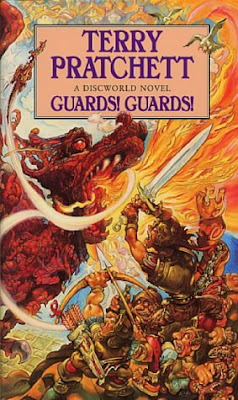
As I mentioned before, one of the interesting things about reading these books out of order is you start to see the pieces gradually fall in together. This is the 9th book in the series, and the one that is responsible for introducing the “Night Watch” of Ankh Morpork. And the characters of the “Night Watch”, go on to pop up in just about every subsequent book since, so it was interesting to see how they got started.
I was once talking to someone in a bar in Japan, and they said “Guards! Guards!” was the funniest book they've ever read.
---I’m not sure I’d go quite that far myself. I’m not sure I’d even say it was the funniest book in the Discworld series. (I mean it’s good, but there are a lot of funny books in the Discworld series). But it was a very entertaining read.
It also managed to make a few insightful comments about human nature in a way that is both morbidly funny and depressing at the same time. At one point in this book, a dragon is crowned king of Ankh Morpork, and the citizens debate the merits of having a dragon as king. The dragon demands a human sacrifice once a month, but the some of the citizens conclude that one human sacrifice a month is actually doing pretty good compared to some of the other rulers they have had in the past.
The dragon itself is appalled when it finds out the true nature of human beings. “We’re dragons,” it says. “We’re supposed to be cruel. But we never kill and torture people and pretend we’re being ethical.”
Continuing on my journey through Japanese pop culture, here’s another anime series.
This series takes place during the French Revolution, so it allows me to combine Japanese studying with my interest in European history.
However this isn't just some obscure anime series I dug up to satisfy my own geeky interests. On the contrary, this is perhaps the most famous Shojo anime series ever. (In fact a “Daily Yomiuri” article recently called it the most influential Shojo miniseries).
Anecdotally, I can say that whenever I’m discussing the French Revolution with Japanese friends, this anime series almost always gets brought up. And it seems to me that a lot of Japanese people, especially a lot of Japanese woman, have gotten all their knowledge about the French Revolution exclusively from this series.
Like a lot of popular Japanese animation, this story has gone through several mediums. It started out as a manga, then was converted into an animation, then a movie, and is currently still being performed as a popular musical in Japan.
And as always, the story gets slightly altered at each transformation. I've been told the original manga is more historical accurate, but I've only seen the anime, so I’ll have to confine my review to that.
In “Shogun”, author James Clavell spent years researching Japanese history, and then in the end decided to write a novel that was not purely historical, but instead mixed large amounts of fiction with Japanese history.
By the same token, Ryoko Ikeda, the author of “The Rose of Versailles” (who published her story in the mid 70s, about the same time as “Shogun”) obviously spent a lot of time researching French history, and is knowledgeable about a lot of small details. But then she decided to write a story freely mixing historical fact with large amounts of fiction.
The story revolves around the fictional character of Oscar François de Jarjayes . On the night of her birth, Oscar’s father was desperately hoping for a son, but got another daughter instead.
So, he decided to raise Oscar as if she were his son. The adult Oscar becomes a soldier who can ride, fence, shoot, and fight as well as any man can. In her soldier’s uniform, she is often mistaken for a man by those who don’t know any better.
This is a surprisingly common theme in Shojo [girl's] anime and manga. Some elements of this were even present in “Romeo X Juliet”, where the princess Juliet was raised as a boy to hide her true identity, and she also fought injustice disguised as a man in the costume of “The Red Wind”.
And in fact, I could list several other Shojo series where the main character is able to disguise herself as a man and operate successfully in a man’s world.
...To the extent that popular entertainment represents wish fulfillment, this probably says something interesting about the desires of the average Japanese woman, Japanese society, and women’s place in that society. But I’ll leave that question to the sociologists.
Also, as you might expect given this scenario, the sexuality gets a little bit confused in this story. Oscar is a beautiful woman, who many men fall desperately in love with over the course of the series. And she herself loves some of them back. (The story follows the commonly established pattern, where Oscar falls in love with brave and dashing men, only at the end to realize her true love is the boy next door who has been right in front of her eyes the whole time).
However at the same time Oscar also appears to be coveted sexually by several of the women in the Versailles court.
Again, assuming this type of entertainment represents a certain degree vicarious wish fulfillment, and keeping in mind that “The Rose of Versailles” is one of the most popular Shojo series in Anime history, one wonders what this might say about the sexual desires of the average Japanese woman (or woman in general?). I’m sure Dr. Kinsey would have had something interesting to say about this. But again I’ll leave that question hanging for people more qualified than me to analyze.
Oscar becomes the captain of Marie Antoinette’s guards, and is responsible for safeguarding Marie Antoinette’s safety. The series begins with Marie Antoinette entering France, and follows over the course of forty(30 minute) episodes the 20 years leading up to the storming of the Bastille. The series ends at the battle of the Bastille, although there is a 15 minute epilogue that recounts the fates of the main characters following the fall of the Bastille.
(According to Wikipedia, Ryoko Ikeda wrote a sequel that follows the events of French history through the Directory and the rise of Napoleon, but this sequel hasn't been made into an anime, and is only available in Manga form).
During the course of these 20 years, the anime series follows Marie Antionette's life through crisises both historical and imagined. Marie Antionette’s rivalry with Madame du-Barry and romance with Count Fersen are both re-counted in this series.
(Some of this is very similar to the Kirsten Dunst “Marie Antoinette” movie version, such as the ongoing battle of wills between Marie Antoinette not to speak to Madame du-Barry, and Madame du-Barry’s backstage politicking to force Marie Antoinette to acknowledge her. Also Marie Antoinette meeting Count Fersen at a masked ball.
I guess the similarities shouldn't be a big surprise since both are based on the same historical source material. And I couldn't help but wonder if the producers of the Kirsten Dunst movie had seen “The Rose of Versailles”, or had been influenced by it a little.)
During this same period, to keep up the excitement, there are numerous fictional cloak and dagger plots against Marie Antoinette’s life, which Oscar must uncover and foil.
One of the main subplots of this series is a story that could have been straight out of Charles Dickens (speaking of another writer who mixed facts with fiction when writing about the French Revolution). In the slums of Paris, a poor dying mother is trying to raise two daughters of completely different temperament. One daughter Jeanne, who is greedy and rebellious, goes off to seek her fortune among the aristocracy. Through a series of lies and deceptions she becomes integrated in aristocratic society, and, as one greedy plot piles on top of another, she eventually becomes the Jeanne of the infamous “Affair of the Necklace”.
The other daughter, Rosalie, stays behind to loyally tend her sick mother, but eventually finds out she was adopted, and that her true mother is Lady Polignac (one of Marie Antoinette’s inner circle, who in accordance with popular perception, is portrayed in “The Rose of Versailles” as a corrupting influence on Marie Antoinette.)
(Rosalie is also one of the women who briefly falls romantically in love with Oscar).
The revolutionaries appear in the story as well. For the first several episodes, we see and hear nothing of them, but they creep into the story slowly to represent the changes that are going on in French society away from Versailles.
Maximilien Robespierre first appears as a young student giving a speech at King Louis XVI coronation ceremony. (A fact true to history, although the historical 17 year old Robespierre stood out in the rain and delivered his speech as the king’s carriage drove by. In “The Rose of Versailles” anime, Robespierre is inside the coronation hall giving his speech before the assembled ministers.)
We next meet Robespierre when Oscar goes on a trip out to the countryside, and meets Robespierre as a young lawyer working for the good of the common people.
Robespierre appears more and more frequently as events progress towards Revolution, although he is often represented not as one demagogue among many, but as all the historical French Revolutionaries rolled into one.
Saint-Just often appears at Robespierre side, at first as a disciple of Robespierre, but he later openly defies Robespierre and starts to represent the radical side of the revolution that Robespierre can not control.
The series then jumps off from the historical rails completely when Saint-Just becomes a masked terrorist setting off bombs and assassinating aristocrats.
The 3rd member of the revolutionary trio is entirely fictional: a journalist named Bernard, who starts out as one of Robespierre’s followers, then has a brief career as “The Black Knight”, a sort of Robin Hood type figure who steals jewels from the aristocrats and gives them to the poor, until he is unmasked and defeated by Oscar and her sidekick Andre. Finally he becomes one of the leaders of the common people, marries Rosalie, and becomes an ally of Oscar and Andre as the two of them decide to join with the people during the battle against the Bastille.
This anime was made in the late 70s, and it’s showing it’s age a bit now. The animation is a little stiff and jerky. It bothered me at first, but it was one of those things that after a few episodes I stopped even noticing.
Also the pacing of this anime started to get to me after a while. There are a lot of action scenes, to be sure, but there’s also a few too many scenes of characters looking lovingly into each other’s eyes while romantic music plays in the background.
I mentioned earlier that “Romeo X Juliet” was a Shojo anime that the 12 year old boy inside of me didn't mind a bit. But in “The Rose of Versailles” the Y chromosome in me was getting a little restless during some of the sappier scenes.
Still, all in all, a mostly entertaining series, and a good way to combine Japanese language study with French History.
Another book in the “World Leaders: Past and Present” series which I picked up from Oita Prefectural Library on my last trip down to Oita City.
This was a very brief summary of Napoleon’s life aimed at the young adult audience, but the gaps in my historical knowledge are such that I still learned tons from it. And I found it fascinating reading. I hope to someday find a full length biography of Napoleon, but for now this will have to do the trick.
I think everyone who ever reads a biography of Napoleon comes away astounded by what he was able to accomplish, and perhaps slightly appalled by the tremendous amount of death and bloodshed that was necessary to satisfy his ambition.
Considering Napoleon started out as nothing but the son of a petty Corsican noble who couldn't even speak correct French, and then later his military career was almost finished before it even started because of his association with Robespierre, what he managed to accomplish was truly amazing. He inherited a situation with France in disarray and under attack by all of Europe, and he was able to beat all of Europe back 3 out of 4 times.
The Napoleonic wars are something I still don’t know about, and this book does a good job of summarizing it. It’s a bit confusing though, since in a relatively short period of time there were 4 coalitions of European powers united against Napoleon.
The scope of the Napoleonic Wars is somewhat astounding as well raging, as it did, back and forth across Europe several times.
To the extent that European wars are sometimes called “World Wars” (World War I at least can be thought of as primarily a European War in which the colonies also took part), the Napoleonic Wars can almost be thought of as 4 World Wars in a 20 year period of time.
One of the things I remember from my Calvin history classes was the paradox of how Napoleon both ended the French Revolution by establishing autocratic rule, but at the same time also cemented the advances of the French Revolution by spreading an enlightened (non-feudal) code of laws and administration throughout Europe.
In some of her last few paragraphs, Leslie McGuire attempts to sum up Napoleon’s mixed legacy:
“Some consider him the enlightened bearer of revolutionary ideals; others regard him as a forerunner of 20th-century dictators. It is hard to asses his role. He redrew the map of Europe several times. He brought lasting reforms to the legal, administrative, judicial, and educational systems of an entire continent. He revolutionized warfare. But the political and social upheavals such as the French Revolution, that shook France and the rest of Europe would have happened without him. Many of his actions brought unintended results. He paved the way for the unification of Italy and Germany. He helped make the United States a world power by selling the Louisiana Territory. His war with Spain gave the countries of Latin America an opportunity to fight for their independence. He strengthened the pope and the Catholic church despite his attempts to do the opposite. Napoleon left behind a powerful legend that grew to enormous proportions after his death. His son, Napoleon II, never ruled France. But in 1852 his nephew, Louis Napoleon, traded on the popularity of his name to proclaim the Second Empire, and took the title Napoleon III. Bonapartism-the belief in a strong, authoritarian ruler appointed by the will of the people-continued to cast its spell over French politics for years and remains a tangible force even today.” (P.106)
A few notes:
* Leslie McGuire claims that: “As head of [the committee of public safety] Robespierre was responsible for the deaths of some 50,000 people during the Reign of Terror”. (P. 24)
This differs slightly from the other books I've been reading recently. Other books in this same series put the figure much lower. In the book on Robespierre, S.L. Carson gives a figure of 2,596 (p.20). Frank Dwyer in his book on Danton says, “during the period known as the “Reign of Terror”, more than 2,300 people were guillotined” (p.16). Guy Endore in “The Werewolf of Paris” which (although not really a serious history) also quotes 2,596.
I’m no expert myself, but I’d be curious to know where McGuire gets her figures from, and why it’s different than the other figures. Is she adding in the deaths caused by the September massacres and the civil war? If so, is it fair to lay all of those deaths at the feat of Robespierre?
* As these are young adult books, they are filled with illustrations, as well as various captions, quotes, and other information filling up the margins of each page.
This adds a lot to the enjoyment of these books, especially for those of us with short attention spans. Although I wish the editors had done a better job of lining the illustrations and quotes up with the main text. Often a picture caption will give away information that won’t be revealed in the main text for a couple more pages.
* And speaking of which, one of the quotations in the margins of the page gives a very graphic portrait of Napoleon’s view of the German Empire. “The Empire is an old serving woman who is used to being raped by everyone.”-Napoleon Bonaparte speaking with reference to the German Empire.
Although that does provoke a very vivid image of the political situation of the time, I’m a bit surprised that the quote made it into a young adult book. Especially since it was just used as one of the superfluous quotes on the side margins.
This wasn't a great movie, but I found it to be a very pleasant waste of time.
Part of it might just have been the mood I was in. I was exhausted from a day of hiking around and swimming, and I wanted to just sit in my apartment and watch a light adventure story--Something that wouldn't make me think to hard, but something that might excite the imagination just a little bit.
This fit the bill. It was fun, and imaginative, and whimsical.
There are a lot of bad fantasy movies out there, but I’m a great fan of the genre when it’s done right, and this was done right. Like all great fantasy movies, it doesn't rely simply on big battle scenes, but also manages to convey a sense of wonder about a strange new world.
The film tries to create the feeling of a fairy tale, and I think it succeeds. It borders on being a little bit too sappy at the end, but on the whole it strikes a good balance.
There’s a lot of black humor mixed in as well, which threw me off at first but once I got used to it I started to enjoy that as well.
As a fan of “The Office” and “Extras” I enjoyed seeing Ricky Gervais in this movie, although I wish he would have had a bigger role. In my opinion he is (once again) criminally underused. Although during the time he is on screen, he plays a character very similar to his character in “The Office”, which perhaps is just one big inside joke. People who have seen “The Office” will think it’s funny, people who have not might not get the humor.
My only regret is that once the movie was over, I saw on the ending credits that it was actually based on a book by Neil Gaiman. Maybe I should have read the book first before watching the movie.
….Oh well, with my memory, I’m sure by the time I get around to reading the book in a couple years I’ll have forgotten most of the movie anyway.
In order to try and make my movie viewing more of an interactive activity (and less of a passive mind-numbing one) I've decided to review everything I watch on this blog. And, because I can be pretty rigid about something once I've put my mind to something, for over a year and a half I've managed to review absolutely every movie I've seen during that time.
...Doesn't necessary mean I have something intelligent to say about every movie I watch though.
I always feel intimidated reviewing a Coen brothers movie, because I know film school students and art house movie buffs all over the country are going to be writing (or have already written) their own reviews, and a low brow philistine like myself doesn't have anything intelligent to add to the discussion.
Well, here are my thoughts anyway. Just your average low brow video rental customer’s view from his couch:
*Because I’m so out of touch these days (a by-product of living out in the Japanese countryside) I knew nothing about this movie before I rented it. Which is probably the best way to approach a Coen brother’s movie. From the moment I pressed the play button, I knew nothing about what the plot would be, or what would happen, and just watched everything unfold before me from a starting point of nothing. It was a lot of fun to see where the movie would take me.
*The first couple Coen brothers movies I saw I had a hard time sitting through, because I was very impatient for the story to just get moving. Once I came to accept the fact that the pacing of a Coen brothers film was different, and that the story was just going to meander along on its own time, I started to enjoy their movies a lot more. It’s all a matter of being in the right mind set. You just need to relax and let the movie go where it’s going to go.
* Like a lot of Coen brothers films, this film has an unpredictable feeling. You don’t know who is going to die and who is going to survive. Anyone of the cast feels like they might be vulnerable. Which really adds to the suspense of the whole thing.
The exception to this is the main bad guy, who unfortunately has a bit of “The Terminator” aura around him. He gets in numerous gun fights, gets shot up several times, and yet is always unkillable.
What’s more, the whole plot is structured in such a way that everything revolves around this bad guy, so you know he’s not going to bite it anytime until maybe the end of the film.
….Of course it’s always a lot easier to point out the problem than it is to solve it. I don’t know how you could fix this other than to completely re-write the movie and make a different one. But I think the invulnerableness of the bad guy still took away from the film a bit.
* The movie is set in the Southwest. It’s one of those movies that does a good job of making you feel the sand in between your teeth. You can hear the sand crunch when a character walks. You can practically feel the hot sun. And it has a great cast of cowboy type figures with leathery faces.
Because of the slow pacing of the movie, you get sucked into the setting and you feel like you’re hanging out with these characters; trading Vietnam War stories and wearing cowboy hats as you have another cup of coffee in the diner.
It’s not the world I grew up in for sure, but the movie did a great job of making me feel like I was in the middle of it.
*I think the movie takes place in 1980, if I got the clues right. (At one point a character makes a reference to a 1958 coin as being 22 years old. There’s also a lot of Vietnam Veterans who are middle aged, but not quite old-old yet). The movie never broadcasts the time setting in white letters at the bottom of the screen like another movie might, but makes you work a bit to figure it out. Which I guess is all part of the fun with a movie like this.
--Still, I couldn't help but wonder if there was a reason it was set in 1980. Was there anything about the story line which would have been different if it was set in the present day? Did anyone catch anything?
*The camera is very selective in what it shows and what it doesn't show. Some deaths you see in all their gruesome glory, others are simply implied, and a few you’re left wondering about. Did he kill her, did he not kill her, what actually happened at the end?
This is another one of those films that avoids the typical Hollywood ending, with all the threads neatly tied up. There were a few things I was still wondering about as the film ended.
(Call me a philistine, but I think I might actually prefer the neatly wrapped up Hollywood ending. But it was still an entertaining film.)
Like the book on Robespierre, this is another book that seeks to navigate all the complexities of the French Revolution for a young adult audience. This book does a slightly better job, perhaps because it’s written by literature professor. This is evident already from the first paragraph, which provides an enticing introduction to the biography but at the same time avoids overloading the reader with information.
“An ingenious and fatal machine casts its long shadow over the pages of this story. It has a tall, strong wooden frame that is grooved along the inside edges to permit the raising and lowering of a heavy blade. The blade is raised by a system of lead weights and pulleys, and is designed to come down quickly, hurled to the base of the frame by its own weight. A movable wooden plank, large enough to lie on, is fitted into the frame close to the base, where two semicircle pieces of wood (the lunette) can open and shut to admit a medium-sized object and hold it in place in the path of a blade. It is a machine for cutting off heads.”
Although brief, there is a lot of interesting biographical information about Danton here, as well as his shifting alliances.
He is portrayed in this book as an opportunist. He began his legal career with a speech, “Woe to those who provoke revolutions, woe to those who make them.” But when he perceived the power of Louis XVI court was finished, he cast his lot in with the revolution.
The author often contrasts Danton, who entered the revolution out of slightly opportunistic reasons, with Robespierre, who entered it for idealistic reasons.
“Danton and Robespierre were both brilliant and courageous revolutionary leaders, but their personalities were very different. Robespierre, known as “the incorruptible” for his famed virtuousness and purity, was cold, hard, distant—a man of ideals and intellect. Danton was warm, easygoing, sociable—a man of passions and heart. For now, these natural rivals were uneasy allies in the Revolution.” (p 49)
And on Danton’s taking bribes:
“The reality of this bribe taking may not be quite as bad as it sounds to the law abiding citizens of a stable government. Robespierre was called “the Incorruptible” because his integrity was so unique. No one would ever have called Danton “the Incorruptible” and he probably would not have appreciated it if they had.”
Although there is no proof that Danton ever took bribes, the author provides lots of interesting circumstantial evidence that indicates he probably did.
There is also the very interesting allegation that Danton bought his famous military victory against the Prussian duke of Brunswick with a bribe of “The Blue Diamond of the Golden Fleece.” Also the interesting connection that Danton, the duke of Brunswick, and many of the other leading men involved in the battle belonged to the secret society of the Masons.
….Again, no hard proof, but a lot of interesting circumstantial evidence.
When Danton became a rival to Robespierre, he was executed by the Revolutionary Tribunal as part of The Reign of Terror. Danton was responsible for helping to create both the Tribunal and the Terror, and then ironically enough became their most famous victim.
“The deputies were forced to create their own Frankenstein, a monster that would eventually murder many of them. Danton’s repentance came too late. “God and my fellow men forgive me,” he said after his fall. “I never meant [the tribunal] to become the scourge of humanity it has. All I wanted was to prevent any recurrence of the September massacres.” He hoped that the Revolutionary Tribunal would replace the unpredictable mob as the protector of the nation from domestic enemies, and believed the tribunal would help to restore order and calm in Paris. Instead, he learned that he and his fellow deputies had given the party—or the individual—in power a swift and efficient mechanism for sending opponents to the guillotine.” (p84-85)
At the same time, the fact that this story is set during the French Revolution satisfies the historical geek in me.
…Baroness Orczy wasn't a huge fan of the French Revolution, by the way, but I’ll get to the politics of the book in a minute. First I want to address the plot.
To my disappointment, there wasn't as much swashbuckling in this book as I was hoping for. In fact there was barely any. Most of The Scarlet Pimpernel’s exploits took place off stage, and the camera lens (so to speak) of the writer’s pen stays almost exclusively focused on our heroine Margaret Saint-Just, and takes place at ballroom dances and Opera houses.
(Saint-Just is the maiden name of the book’s heroine, as well as the surname of her loving brother, Armand. It’s an odd choice of names for a book as anti-revolutionary as this, considering Saint-Just was also the name of one of the more infamous Jacobin radicals, and Robespierre’s right hand man. As Baroness Orczy must no doubt have known.)
Margaret Saint-Just is the queen of London’s fashionable society. She attends the best parties and wears the finest dresses. She often hears stories of the deeds of the Scarlet Pimpernel, and admires his daring while she wonders what his true identity might be. She is also confused about her husband, and wonders why he seems so cold and distant and dull.
For over half the book, the identity of the Scarlet Pimpernel is unknown, and the suspense of the book revolves around Margaret trying to find out who the Scarlet Pimpernel is.
This may have been suspenseful to the book’s first readers, but by now the Scarlet Pimpernel is so much a part of popular culture, I suspect most people already know who he is before even picking up the book. (And if that wasn't enough, the cover jacket on my edition gave the name away anyway).
Perhaps it’s just as well, because the identity of the Scarlet Pimpernel is so obvious that all but the most dimwitted of readers will have figured out the mystery long before Margaret. Thus for the first 175 pages of the book, the reader is simply waiting for Margaret to figure out what they already know.
The second half of the book takes place in France, where Margaret journeys to France to try and warn the Scarlet Pimpernel of the French police who know his identity. Margaret is captured by the French soldiers as they are hunting the Scarlet Pimpernel. The soldiers are led by a mysterious Jewish man, who claims to know the Scarlet Pimpernel’s hide out. The Scarlet Pimpernel himself (who is well-known to be a master of disguises) is nowhere to be seen.
Once again, I think most readers will figure out what is going on long before Margaret does. (Margaret Saint Just isn't one of the most intelligent characters in the history of literature). And once again, it becomes a bit tiresome having to wait for several chapters until Margaret finally realizes what the reader knew all along.
(Although to be perfectly fair, “The Scarlet Pimpernel” is supposed to be a children’s book, so maybe if I had read this book 20 years ago I might have been a little bit more taken in by the story. I think I was a lot easier to fool at that age).
Although the Scarlet Pimpernel dons several disguises in the course of this book, nowhere does he ever appear in the infamous mask and cape that have become his trademark. Maybe that costume pops up in one of the many sequels. Or maybe it’s just a Hollywood invention.
Nevertheless, comparisons to greater atrocities aside, I don’t think any sane person would argue that the Reign of Terror wasn't an awful episode of history, and the Scarlet Pimpernel efforts to save people from the guillotine is something we can all cheer. (If only an historical Scarlet Pimpernel had actually existed…)
Furthermore, it would be hard to accuse Baroness Orczy of being either anti-French or anti-Republican. After all the heroine of the book, Margaret Saint-Just is French (albeit one who immigrated to England and married an Englishman) and she and her brother both have moderate Republican views.
And yet the French police and French spies in this book are described in such exaggerated terms of pure evil. To take one example:
“I had forgotten,” repeated Chauvelin, with a weird chuckle, as he rubbed his bony, talon-like hands one against the other with a gesture of fiendish satisfaction…. He laughed, as Dante has told us that the devils laugh at sight of the torture of the damned…That fiend there…was too much of a devil to allow a brave man to die the quick, sudden death of a soldier at the post of duty.”
England, by contrast, is described as the home of everything good and free. The young aristocratic gentleman belonging to the Scarlet Pimpernel’s league are described as virtue incarnate.
A friend of mine, when describing the reaction of the civilized world against the French Revolution, once said, “It was the Soviet Union of its day.” No doubt if Baroness Orczy had lived 100 years later, she would have fit right into the cold war spy story genre, and would have been writing stories about how the Scarlet Pimpernel battled the dastardly evil Boris and Natasha.
It has always been a feature of pulp fiction, especially superhero fiction, that the villain is the representative of everything evil, the hero the embodiment of everything good. This is perhaps all part of the fun when it’s Dr. Octopus battling Spiderman, but it gets a bit more problematic when the villains represent people from another country or another ideology. Especially when it is aimed at children.
Of course the fact that the French Revolution had been already over and done with and consigned to history 100 years before Baroness Orczy put pen to paper makes this book less morally problematic than say, “The Rocky and Bullwinkle Show” or World War II era Warner Brothers cartoons, or any other kind of propaganda aimed at children (in a shameless attempt to get them to start hating the right people from a young age).
But it still makes me uneasy.
I’ll be honest, I don’t think I would be reading these books if I had more reading material to choose from around here. But in the Japanese countryside, beggars can’t be choosers, and the books in this series were the only European history books I could find.
This series of books was published back in 1987-88, which was a few years ago now, but then the Oita Prefectural Library was never famous for its collection of new books. It is a series of 157 biographies of world leaders from all time periods and all places.
(Hmmm. Bit of an odd cut off point there, 157. Why not 294, or 129? Perhaps there were other books in this series that came out later. Oita library only has through 1988).
Each book contains a 5 page introductory essay on leadership by Arthur M. Schlesinger, Jr. And it’s always the same introductory essay in every book, which can feel like a bit of a waste of paper when you have several books from this series in your library. The essay argues against the idea of historical determinism, and instead argues that:
1). Individual actions, not historical determinism, shapes the course of history and
2). Leaders are necessary for society.
(The first point I agree with, the second point I disagree, but I won’t get into that now).
The 157 profiles of leaders chosen for this series are chosen in part to demonstrate this thesis. And I have to admit that whoever was in charge of this project did a great job of choosing some of the most fascinating people from history for this 157 list. It’s not just the usual suspects either, there are some really interesting names chosen. It makes me wish the Oita Library actually had the whole set, because I’d love to read more about a number of these people such as Sun Yat-sen, Robert Mugabe, Che Guevera, Giuseppe Garibaldi, Leon Blum, Willy Brandt, Oliver Cromwell, Lech Walesa, Leon Trotsky, Pericles, Daniel Ortega, Emiliano Zapata, Zhou Enlai, Layfayette, Anwar Sadat, Golda Meir, Yasir Arafat, et cetera.
The books are all just slightly over 100 pages, which prevents you from getting in depth, but on the other hand it is just long enough to give you a few interesting facts you didn't know, and yet short enough that you can get through several of them in a short period of time.
They’re classified as Juvenile Literature in the publication data, and Young Adult literature on the back cover. And indeed the picture book proportions (about 25 cm by 20 cm) of the book and large illustrations ensure that no self respecting businessman is going to be caught dead reading this in a coffee shop. However the short length and large pictures in this book aside, I didn't find it a particularly easy read. There’s a lot of information packed densely into a small amount of space, and you have to read very slowly and carefully so as not to miss anything. Consider for example the passage on the beginning of “The Reign of Terror.”
“Believing he had been ill treated by the Jacobins, Herbert presented himself to Paris as the new guardian against corruption. His sweeping program called for cracking down on suspects, trying the queen, and ridding the military of aristocrats. Followers of both Herbet and Danton wanted the Committee of Public Safety to take on more tasks and responsibilities. Under this pressure, the committee extended its control over the state. Danton resisted having anything more to do with the committee, although he urged it to expand its work. Couthon, Sechelles and Saint-Just were frequently away from Paris on various assignments and their absence left Robespierre to become the vital link between the National Convention and the busy committee. In September, the committee was joined by the more extremist supporters of the left: Jean-Nicolas Billaud-Varenne and Jean-Marie Collot d’Herbois. The only moderate on the committee was the engineer Lazare Carnot, who quarreled bitterly with Saint-Just.” (p 103)
…Now is it just me, or is that a lot of information for your average “Young Adult” (which is what? 10-12?) to absorb in one paragraph? I’m not saying the brighter ones couldn't do it, but those kind of kids could probably go right into the regular length popular histories anyway.
And as you can see from the quoted paragraph above, there’s also a lot of name dropping in this book—another side effect of cramming a lot of information in a small amount of space. Sometimes a name will be introduced briefly on one page, and then won’t pop up again until 50 pages later, at which time you've completely forgotten who they are. Fortunately, there’s a good index to help you keep track of the names, but it still meant a lot of flipping back and forth for me.
Interestingly enough, not one of the books I checked out in this series was written by a trained historian. This book on Robespierre was written by a Presidential speech writer. The book on Lenin was written by someone with a honors degree in classics who plays in a musical ensemble. The book on Queen Victoria is written by someone described simply as a “mother of three”.
…Well, this series may not be ideal, but it will at least allow me to get a broad understanding of these historical figures. At this point there are so many gaps in my historical knowledge, that I’m sure I can learn a lot from even these brief biographic overviews.
…Now, onto this book itself:
Robespierre
Robespierre is one of the most fascinating historical figures, and if I ever get the chance I’d love to sink my teeth into an actual full length biography instead of the Young Adult summary version. For now, however, this will have to do.
What makes Robespierre so fascinating is the difference between the young Robespierre and the old Robespierre. (Well, since Robespierre died at 36, maybe it would be better to make the comparison between the reformer Robespierre and the tyrant Robespierre.)
The reformer Robespierre was an opponent of the death penalty, who “once spent two sleepless nights struggling with his responsibility as a magistrate to impose the death penalty on a convicted murderer”. (p 34).
The tyrant Robespierre was the master of terror, who “caused 60 to 80 people to die on the guillotine each day during the dreadful summer of 1794.” (p. 106)
I am not, of course, the first person to point out these contradictions, and when talking about Robespierre one is always in danger of slipping into clichés. When people say, “Power corrupts, and absolute power corrupts absolutely,” they are usually thinking about Robespierre.
Robespierre was one of the first revolutionaries who exposed views on freedom and equality, and then became an absolute tyrant when in power. Unfortunately he was not the last. Lenin, Castro, Mao, Daniel Ortega, Robert Mugabe, and many others later followed his example. (Many conservatives claim that Lenin, Mao, Castro, et cetera, became brutal dictators because they were communists, but Robespierre’s example shows that even republicans are not safe from the temptations of power.)
Had these revolutionaries been wolves in sheep clothing all along, desiring nothing but power from the beginning and managing to fool everyone around them? Or is there something about the nature of power that manages to corrupt even “the incorruptible”.
The answer to these questions can not be found in this brief biography, but I was able to learn several interesting biographical tidbits.
For example, I learned about the cases that Robespierre argued as a young lawyer. (“Accustomed to living modestly, Robespierre took on cases that allowed him to display his high regard for social virtue and justice.” (p.33))
I also learned that Robespierre started out as a poor public speaker, and at first was constantly overshadowed by Mirabeau. “When Mirabeau entered the chamber, other deputies drew away in disgust, but he nevertheless commanded their attention whenever he spoke. As for Robespierre, however, it was reported that on one occasion he was so flustered that he was forced to leave the rostrum in tears. Mirabeau gave more than 100 speeches from 1789 to 1790. Robespierre managed to give fewer than 30.” (P.62).
The French Revolution, with all its various stages and with all its competing factions, is a lot of information to cram into a small book like this. As a consequence, the book focuses mostly on the stages of the Revolution, and doesn't go into detail on Robespierre’s life at this time. However the book does note his position on a number of issues.
* Robespierre argued in the assembly that all citizens, not just property owning citizens, should have the right to vote (and he eventually won on this point).
*He argued that the French slave trade should be abolished, but lost out to strong deputies in favor of the slave trade.
*He was unequivocally for freedom of the press.
*In an effort to prevent power from being established, Robespierre argued that the new Legislative Assembly should consist of entirely newly elected members, and none of the members of the old Constituent Assembly should be allowed to stand for election.
*Robespierre opposed the war with Austria, correctly cautioning that Revolutionary zeal was no substitute for military strength (although he lost out to Brissot on this point).
In short, Robespierre appears to be a reasonable man of pure democratic principles. He was considered radical at the time, but by the standards of today he stands as a moderate classical liberal. And then, he begins to lose his mind with power.
Unfortunately, because of the brevity of this book, there isn't space to do much more than list Robespierre’s positions, with little insight into why he began to harden into a dictator, and almost no information about his personal life.
Hopefully someday I’ll be able to find a more in-depth biography. In the meantime, this was a very interesting short book for the amount of time it took to read.
I had never heard of this movie before I saw it in the video store. It apparently came out a few years ago, but it was one of those movies I missed because I was living out in the Japanese countryside.
I was, however familiar with the historical incident the film is based on, at least in broad terms. And so I had mixed feelings about renting this movie. Since I already knew what the outcome would be, I feared the movie would simply be a slow and boring 2 hours as it retread old ground. Especially since the last movie I rented about Marie Antoinette I found pretty dull. But, after some debating with myself at the video store, I decided to rent this movie and give it a chance.
To my pleasant surprise, the movie actually turned out to be quite entertaining. And I even learned a lot from it.
“The Affair of the Necklace” is the story of an extremely expensive diamond necklace, that was originally made for Madame du Barry, Louis XV mistress, and Marie Antoinette’s rival at court. By the time the necklace had been completed, Louis XV was dead, and Madame du Barry had been expelled from Versailles. The jewelers were desperate to find another buyer. Marie Antoinette refused, but a gang of swindlers were able to convince the dim-witted Cardinal Rohan that Marie Antoinette secretly wished him to purchase the necklace for her, and to act as a guarantor.
When the affair came to light, an outraged Louis XVI arrested Cardinal Rohan, and put him on trail. The whole affair was yet another blow to the monarchy’s already tattered image.
Although I had been already familiar with the basic outlines of this story, I knew nothing about the gang of swindlers themselves. So I was able to learn a lot about their history and motives. (A little research on wikipedia revealsthis movie isn't perfectly historically accurate. I guess here I’ll have to admit my ignorance.
...But really, did you ever know a Hollywood movie that was perfectly historically accurate? I wasn’t really expecting textbook accuracy anyway.)
The acting is pretty good in this movie as well. Christopher Walken does a good job as Count Cagliostro. Adrian Brody is brilliant as Nicholas de Lamotte, the estranged husband of Jeanne, portraying him as the perfect lovable scoundrel.
And what really makes the movie is Jonathan Pryce as Cardinal Rohan. He plays the character with just the right mixture of arrogance and stupidity.
Unfortunately the weak link in the cast is the main role itself: Jeanne du Valois played by Hillary Swank. But the strength of the surrounding cast is more than enough to carry her through.
Unlike the works of Bram Stoker or Mary Shelley, the werewolf legend has no one classic definitive novel that it is based on. But if there was a novel that was responsible for entrenching the werewolf into popular culture before the Universal Monster movies, this would be it.
It was first published in 1933, and was shortly thereafter the inspiration for the movie “The Werewolf of London” (a movie I actually saw as an adolescent, when it was re-run cable), although the Hollywood version shares almost no similarities with the book other than the parallel structure of the title.
It was filmed again a few years later as “Curse of the Werewolf” (which I haven’t seen, but which is apparently not much more faithful to the original book than “The Werewolf of London”). This book had little to no direct influence on the Lon Chaney Jr. “Wolfman” movie, but perhaps indirectly paved the way by helping to make werewolf movies fashionable at the time. (Or at least you can find some people on the internet arguing this. I’m no expert myself.)
The Paris Commune seems like an odd choice at first to set a werewolf story, but as you read through the book you find it works on a number of levels.
First of all the 19th Century time frame gives it a classic Victorian Era setting contemporary with the “Dracula” or “Frankenstein” stories.
Secondly the starvation accompanying the siege of Paris, and the massacres during the following civil war give the book an additional macabre tone that adds to the grimness of the story.
Also the social upheavals and chaos of the Paris Commune create an explanation as to why the werewolf attacks went largely unnoticed by the public and undetected by the police.
And the fanatical anti-clericism of the Paris Commune’s leaders means that even when they come face to face with evidence of werewolf attacks, they refuse to believe in medieval Catholic superstitions. (Like most Western horror stories, this book makes use of old church superstitions as its basis).
Lastly, and most importantly, the fall of the Paris Commune becomes very important to the theme of this book. This is revealed when the focus of the book shifts in a subtle, but very clever way, at the end. Up until the end of the book the reader is only concerned with the story of the werewolf, while the events of the Paris Commune are going on in the background.
At the end of the book, the writer takes a moment to examine the great massacres that were inflicted during the civil war, and suddenly the reader is confronted with the question of whether the handful of deaths caused by a werewolf really matter when confronted with the huge amount of evil humanity is capable of all by itself.
Aymar soon discovered that he was talking nonsense. The Commune shot fifty-seven from the prison of La Roquette. Versailles retaliated with nineteen hundred. To that comparison add this one. The whole famous Reign of Terror in fifteen months guillotined 2,596 aristos. The Versaillists executed 20,000 commoners before their firing squads in one week. Do these figures represent the comparative efficiency of guillotine and modern rifle, or the comparative cruelty of upper and lower class mobs. [The werewolf] it now seemed to Aymar was but a mild case. What was a werewolf who had killed a couple of prostitutes, who had dug up a few corpses, compared with these bands of tigers slashing at each other with daily increasing ferocity! “And there’ll be worse,” he said, and again he had that marvelous rising of the heart. Instead of thousands, future ages will kill millions. It will go on, the figures will raise and the process will accelerate! Hurrah for the race of werewolves.
(This seems very prophetic indeed when you consider the book was published in 1933, before World War II, the Holocaust, the Vietnam War, Pol Pot, Communist China, et cetera, et cetera, et cetera).
Guy Endore was an established historical novelist in addition to being a horror writer, and he had written historical novels about Dumas, Voltaire, the Marquis De Sade, and others. So he is very much at home writing about a historical time period, and his novel is dotted with names and events from French history.
Many actual historical figures from the Paris Commune, like Raoul Rigault, the Commune’s head of police and Gustave Courbet, the Commune’s head of art, make appearances in this novel. The Picpus affair, in which the Commune discovered what appeared to be a secret prison and a secret graveyard in a Catholic Church (an issue still somewhat controversial to this day) is covered in detail. And Rigault’s famous conversation with a Jesuit priest is also faithfully recorded:
Rigault examined them personally. “What is your profession?” he asked a Jesuit. “Servant of God.” “God? What is your master’s address?” “He is everywhere.” “Write,” said Rigault to one of his secretaries. “So-and-so, styling himself servant of God. Citizen God, a vagabond without fixed address.”
Guy Endore was a leftist, and blacklisted by Hollywood during the Red scares of the 1950s. This is perhaps yet another reason he chose the Paris Commune as a setting for his book. And yet he is not overly sympathetic to the Commune leaders, and tends to portray them mainly as out of control madmen and ego maniacs. However, as shown in one of the above quotations, he does make a clear distinction between the relatively little amount of blood shed by the Commune, and the large scale massacres conducted by the forces of Versailles.
 (book review)


