Monday, July 24, 2006

Pictures of Shoko


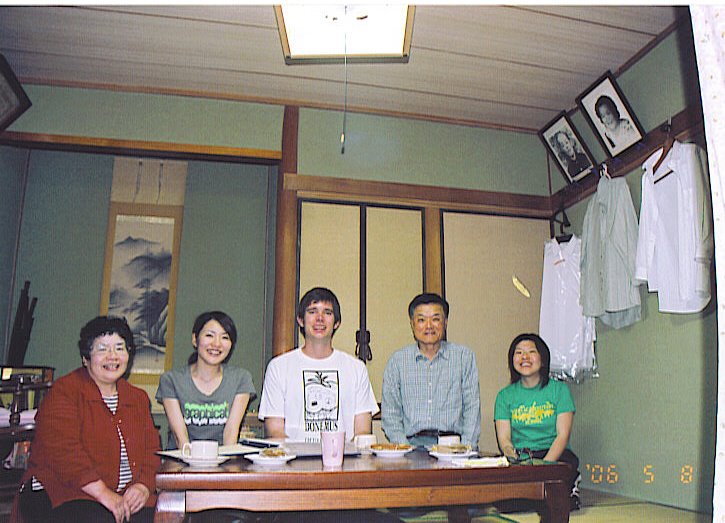
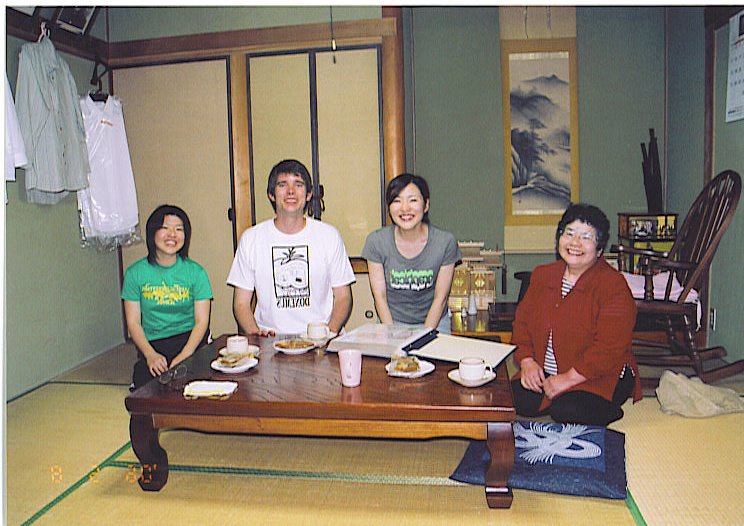
Just a few weeks ago I apologized one this blog for not having any pictures of Shoko with her eyes open. Then today I got more pictures from Shoko in the mail.

The first 5 are of me and Shoko at her Aunt and Uncles place. [Actually since Blogger loaded the new pictures from the top down, they've become the bottom 5 now]. Shoko still has her eyes closed in a couple of them. I can't really figure out why she has such bad luck with cameras because if you meet her in person she really does have very nice eyes. I think maybe she must just blink a lot.

This was in early May, about a week before I returned to Grand Rapids. In contrast to Shoko's mother, I was a big hit at this house. They were really excited to have me. The uncle said that they had never had a foreigner over for dinner before, so it was a big deal. The daughter was studying the protestant reformation at school, so they were really excited to have an actual real live protestant in the house who she could talk to. I did my best to explain the differences between Catholicism and Protestantism, and generally enjoyed playing the expert.

The bottom 4 [or I guess they're the top 4 now] are pictures Shoko just took last week and mailed out to me so I wouldn't complain about how I never had any pictures of her. Notice the nice eyes.

Useless Wikipedia Fact
Oita's Mt. Hachimen is also home to the popular music festival, Concert on the Rock. This annual charity event sees over 30 international acts performing over a June weekend for the pleasure of Japan's music lovers. The natural surroundings make it one of the most picturesque rock festivals in the world. Hmmm....I heavily suspect the Concert on the Rock folks had a hand in writing this very generous Wikipedia entry. Nevertheless I do have found memories of my own experiences at this concert.

Link of the Day
Regular Readers of this blog have probably noted I usually link to Chris or Justin when they describe some aspect of Ajimu or Oita life that I either never got around to or didn't describe very well myself.
Chris has a good entry summarizing the "Sex Museum" in Beppu (just one town over from Ajimu). I spent a very interesting afternoon here myself a few years ago.
Also both Chris and Justin wrote about the local Jamaica festival. Read Chris here or Justin here.

I wrote about this festival at this time last year ( seems so long ago now), but they've got pictures on their blog which help give it more of a flavor.

Friday, July 21, 2006

Ragtime by E.L. Doctorow

 (Book Review)
I first heard about this book because it was mentioned in “U.S.!” By Chris Bachelder, another book I read recently. In “U.S.!”, there is a fictional scene in which Upton Sinclair and E.L. Doctorow meet to discuss their respective works, and Doctorow’s "Ragtime" is mentioned because of its fictional treatment of anarchist Emma Goldman.

Since I read Emma Goldman’s autobiography last summer, that was enough to get me interested in this book. And then I found out “Ragtime” was listed as one of the 100 best novels of the 20th Century by the Modern Library, and I thought this would be an opportunity to check another one of their books off my list and feel smugly superior to everyone else in the process. So when I walked into my local library to find this book on their display case, it was a foregone conclusion to check it out.

Although Emma Goldman does pop up several times in this book, its not “The Emma Goldman Book” by any means. Emma Goldman is but one of several historical characters who walk in and out of the book, sharing the stage with Henry Ford, J.P. Morgan, Harry Houdini, Zapapata, the archduke Franz Ferdinand, Booker T. Washington, Sigmund Freud, and many others.

In addition to these historical giants a lot of minor and forgotten historical figures also pop up in the novel, like Evelyn Nesbitt, who appearently at one time was all over the tabloid papers because of her part in a love triangle that ended in a sensational murder and media circus courtroom trial.

I felt like I knew Emma Goldman’s life well enough to easily distinguish which parts of her story were fictional and which were real. (In fact, I’m pretty sure Doctorow must have also read Goldman’s autobiography, because most of Goldman’s biographical details seem lifted from Goldman’s own account). But for the rest of these characters I was constantly running back and forth to Wikipedia to find out what was true and what was not. This is a book that mixes history with fiction, and if you’re a history nerd like me you can’t sleep at night until you sort out what is true and what isn’t. So be forewarned.

I was somewhat surprised to learn that this book has been made into both a film and a Broadway musical. It’s a good book, but not all good books translate into good movies, and this book in particular doesn’t seem to have much of a linear plot. It wouldn’t have been my first choice to convert into the medium of drama, but I’ve not seen either the film or the musical, so I don’t know how they handled it.

Stylistically this book was a bit of a struggle for me at the beginning, but got progressively easier to read as I got into it. The story also starts out slowly, but really picks up a lot of speed in the last 100 pages.

Useless Wikipedia Fact
A swagman is an old Australian term describing an underclass of transient temporary workers, who travelled by foot from farm to farm carrying the traditional swag. A romanticised figure, the swagman remains famous through the song "Waltzing Matilda", by Banjo Paterson, which details a swagman who turns to stealing a sheep from the local squatter.

Link of the Day
I Was Israel’s Dupe By TOM HAYDEN
Hayden Revisits Sharon’s 1982 Attack on Beirut and His and Fonda’s Trip of Shame

Ragtime by E.L. Doctorow: Book Review (Scripted)

Wednesday, July 19, 2006

Paris Babylon by Rupert Christiansen

(Book Review)

This is another book on the Paris Commune, a subject which, as I’ve indicated several times on this blog, has become an interest of mine.

The Paris Commune is like any event in history in that it is very easy to understand if viewed in its simplest terms, but becomes very complex and confusing when you look at the details.

The accepted myth about the Paris Commune is that it is the first communist revolution. The French right was eager to demonize the Paris Commune with this accusation, and the Communists were eager to take credit, so the myth went unchallenged by both left and right historians for many years. Marx, Lenin, Trotsky, and Mao all wrote extensively about the Paris Commune and viewed it as the birth of the communist era.

The anarchists also lay claim to the Paris Commune for different reasons. This may seem contradictory, but remember anarchism and communism come out of the same socialist tradition, and 1871, the year of the Paris Commune, was before anarchists had been expelled from Marx’s International Workingmen’s Association. (This website here explains the Paris Commune from an Anarchist perspective).

But what was the Paris Commune really? Was it an international conspiracy controlled by the nefarious Dr. Marx and the International Workingmen’s Association, or was it a spontaneous uprising by a population who had suffered too much under the callous of the Second Empire, the blunders of the French Government during the Franco-Prussian War, and the Siege of Paris by the Prussian army.

Although Christiansen’s book is subtitled “The Story of the Paris Commune”, the Paris Commune itself doesn’t come on the scene until the last 100 pages. The rest of the book is dealing with the decadence of Paris under Napoleon III and the Second Empire, and the sufferings of the Parisian population during the siege. Hence the title and the comparisons with Paris as the second Babylon.

As a popular historian Christiansen does a great job during the siege of Paris and the Paris Commune. During both the siege and Commune he gives a day by day blow of what was going on in Paris, focusing on journal entries and memoirs from the participants. Fascinating reading.

Unfortunately the beginning of the book, the first 160 pages, is a bit slow. And nothing kills a book like a slow beginning. Unless the reader has a lot of patience, they might never get to the interesting parts.

For example there is the long chapter devoted to Urban renewal programs in Paris in the 1860s, during which I almost gave up the book. This is important historically, and certainly one of the causes of the Commune. (The fact that the poor were forced out of their old neighborhoods to make room for the Opera houses of the rich is cited by every historian as one of the causes of urban unrest in the late 1860s). But in a popular history, is it necessary to spend a whole chapter on the details of the urban renewal program? Could this point have been made in fewer words?

Others of Christiansen’s excursions are of questionable relevance. He devotes another chapter to the murder of Kinck family, a brutal murder which became a media circus in Paris in the 1860s. Even 100 years later the crime still feels fresh with tabloid voyeurism, but what is the connection to the Commune? According to Christiansen: “Every murder holds a mirror to society’s underbelly–its conscience, its values its soul. [Kinck’s murder trial] tells us about the way the Second Empire’s promotion of enterprise, commerce and profit as moral ideals could poison a fantasizing young teenager; it tells us about the bourgeois’ fear of the worker and the corruption of justice.”

Yeah, I suppose. Or one could say that every society, at any point in history, has always had its sickos and murderers.

Useless Wikipedia Fact
The Metric calendar was abolished because having a ten-day work week gave workers less rest (one day off every ten instead of one day off every seven); because the equinox was a mobile date to start every new year (a fantastic source of confusion for almost everybody); and because it was incompatible with the secular rhythms of trade fairs and agricultural markets.

Link of the Day
The Rightwing Language Police

Paris Babylon: The Story of the Paris Commune by Rupert Christiansen: Book Review (Scripted)

Friday, July 14, 2006

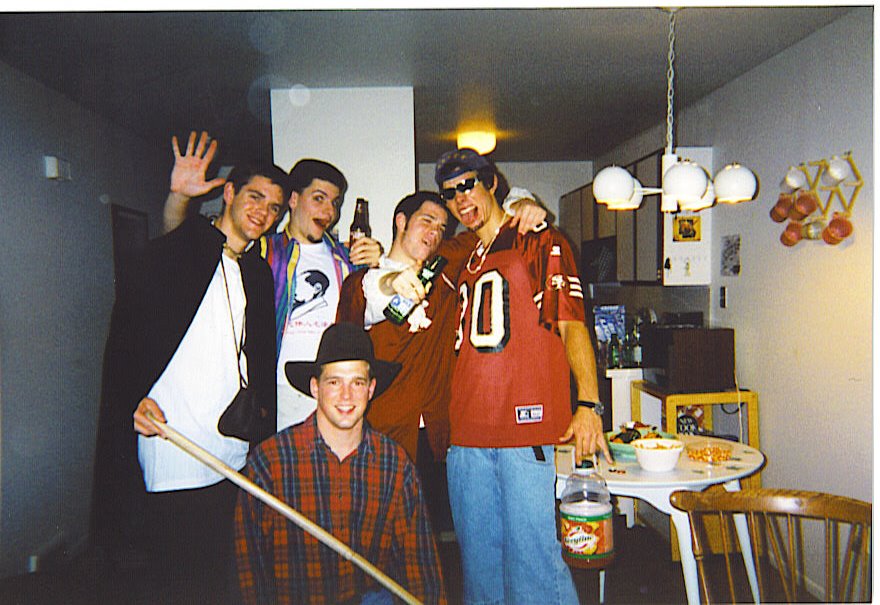
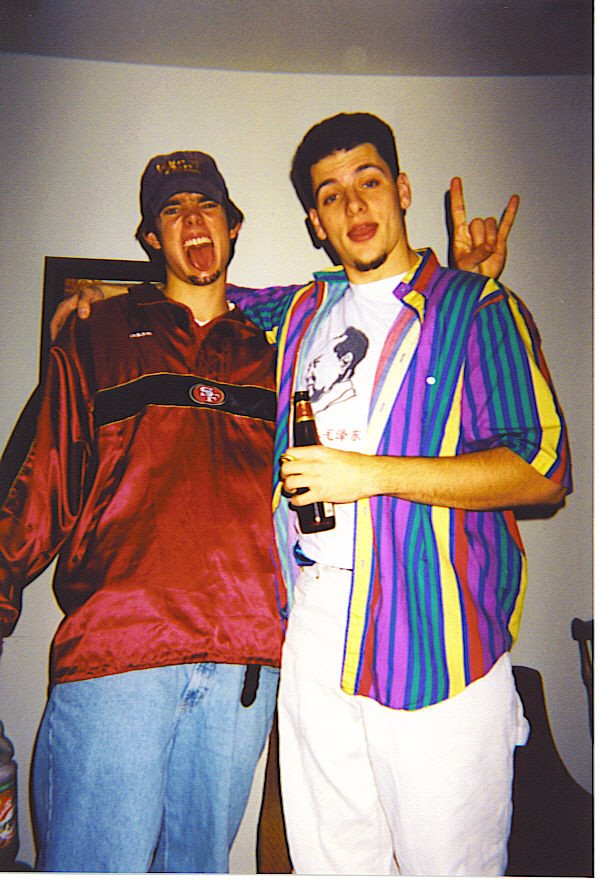
Halloween 1999


(Retrospection)

Perhaps my favorite Halloween ever. I dressed up like Rob and imitated him, he did likewise with me. We sent the pictures to Brett who was doing an exchange program in China. Brett's Korean girlfriend, who had never met either of us, thought that we looked good in each other's clothes, and should always keep the other one's fashion. We didn't follow the advice though, and the next day I was back to me, and Rob was back to Rob.

Useless Wikipedia Fact
Fictional Japanese Superheroes in the DC Universe:
Tsunami, aka Miya Shimada, an American citizen, the daughter of Japanese immigrants. She has superhuman control over the waves.
and
Doctor Light, aka Kimiyo Hoshi has the ability to manipulate ambient light for a variety of purposes. She can absorb all forms of illumination, and release that absorbed enregy as blinding flashes or light, or destructive laser beams. (Probably more, but those are the only two I know about).

Link of the Day
I've been lurking on Whiskey Prajer's blog (one of Phil's friends) for a long time now because I enjoy his thoughtful reviews of books and movies. He's started a project of blogging his favorite movies, counting down from 15. He's up to 11 last time I checked.
I think I'll sit this one out, but any one else feel like taking on the same project? I'm sure it would make interesting reading.

Wednesday, July 12, 2006

For Whom the Bell Tolls by Ernest Hemingway

 (Book Review)

Wow, did I love this book!

This is one of those books that’s been on my list for a long time, but that I kept putting off. I wanted to read it because I had heard it was about the Spanish Civil War, which is one of my historical interests because of the connection with anarchist and radical history. 5 years ago this is one of the few books I brought with me to Japan with the intention of reading, but never did.

I kept putting the book off because I had bad experiences with Hemingway in high school, and found the famous Hemingway style to be more annoying than anything else.

Perhaps I’ve matured as a reader, or perhaps this book is better than Hemingway’s usual, but I did not find Hemingway’s style as annoying as I remembered it. In fact I thoroughly enjoyed this book.

The story takes place in the mountains behind the fascist lines among the guerrilla fighters. Robert Jordan is an American volunteer who has been sent to dynamite a bridge in the fascist territory. Pablo, the leader of the guerrilla’s, is opposed to this mission because he views it as an unnecessary risk.

The debate about whether or not to destroy the bridge takes up most of the book. In a way it reminded me of those George Romero Zombie movies. An army of zombies is outside the house, but the humans spend the whole time arguing among themselves. “Go to the basement.” “No stay upstairs!”

“For Whom the Bell Tolls” has the same sense of misdirected energy. The guerillas are deep behind fascist lines, but they spend most of their time arguing with each other. Although this is a tactical rather than ideological debate, I suspect Hemingway might have meant this to be symbolic of the Spanish Civil War as a whole, and the failure of the anti-fascist forces to form a United Front. The issue of internal divisions is addressed more explicitly later in the book. Near the end there is a passage when one of the characters is sent to deliver a crucial message and gets delayed first by paranoid Anarchists, next by bureaucratic republicans, and finally by purge happy communists. The end result is that the message arrives too late.

Its always difficult to tease out the political beliefs of an author based on statements made by his characters, but I suspect Hemingway and I do not line up exactly. Robert Jordan, the main character, makes a number of statements that I really agreed with, including the subject of hidden fascism in the United States. On the other hand, the anarchists in this book are portrayed as either useless or drunks. And several characters make racist statements against Gypsies. (I guess it might be unfair to extend these sentiments to Hemingway himself, but they are never corrected elsewhere in the book.)


But politics aside the book as a story is amazing. I think especially Hemingway has a real skill for conversation. Not necessarily “writing the way people talk” (in fact much of the dialogue sounded stilted) but rather having a sense for the natural flow conversations take. And also the mental thought process of the characters was very well described.

The book is not antiwar, at least not in the tradition of “All Quiet on the Western Front.” The characters believe in the cause they are fighting for. But Hemingway makes a real effort to show the costs and misery of war. And the fascist soldiers are not shown as mindless robots to be killed like they would be in an Indiana Jones movie.

The theme of suicide is prevalent as well. Given how Hemingway ended his life, it’s interesting to see what his thoughts on the subject are.

Oh, and lest I forget, the book is also a love story. I guess I haven’t mentioned that yet, even though that’s the main point of the book. Actually the love story parts didn’t really stick with me that much. I enjoyed them for what they were, but it is the other themes of the book that I took more interest in. I guess there’s just no hope for me as a romantic.

Useless Wikipedia Fact
Aquaman has been referenced on two occasions in the animated television series The Simpsons (1989—). In "Treehouse of Horror VIII" (airdate October 26, 1997), in a sequence entitled "The Homega Man," the Comic Book Guy is shown reading an Aquaman comic as he states aloud, "But Aquaman, you can't marry a girl without gills. You're from two different worlds." He looks up to see a neutron bomb heading directly for him and mutters, "Ooo, I wasted my life," just before the bomb explodes. In "Hello Gutter, Hello Fadder" (airdate November 14, 1999) when Homer is drowning at the beach, he shouts out to his infant daughter, "Maggie, help! Call Aquaman!"

Link of the Day
This one is old news, about 3 years ago now, but I wanted to link to it just because I realized I never linked to it before. A salon.com article on police spying in Grand Rapids.
I was in Japan when all this was going on, but I'm extremely proud to say I know most of the people mentioned in the article. Abby Puls is a good friend from Calvin, and in fact stayed over here at my parents house a few nights once when she was waiting on a ride home for Christmas break. Erica Freshour and Jeff Smith are friends from Media Mouse, and I've gone on many adventures with them including the Quebec protest.

I know many of you have already seen this article. I see Phil Christman even had a letter into Salon about it. I was asking Jeff Smith about this the other day, and he told me that they had told the local media all about it, but no one thought it was news worthy until after Salon did a piece on it. Only then did the Grand Rapids Press and others cover the incident. Pathetic.

For Whom the Bell Tolls by Ernest Hemingway: Book Review (Scripted)

Sunday, July 09, 2006

Couch Burning

It’s great to be back home and having good times with friends once again. Last night there was a good old-fashioned couch burning at Hoort’s place.

Guam or Dean could probably tell you more about the history of this couch. Apparently its been in the Calvin family for about 9 years or so now, and has a lot of memories attached to it. But its also getting old and needed to be put out of its misery. As we watched that couch go up in flames, we felt the last of our youth burning away with it.

But it wasn’t just about couch burning. We had a great game of frisbee golf first. I’ve decided not to keep track of my score, but I have a feeling I was near the back of the pack. The amazing Mr. Guam put away another win.

Word is gradually getting around that I’m engaged, and so I was asked to tell my story. (Such as it is. I’m going to have to come up with a new story so that I have something better to tell). Also some people wanted to see pictures. I didn’t have pictures with me at the time, but pictures of Shoko can be seen on-line here and here. Neither of them are very good actually, because she has her eyes closed.

(Now that I have acess to a scanner, I guess I'm no longer limited to digital pictures other people take. I'll try and make it a point to scan in more pictures sometime soon. Although even on those pictures Shoko has her eyes closed a lot. I think she must just blink a lot at the wrong times).

We tried out Hoort’s throwing knives for a while, which I think could easily have provided hours of amusement had we not stopped for dinner. I also had the distinction of losing a knife on the first throw. I stepped up, threw the knife as hard as I could at the target, and it sank right into the ground. After all the knives had been thrown, nobody could find mine. We all remember it disappearing into the dirt a few feet away from me, but despite endless searching (and Hoort even getting out the gardening tools to dig with) we couldn’t retrieve the knife.

Hell of a first throw, huh? Pasta suspects that my knife was actually picked up by another person in the confusion, and it was a different knife that got lost. And I like this theory a bit because it lets me off the hook for losing Hoort’s knife. On the other hand, I do kind of like the idea of having so powerful a throw as to bury the knife deep into the dirt.

The couch, when we finally put it on the fire, really went up in flames a lot quicker than I think any of us expected. There were a couple minutes when it looked like the neighboring trees were going to catch fire, and Hoort brought out the garden hose just in case. And then, as quickly as it had flared up, the flames subsided.

Afterwards a night of good discussion and reminiscing. In addition to losing Hoort’s knife, I also had the distinction of being the last guest to leave. I was just saying to Hoort, “Well, now that Dean and Jess have left, if I’m not careful I’ll be the proverbial last guest who has to be kicked out of the house.”
“You already are,” Hoort said. “Guam and Yoshi, the only ones left, are staying the night.”

Useless Wikipedia Fact
The Peanuts are a Japanese twin sister singing group. They are Ito Emi (Ito Hideyo) and Ito Yumi (Ito Tsukiko). The twins were born in Nagoya on April 1, 1941.
They are very well known from their appearances in Mothra and Godzilla movies of the 1960s, in which they appeared as fairies called shobijin (small beauties) who had telepathic communication with Mothra.
(A bit cheesy perhaps, but one of my favorite Japanese groups. I'm listening to their CD as I write this).

Link of the Day
Star Democrats and the Prolongation of the Iraq War

Friday, July 07, 2006

Pudd’nhead Wilson by Mark Twain

 (Book Review)

This isn’t one of Mark Twain’s better known works, but Twain is one of those authors you can never go wrong with.

The plot is a little difficult to summarize, partly because this is, as Twain admits, a combination of different stories. And partly because most of the action takes place in the 5th act. Most of the rest of the book is just the characters positioning themselves.

So I think it is easier to just introduce the main characters instead. First is Dave Wilson, who is the smartest person in the town, and a great wit. Unfortunately no one else in the town understands irony, and so Wilson’s ironic witticisms are taken at face value, and the town people conclude he’s actually a complete idiot, thus the nickname “Pudd’nhead Wilson.”

Then there are the two babies switched at birth. One, Tom Driscoll, is the legitimate son and heir to the estate fortune. The other one, Chambers, is 1/32nd black, 31/32nd white, and thus under Southern law considered a slave and a piece of property. But no one notices when his mother switches the two babies and thus reverses the fortunes of each.

And finally two twin Italian nobles, who rent out a room in the town, and become the fascination and darlings of this sleepy Southern town.

When these three elements are mixed together, and a murder mystery thrown in during the 5th act, hilarity and Twain’s biting social commentary ensues.

According to the book’s cover jacket: “Twain’s ruminations on the issues of the day make this a novel of perpetual questions, and one of the author’s most ironic and elusive.” Which I took to mean: “We know he’s criticizing something, we just don’t know what.”

Some of the themes of the novel are easier to tease out than others. For instance an obvious point of criticism is the Southern law that 1/32nd black blood was enough to make one a slave. And the fact that these two babies could be switched and no one would ever notice hints that race is not so much a physical reality as much as a social concept. In this way Mark Twain seems to be ahead of his time. Also the fate of poor Pudd’nhead Wilson shows that genius is mocked more frequently than it is appreciated. As to the rest of the themes, I’ll leave to those more perceptive than me.

The actual story itself, I found the ending anti-climatic, and too predictable. Instead the real beauty of this book is all the humor mixed in along the way. For example each chapter opens with delightful ironic quotes from “Pudd’nhead Wilson’s Calender,”; the kind of biting one-liners that Mark Twain is famous for. My personal favorite was: “Adam was but human -- this explains it all. He did not want the apple for the apple's sake, he wanted it only because it was forbidden. The mistake was in not forbidding the serpent; then he would have eaten the serpent.”

(For someone who didn’t believe in the Bible, Mark Twain sure references it a lot. If you don’t know the story about Elisha, the 42 youths, and the bears, you’ll miss another great one-liner. I suppose in the days of Mark Twain biblical literacy must have just been assumed.)

Useless Wikipedia Fact
Davy Crockett had a son named Rob Patton Crockett, who in 1838 administrated his father's Texas land claim after Davy Crockett's death at the Alamo.

Link of the Day
Another addition in Swagman Family Blogging. It appears my little brother has set up a blog here.

Pudd’nhead Wilson by Mark Twain: Book Review (Scripted)

Wednesday, July 05, 2006

Happy 4th of July to Me

So, yesterday was my first 4th of July in the United States for four years. It's not really a holiday they celebrate in Japan, so it is nice to be back in the US for a good old 4th of July celebration, for nostolgia's sake, if nothing else.

Although to a certain extent, I almost enjoyed the 4th of July more when I was abroad. Being downtown in a crowd of several thousand of Americans, you don't really feel that special. When you're the only American in your town, the day kind of takes on new meaning for you. Sometimes some of us ex-pats would get together at Tropicoco or something for a little impromptu 4th of July Celebration. It was just like in "The Great Escape" when the Americans and British are celebrating the 4th of July together, and Steve McQueen kept saying, "Happy 4th of July, down with the British" and everyone had a good laugh.

When in Japan, I'd also make it a point to try and talk to my students about the 4th of July, as part of a cultural exchange if nothing else. I'd tell them that it was a really important day, because it was the first time since antiquity that a country had done away with the king, and created a free Republic.

Although recently I've been doing some reading, and I'm not sure if this is true anymore. In a book I was reading, it turns out the Netherlands were a Republic from 1581 and 1795. (There's also a Wikipedia Article here, if anyone wants a quick reference.) Strange that this never came up in any of my American civics classes in school. Maybe Guam or Lucretius or any of you other history nerds can help me out here with explaining why this is often overlooked. At any rate, it looks like my pride in being American is slightly diminished, but my pride in being Dutch is now slightly increased, so my overall pride is still at a steady level.

The last 4th of July I was in Grand Rapids (July 4th, 2001) we at Media Mouse joined in with the AdBusters campaign, and ordered an American flag filled with corporate symbols. We then had a little rally down at Veterans park, where we waved our Corporate America flag, and handed out flyers about how America was under the dominance of corporations. (Bork and Mulder were there as well, I recall. Do you guys remember that?) The old pamphlet is still on Media Mouse's website, if anyone is looking for a blast from the past.

So, anyway, now that I'm back in the US again, I thought it appropriate to once again exercise my patriotic duty to dissent on July 4th. After all, as Howard Zinn says, "Dissent is the highest form of patriotism".
(A contrary opinion can be found on my sister's blog. She records her disgust with my protesting on July 4th here. Once again it's gotten a bit hard to read these days since her unfortunate visual choice of white print over white flower, but I usually just copy and paste it onto a different screen).

This year there is a fast for peace going on national through September 21, and the Grand Rapids Chapter of Code Pink organized a local presence at Veterans park. (Information on the national fast is here, and you can Read the local flyer here. Also Sarah sends me information on Celebrities participating here.)

Unfortunately for me, fasting is not one of my strong points. I just like food way too much. And I never really saw the point of it.

(Some of you may remember how I used to antagonize the people at Calvin who were fasting for spiritual reasons by talking about food the whole time. To me the point of religion has always been in doing outward good, and I viewed the inward spiritualism as self-righteousness. Although in retrospect it was childish of me, and I do regret antagonizing the fasters. After all if Nate wanted to fast, what harm was he doing me? I should just have let him alone. But then again whenever we get together with the boys, the memory of me talking about my favorite foods and Nate getting up and leaving and slamming the door always comes up as one of the funnier Calvin memories).

Anyway, it was explained to me that I could do a modified Fast, so I decided to give up Caffiene and sweets for the Duration. I'm not sure if this really counts because both are things that I really should be giving up anyway. Just like I'm not really sure if it counts giving up bad things for Lent. Not that I'm currently in the habit of observing Lent, but just as an intellectual question. If you give up smoking or sweets or something you probably shouldn't be having anyway for Lent, does that count?

Brett was also somewhat skeptical about how my plan to give up coffee was going to bring the war to a close, and when pressed I had a hard time defending it. "What do you think people are going to say," he said sarcastically to me. "For God's sake don't shoot! That man hasn't had a cup of coffee in two months!"

Well, I guess it's a token effort, right? My general philosophy is that it's easy to just sit back and be critical, but its also important for people to try and make some sort of an effort in some way. In the meantime, Nate, if you want to brew a cup of coffee right in front of me, we'll just call it even, okay?

Anyway, if anyone is interested in participating, there are fast pledge sheets you can down load here, and then mail into Washington.

The peace presence on the 4th of July in Grand Rapids was a bit disappointing. Other than the family that organized it, very few people showed up. Although that is discouraging, it does make me that much more glad I went, because they were really hurting for people.

In the evening I went downtown to see Fireworks with Brett and Sarah and friends. I saw a few people I hadn't seen in years, so that was really nice. On the other hand I remember during my Calvin days I used to go downtown for festivals and see tons of people I know. Naturally after being out of the country for 5 years, I guess I can't expect to keep up so many contacts, but I think a lot of it is just getting older as well, and high school and college friends have moved away. A little depressing in a way.

Useless Wikipedia Fact
Philistinism is a derogatory term used to describe a particular attitude or set of values. When a person is called a Philistine (in the relevant sense), he is said to despise or undervalue art, beauty, intellectual content, and/or spiritual values. Because the Philistines were neighbors and enemies of the Israelites, the term originates from German student slang, supposedly first in Jena in the late 17th century, as a dismissive term for the townspeople (compare the British university slang, 'townies,') It is said that at a memorial service for a student killed in a town-gown clash, the minister took for his text the words of Delilah to Samson,'The Philistines be upon thee, Samson!'

Link of the Day
Patriotism & The Fourth of July by Howard Zinn

Monday, July 03, 2006

Two Different Thoughts

Once again I’m combining two unrelated thoughts under one post.
First:

Congress
Suppose you were an idiot. And suppose you were a member of Congress. But I repeat myself.
- Mark Twain


The Behavior of Congress for the past few weeks has been even more idiotic than usual: debating an amendment to ban flag burning, ban gay marriage, and the problem of violent video games. If you’ve been watching “The Daily Show” lately, they’ve been doing a good job of satirizing this, but I want to add my voice of disgust.

There is apparently a widespread belief in Republican circles that poverty, business regulations, health care, and environment is all the job of the private sector, and it’s the government’s responsibility to regulate what video games you buy and making sure gay people can’t get married, and protect the flag. I just don’t understand this. And I suspect the founding fathers are rolling in their graves. We don’t send these guys to Washington so they can debate about whether or not we have too much liberty. They’ve got more important things to do.

I know I’ve gone on similar rants before, but this is one thing I’ve never understood. As this old Tom Tomorrow cartoon shows, Democrats can sometimes fall into the same fallacy, but the last 6 years have been safely Republican.

Superman Returns
I saw “Superman Returns” the other night with my family.

As with any summer blockbuster movie, this has been getting more than its fair share of ink. (Imagine if we paid that much attention to what Congress was doing!) But I want to throw in my two cents.

I’ve heard a lot of talk lately from certain people about how lame Superman is: how Superman is too powerful so that his adventures not even interesting, or how he is too perfect so that he doesn’t have any of the necessary human faults necessary to sustain human interest.

There’s no doubt that Superman is outdated. You could argue that Batman is cooler because he doesn’t have any superpowers. Or you could say Spider-man is cooler because he has a lot more real life type problems. And you’d be right. But you’d be missing the point.

Superman is the closet thing we have to an American legend; an American equivalent of King Arthur or Joan of Arc or what have you. If you doubt it, just see how much name recognition Davy Crockett or Daniel Boone or whoever have overseas. But people in every country of the world recognize Superman immediately. To say Superman is the most famous comic book character ever would simply be stating the obvious.

To my mind, the Superman story is a lot like the Trojan War. The concepts behind the Trojan War became outdated centuries ago. (A ten year war over a woman?) And yet every generation feels the need to try their hand at retelling it. Remember how excited some of us got when the Troy movie came out?
Superman’s the same way. Sure his story is not 3000 years old, but 70 years is a long time for a comic book character. How many boys today have lunch boxes with “The Lone Ranger” or “Flash Gordon” or “Dick Tracy” etc.

The challenge is in reinventing this American icon for a new generation. Its also part of the fun. Sure, Superman’s godlike abilities make it hard to write a suspenseful story, but it can be done. You just have to pit him against an equally skilled villain, like Doomsday or Lobo, or Brainiac in the comic books. Or you focus on the subplots and relationships instead, like in the TV show “Lois and Clark”.

The point is it can be done. All that being said...
This new Superman movie really sucked eggs. Kevin Spacey was good as Lex Luther, but there was absolutely no plot to speak of. The ending was melodramatic, drawn out, and just symbolic enough to be pretentious. (Pretentiousness is the kiss of death for any comic book adaptation.) Matt Lind has a good post going further into some of this symbolism.
Too much of the movie revolved around Superman flying around or posing against the backdrop of dramatic music. Everyone’s glad to see Superman back on the silver screen, but there’s a limit to what the audience should have to put up with for the sake of nostalgia.

Useless Wikipedia FactThe Beatles' "Revolver" is often cited as one of the greatest albums in pop music history. In 1997 it was named the 3rd greatest album of all time in a 'Music of the Millennium' poll conducted by HMV, Channel 4, The Guardian and Classic FM. In 1998 Q magazine readers placed it at number 2, while in 2001 the TV network VH1 placed it at number 1. Revolver was also voted the best album of all time in the Virgin All Time Top 1,000 Albums . A PopMatters review described the album as "the individual members of the greatest band in the history of pop music peaking at the exact same time", while Ink Blot magazine claims it "stands at the summit of western pop music".

Link of the DayTen Lessons from the Criminalization of Dissent

Superman Returns: Movie Review (Scripted)

Sunday, July 02, 2006

Invasion of the Body Snatchers by Jack Finney

 (Book Review)

Surprise! This book is actually pretty well written. Despite its title being synonymous with B-movies, the original book demonstrates that Jack Finney has a lot of talent.

I know many of you will question my literary tastes, but I challenge you to just read the first couple pages and look at what skill the author sets up his characters with. Then, for comparisons sake, read a couple pages of something from the “Left Behind” series.

My only problem is with the plot. For one thing it moves pretty slowly. I guess most of that is intentional, but it’s always annoying when it takes the main characters a long time to realize something the reader knows from page one. The main characters realize very early on that many of their friends just don’t seem the same, but don’t realize the truth until much later in the book when the evidence is absolutely overwhelming. Which I suppose is probably how things would be in real life. Most sane people wouldn’t realize it was an alien invasion until they had exhausted all other possibilities.

I think (and I’m just thinking off the cuff here) that perhaps there has been an evolution in science fiction writing. Modern readers are so sick of the main characters taking forever to realize what they already know that modern writers short circuit a lot of the plausible disbelief, and have characters jump to conclusions a lot sooner. But again, that’s just off the cuff.

The other problem is that after all the build-up, the ending is anti-climatic, and seems a little bit deus-ex-machina. Somewhat like the “War of the Worlds” ending. Just when it looks like all is lost, all of a sudden.....(Well, I won’t give away the ending, but if you’ve read “War of the Worlds” it’s not all that dissimilar). Although, given the enormous odds against which the main characters had to fight, I was thinking that the final ending would be something like that. There was no way they could have won in a straight fight.

Useless Wikipedia Fact
Perhaps most controversial of all of Mark Twain's work was the 1879 humorous talk at the Stomach Club in Paris, entitled "Some Thoughts on the Science of Onanism", which concluded with the thought, "If you must gamble your lives sexually, don't play a lone hand too much." This talk was not published until 1943, and then only in a limited edition of fifty copies
Link of the Day
Media coverage of Iraq debate steeped in GOP talking points


Invasion of the Body Snatchers by Jack Finney: Book Review (Scripted)