Showing posts with label Aesops Fables ESL Listening. Show all posts

Saturday, June 12, 2021

The Man The Boy and The Donkey: Aesop's Fables ESL Story Time

(TESOL Worksheets--Aesop FablesStory Time ESL Listening)

Worksheet: docspub
Slow speed Version: HERE, Normal speed version: HERE, Quizlet: HERE
(The text is based on this lesson HERE).


The Man The Boy and The Donkey Aesop’s Fables #721

(Original Title: The Miller, His Son and The Donkey)

Video slow speed: https://youtu.be/o6FGtStarE8

Video normal speed: https://youtu.be/QXRpb77Kxts

Quizlet: https://quizlet.com/_5zsk9d


Suggested Use:

Step 1: Look at the vocabulary. Check any words that you don’t know in your dictionary.

Step 2: Listen to the video. (Listen only.  Don’t look at the reading yet).

Step  3: Practice the vocabulary on Quizlet 

Step 4: Watch the video again.  This time look at the reading. Read and listen at the same time.

Step 5: Practice the vocabulary on Quizlet again.

Step 6: Listen one last time.  The last time, don’t look at the reading. 


Vocabulary

along, bridge, cause, continue, continue down, decide, donkey, drop, drown, foot, fall, follow funny, hear, kick, laugh, laughter, lazy, leg, lesson, loose, moral,  once, once upon a time, pass, point, pole, poor, raise, ride, shoulder, son, stupid, tie, tired, tired of, townspeople, upon


The Man The Boy and The Donkey Aesop’s Fables #721

Once upon a time, a man and his son were going to the market with their donkey. As they were walking along the road, two men saw them.   One of the men said, “They are so stupid!  They have a donkey, but no one is riding it.”  

When the man heard this, he told his boy to ride on the donkey.  And then they continued down the road.  But soon they passed a group of men.  The men said, “That boy is so lazy.  He is riding while his poor old father has to walk.”  

When the man heard this, he told his boy to get off of the donkey, and he got on the donkey himself.   And then they continued down the road again.  But they hadn’t gone far when they passed two women.  The women said, “That man is so lazy.  Look, he is riding while his poor young son has to walk.”

 When the man heard this, he didn’t know what to do.   He thought for a while, and then he told his son to come up onto the donkey with him.  So the two of them were riding the donkey together.

A little while later, they passed some more people.  Someone said, “Look at that! The poor donkey must be so tired.  It has to carry two people at the same time!”

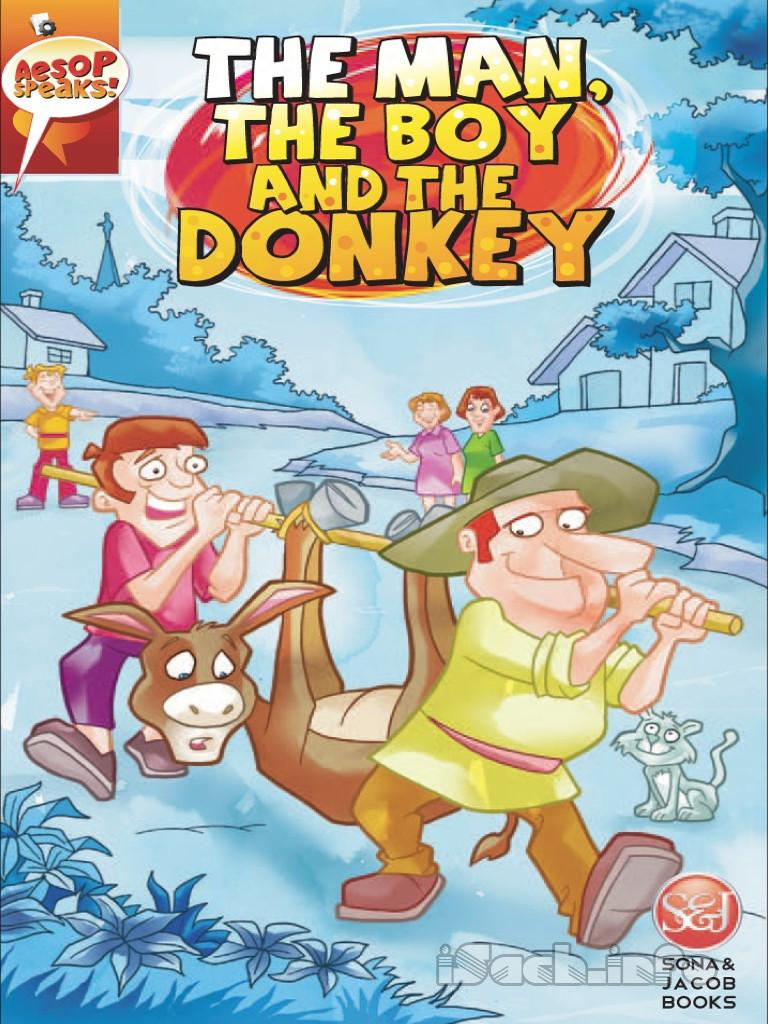
So, the man and his boy both got off the donkey, and they tried to think what to do next.  They thought, and they thought, until at last they decided to carry the donkey.  They took a large pole, and tied the donkey’s feet to the pole, and raised the pole up to their shoulders, and carried the donkey along.  

By this time, they had come into town.  The townspeople saw them carrying the donkey, and they thought it was the funniest thing they had ever seen.  They laughed and laughed.

The man and the boy walked along, hearing the laughter from all the people who met them.  At last, they came to the bridge over the river.  At this point, the donkey was tired of being carried, and it kicked its legs to try to get loose.  This caused the boy and his father to drop the pole, and the donkey fell into the river and drowned.

“That will teach you a lesson,” said an old man who had followed them.  “If you try to make everyone happy, no one will be happy.”


The moral of the story is:

You can’t please everyone.
 

Vocabulary

along - from one part of a road, river, etc to another:

We drove for miles along dusty roads.


bridge - a structure that is built over a river, road, etc so that people or vehicles can go across it:

We will go across the bridge.


cause - to make something happen:

The hurricane caused widespread damage.


continue - to keep happening, existing, or doing something:

It continued to snow heavily for three days.


continue down - to go further in a particular direction:

Continue down the road until you reach Walnut Street.


decide - CHOOSE

to choose something after thinking about several possibilities:

I haven't decided whether or not to tell him.


donkey - an animal that looks like a small horse with long ears


drop - LET FALL

to let something you are carrying fall to the ground:

She tripped and dropped the vase.


drown - to die because you are under water and cannot breathe:

Two people drowned in a boating accident yesterday.


foot - one of the two flat parts on the ends of your legs that you stand on:

He stepped on my foot.


fall - to move down towards the ground:

Huge drops of rain were falling from the sky.


follow - to move behind someone or something and go where they go, sometimes secretly:

She followed me into the kitchen.


funny - making you smile or laugh:

That is a funny story.


hear - to be aware of a sound through your ears:

I could hear his voice in the distance.


kick - to move your feet and legs forwards or backwards quickly and with force:

I kicked at them and screamed for help.


laugh - to smile while making sounds with your voice that show you are happy or think something is funny:

You never laugh at my jokes.


laughter - the sound or act of laughing:

I heard the sound of laughter in the room next door.


lazy - Someone who does not like working or using any effort:

He's too lazy to make his bed in the morning.


leg - one of the parts of the body of a human or animal that is used for standing and walking:

My legs are tired after so much walking.


lesson - an experience that teaches you how to behave better in a similar situation in the future:

My parents made me pay back all the money, and it was a lesson I never forgot.


loose - not firmly fixed:

There were some loose wires hanging out of the wall.


moral - something you learn from a story or event about how to behave:

The moral of the story is never lie.


once - in the past, but not now:

This house once belonged to my grandfather.


once upon a time - used at the beginning of a children's story to mean that something happened a long time ago


pass - to go past something or someone:

She passed me this morning in the corridor.


point - a particular time in an event or process:

At this point, people started to leave.


pole - a long, thin stick made of wood or metal, often used to hold something up:

These are tent poles..


poor - used to show sympathy for someone:

That cold sounds terrible, you poor thing.


raise - to lift something to a higher position:

He was ordered to raise the flag.


ride - to travel by sitting on a horse, bicycle, or motorcycle and controlling it:

I ride my bike to work.


shoulder - where your arm joins your body next to your neck:

She looked over her shoulder.


son - your male child:

Jenny has a grown-up son of 24.


stupid - silly or not intelligent:

That was a really stupid thing to do.


tie - to fasten something with string, rope, etc:

The dog was tied to a tree.


tired - feeling that you want to rest or sleep:

I'm too tired to go out tonight.


tired of - bored or annoyed by something that has happened too often:

I'm tired of listening to her problems.


townspeople - people who live in a particular town, considered as a group:

The townspeople have embraced the summer music festival.


upon - on:

The jar had been placed upon the table.

Friday, June 11, 2021

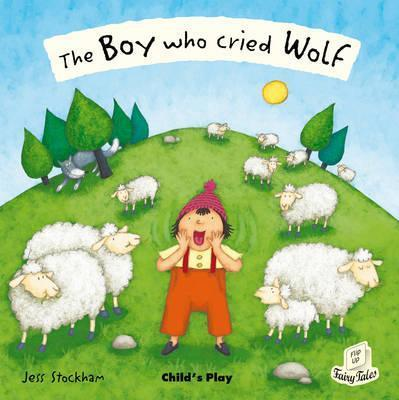
The Boy Who Yelled Wolf: Aesop's Fables ESL Story Time Listening

(TESOL Worksheets--Aesop FablesStory Time ESL Listening)

Worksheet: docspub
Slow speed Version: HERE, Normal speed version: HERE, Quizlet: HERE
(The text is based on this lesson HERE).


The Boy Who Yelled Wolf Aesop’s Fables #210

(Original Title: The Boy Who Cried Wolf)

Video slow speed: https://youtu.be/KASysdw_wEw

Video normal speed: https://youtu.be/JI6BeM1q-sE

Quizlet: https://quizlet.com/_5vzo2q


Suggested Use:

Step 1: Look at the vocabulary. Check any words that you don’t know in your dictionary.

Step 2: Listen to the video. (Listen only.  Don’t look at the reading yet).

Step  3: Practice the vocabulary on Quizlet 

Step 4: Watch the video again.  This time look at the reading. Read and listen at the same time.

Step 5: Practice the vocabulary on Quizlet again.

Step 6: Listen one last time.  The last time, don’t look at the reading. 


Vocabulary

angrily, bored, chase, face, fool, fun, funny, hillside, jump, laugh, liar, lie, loudly, moral, nobody, once, once upon a time, return, sheep, sunset, townspeople, truth, upon, yell, wolf, wonder


The Boy Who Yelled Wolf Aesop’s Fables #210

Once upon a time, there was a shepherd boy who was bored as he sat on the hillside watching his sheep. To have some fun, he yelled out, "Wolf! Wolf! A wolf is chasing the sheep!"

The townspeople came running up the hill to help the boy. But when they came to the top of the hill, they found no wolf. They got very angry.  The boy thought it was all very funny, and he laughed at their angry faces.

"Don't say 'wolf' when there is no wolf!" said the townspeople.  Then they went angrily back down the hill.

Later, the boy yelled out again, "Wolf! Wolf! A wolf is chasing the sheep!" And again, he watched the townspeople run up the hill. 

When the townspeople saw no wolf, they angrily said, "Don't say ‘wolf' when there is no wolf!"  But the boy just laughed and watched them go angrily down the hill once more.

But then, the boy saw it: a real wolf coming up the hill.  He jumped up, and yelled as loudly as he could, "Wolf! Wolf!"

But the townspeople thought he was trying to fool them again, and so they didn't come.

At sunset, the townspeople wondered why the shepherd boy hadn't returned to the town with the sheep. They went up the hill to find the boy. They found him crying.

"There really was a wolf here! The sheep are all gone! I cried out, ‘Wolf!’ Why didn't you come?"

An old man put his arm around the boy. “This is what happens when you tell lies,” he said.


The moral of the story is:

Nobody believes a liar...even when he is telling the truth


.

Vocabulary

angrily - adverb form of angry


bored - feeling tired and unhappy because something is not interesting or because you have nothing to do:

I'm bored with doing homework.


chase - to run after someone or something in order to catch them:

The dog was chasing a rabbit.


face - the front part of the head where the eyes, nose, and mouth are, or the expression on this part:

She's got a long, thin face.


fool - to trick someone:

He fooled the old man into giving him the money.


fun - enjoyment or pleasure, or something that gives you enjoyment or pleasure:

You'll like it - it's good fun!


funny - making you smile or laugh:

It's not funny. Don't laugh!


hillside - the sloping side of a hill


jump - to push your body up and away from the ground using your feet and legs:

I jumped over the log.


jump up - to get up quickly


laugh - to smile while making sounds with your voice that show you are happy or think something is funny:

You never laugh at my jokes.


liar - someone who tells lies


lie - something that you say or write which you know is not true:

I told a lie when I said I liked her haircut.


loudly - Adverb form of "loud":

he was speaking very loudly.


moral - something you learn from a story or event about how to behave:

The moral of the story is never lie.


nobody - no person:

There was nobody I could talk to.


once - in the past, but not now:

This house once belonged to my grandfather.


once upon a time - used at the beginning of a children's story to mean that something happened a long time ago


return - to go or come back to a place where you were before:

She returned to America in 1954.


sheep - a farm animal whose skin is covered with wool:

There was a flock of sheep.


sunset - the time when the sun disappears in the evening and the sky becomes dark


townspeople - people who live in a particular town, considered as a group:

The townspeople have embraced the summer music festival.


truth - the real facts about a situation:

Do you think he was telling the truth?


upon - on:

The jar had been placed on the table.


yell - to shout something very loudly:

The policeman yelled at them to stop.


wolf - a wild animal like a large dog


wonder - to want to know something or to try to understand the reason for something:

I wonder what he's making for dinner.

Thursday, June 10, 2021

Aesop at the Shipyard: Aesop's Fables ESL Story Time Listening

(TESOL Worksheets--Aesop FablesStory Time ESL Listening)

Worksheet: docspub
Slow speed Version: HERE, Normal speed version: HERE, Storytelling version: HERE, Quizlet: HERE


Aesop at the Shipyard Aesop’s Fables #8

Video slow speed: https://youtu.be/DXhKz6IdKKU

Video normal speed: https://youtu.be/xeYuU2YGjIk

Video Storytelling: https://youtu.be/DeVUx5VmxRQ

Quizlet: https://quizlet.com/_6spqab


Suggested Use:

Step 1: Look at the vocabulary. Check any words that you don’t know in your dictionary.

Step 2: Listen to the video. (Listen only.  Don’t look at the reading yet).

Step  3: Practice the vocabulary on Quizlet 

Step 4: Watch the video again.  This time look at the reading. Read and listen at the same time.

Step 5: Practice the vocabulary on Quizlet again.

Step 6: Listen one last time.  The last time, don’t look at the reading. 


Vocabulary

alive, ancient, appear, background, background information, believe, boat, builder, clothes, cover, culture, disappear, drink, Earth, entirely, even, famous, fun, giant, goddess, grassland, gulp, in order to, including, land, laugh, laugh at, level, lose, make fun of, moral, mountain, nobody, ocean, once, part, place, poor, quickly, ship, shipyard, someday, storyteller, tomorrow, ugly, whole


Names

Names of people: Aesop


Names of nationalities: Greeks


Aesop at the Shipyard Aesop’s Fables #8

Background Information: (“Background information” is something you need to know in order to understand the story.)

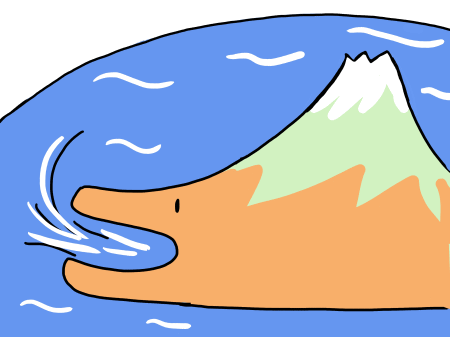
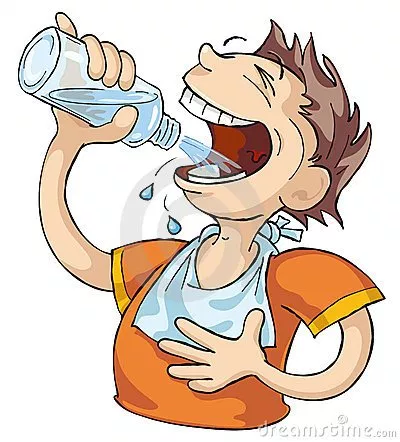
Every culture has its own story about how the Earth began.  The ancient Greeks believed that the Earth was alive.  They thought that the whole Earth--all of the land, including all the mountains, forests, and grasslands--was all part of one giant Earth goddess.  The Greeks believed that in the beginning the whole earth was covered by ocean.  But one day, the Earth took a big gulp of water.  (“Gulp” means to drink a lot of something very quickly).  Much of the ocean disappeared, and because the ocean level went down, the mountains could be seen. Then the Earth took another big gulp of water, and the ocean level went down even more, and this time the forests and the grasslands appeared.  The Greeks believed that one day the Earth goddess might take a third gulp, and then the ocean would disappear entirely.  


The Story

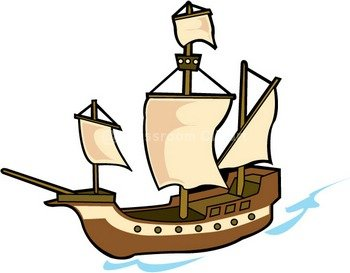
Aesop, the famous storyteller, once visited a town that was next to the ocean.  Because this town was next to the ocean, they needed a lot of ships.  (“Ships” are large boats that can carry things over the ocean.)  So, many people had jobs building ships.

Aesop went to the shipyard to watch the builders.  (A “shipyard” is a place where ships are built.)  

Now, Aesop was very ugly.  And he was very poor.  When the builders saw how ugly Aesop was, and how poor his clothes looked, they laughed at him, and made fun of him.  

“Ah,” said Aesop.  “You think you are better than me because you have money and good jobs.  Well, let me tell you a story.  In the beginning, the whole Earth was covered by ocean.  And then, the Earth took a big gulp, and the mountains appeared.  Then the Earth took a second gulp, and the forests and grasslands appeared.  Someday, the Earth may take a third gulp, and then all of the ocean will disappear.  And then, nobody will need ships, and you will all lose your jobs.”  


The moral of the story is:

The world is always changing, and the good things you have today could be gone tomorrow.  

.


Aesop at the Shipyard Aesop’s Fables #8

Video slow speed: https://youtu.be/DXhKz6IdKKU

Video normal speed: https://youtu.be/xeYuU2YGjIk

1. What is something that you need to know in order to understand the story?


2. What does every culture have?


3. What appeared after the Earth took the first gulp of water?


4. What appeared after the Earth took the second gulp of water?


5. What would happen if the Earth took a third gulp of water?


6. At the town Aesop visited, what did a lot of people have jobs doing?


7. Where did Aesop go to watch the builders?


8. Why did the builders laugh at Aesop and make fun of him?


9. Why did the builders think they were better than Aesop?


10. What will happen if the ocean disappears?


Answers

1. What is something that you need to know in order to understand the story?

Background information


2. What does every culture have?

Its own story about how the Earth began 


3. What appeared after the Earth took the first gulp of water?

The mountains


4. What appeared after the Earth took the second gulp of water?

The forests and the grasslands


5. What would happen if the Earth took a third gulp of water?

The ocean would disappear entirely


6. At the town Aesop visited, what did a lot of people have jobs doing?

Building ships


7. Where did Aesop go to watch the builders?

The shipyard.


8. Why did the builders laugh at Aesop and make fun of him?

Because he was very ugly, and he was very poor.


9. Why did the builders think they were better than Aesop?

Because they had money and good jobs.


10. What will happen if the ocean disappears?

Nobody will need ships, and the builders will all lose their jobs.


Vocabulary

alive - living, not dead:

Are your grandparents still alive?


ancient - from a long time ago:

This is an ancient building.


background - the situation that an event happens in, or things that have happened in the past that affect it:

The talks are taking place against a background of economic uncertainty.


background information - all information that a reader requires to increase his awareness of the topic


believe - to think that something is true, or that what someone says is true:

They believe that their health has suffered because of the chemicals.


boat - a vehicle for travelling on water:

This is a fishing boat.


builder - someone who makes or repairs buildings or structures as a job


clothes - items such as shirts and trousers that you wear on your body:

She was wearing her sister's clothes.


cover - to form a layer on the surface of something:

Snow covered the trees.


culture - the habits, traditions, and beliefs of a country, society, or group of people:

It's a good opportunity for children to learn about other cultures.


disappear - to stop existing:

These flowers are disappearing from our countryside.


appear - to start to be seen:

He suddenly appeared in the doorway.


drink - To put liquid into your mouth and swallow it:

Would you like something to drink?


Earth - the planet that we live on:

The spaceship returned to Earth.


entirely - completely:

I'm not entirely convinced that it will work.


even - used when comparing things, to emphasize the difference:

I think Alex is going to be even taller than his father.


famous - known or recognized by many people:

New York is a city famous for its shopping and nightlife.


fun - enjoyment or pleasure, or something that gives you enjoyment or pleasure:

You'll like it - it's good fun!


giant - extremely big, or much bigger than other similar things:

This is a giant spider.


goddess - a female spirit that people pray to and who has control over parts of the world or nature:

She was the ancient goddess of hunting.


grassland - a large area of land covered with grass:

Conservation groups are restoring grasslands in the Midwest.


gulp - to drink or eat something quickly:

He took a large gulp of tea.


in order to - with the purpose of achieving something:

She worked all summer in order to save enough money for a holiday.


including - used to show that someone or something is part of a larger group, amount, or process:

Fourteen people, including a prison warden, were killed.


land - the surface of the Earth that is not sea:

I want to travel over land and sea.


laugh - to smile while making sounds with your voice that show you are happy or think something is funny:

You never laugh at my jokes.


laugh at - to show that you think someone or something is stupid:

I can't go into work looking like this - everyone will laugh at me.


level - the height of something:

The water level is going up.


lose - to stop having someone or something that you had before:

I hope he doesn't lose his job.


make fun of - to make a joke about someone or something in an unkind way:

The other children at school used to make fun of his hair.


moral - something you learn from a story or event about how to behave:

The moral of the story is never lie.


mountain - a very high hill:

It was a long climb up the mountain but the view was worth it.


nobody - no person:

There was nobody I could talk to.


ocean - the sea:

I want to swim in the ocean.


once - in the past, but not now:

This house once belonged to my grandfather.


part - one of the things that, with other things, makes the whole of something:

Part of this form seems to be missing.


place - a position, building, town, area, etc:

Is there a place where we can talk privately?


poor - having very little money or few possessions:

Most of these people are desperately poor.


quickly - fast or in a short time:

I quickly shut the door.


ship - a large boat that carries people or goods by sea:

This ship sails weekly from Florida to the Bahamas.


shipyard - a place where ships are built or repaired


someday - at an unknown time in the future:

We plan to get married someday.


storyteller - a person who writes, tells, or reads stories


tomorrow - the day after today or on the day after today:

It's my birthday tomorrow.


ugly - unpleasant to look at:

It hurt my feelings when he said I was ugly.


whole - complete, including every part:

She spent the whole afternoon studying.


Aesop - a Greek fabulist and storyteller credited with a number of fables


Greek - Someone from Greece, or coming from or relating to Greece