Showing posts with label 6 stars books. Show all posts

Monday, April 11, 2022

The Tin Woodman of Oz by L. Frank Baum

(Book Review--Land of OzFantasyChildren's Books)  

Started: March 17, 2022
Finished: March 31, 2022
(This review is written using my new format for book reviews.) 

Background Information

Originally published  in 1918, this is the 12th book in the Land of Oz series by L. Frank Baum. The story of this book is based upon an unresolved plot thread from the first Oz book.  

So, to set this book up, it's necessary to go back to some comments I made in my video review of the first Oz book: The Wonderful Wizard of Oz.  Specifically from 17:53:
...speaking of the Tin Woodman, his origin story is a little bit bizarre, and I actually don't remember how they explained it in the movie, but here in the book he says that he was in love with a Munchkin woman and then what happened, somebody got jealous or something, and so the wicked witch enchanted his axe, so he cut one arm off and then he had it replaced with tin and then he cut another arm off with his axe so the axe was enchanted so whenever he would swing it, it would fly so it would cut off a piece of his body,  and then he lost his limbs, and then it cut off his body, so he had to get his body replaced and then he had to get his head replaced ...and then the the Tin Woodman, because he's all made out of tin he's no longer in love with that Munchkin woman who he had been in love with, and she just is waiting for him and he has completely no desire for her anymore, so he thinks that if he gets the heart then maybe he'll remember his love for this Munchkin woman he was once in love with...but then once he gets the heart at the end, then there's there's never any mention made about that Munchkin woman again. She's mentioned in his origin story, but then once he gets his heart in fact he goes off to become the ruler of the Winkies and and has no desire to... I don't know, maybe that will be addressed in one of the later books. Maybe, you know, near the end of the series, book 15, he'll remember his Munchkin lover or I don't know...


...it turns out, I was right.  This unresolved plot thread from the first book is now finally being picked up in book 12 (18 years later).  Apparently I wasn't the only one who noticed this plot whole, because L. Frank Baum opens up the book by saying: 
I know that some of you have been waiting for this story of the Tin Woodman, because many of my correspondents have asked me, time and again what ever became of the "pretty Munchkin girl" whom Nick Chopper was engaged to marry before the Wicked Witch enchanted his axe and he traded his flesh for tin. I, too, have wondered what became of her, but until Woot the Wanderer interested himself in the matter the Tin Woodman knew no more than we did. However, he found her, after many thrilling adventures, as you will discover when you have read this story.

Plot Summary (***SPOILERS***) and Evaluation

A boy named "Woot the Wanderer" (a new character) shows up at the Tin Woodman's palace, and asks about his origin story.  The Tin Woodman tells the story about the enchanted axe and the girl he was in love with, and Woot asks why the Tin Woodman never returned to her.  
The explanation for this (something that was never explained in the first book) involves a bit of retconning.  It's explained that the Tin Woodman was given a kind heart, but not a loving heart, so even after getting his heart from the wizard, he still wasn't able to return the love of the Munchkin girl he left behind.  (The continuity in the Oz books is so fluid that at this point in the series you just have to accept it.  The cast of characters is largely consistent, but every book re-imagines their shared history, and you just have to go with it.)
Woot the Wanderer points out that even someone with a kindly heart wouldn't abandon the girl that was waiting for him.  The Scarecrow says that Woot is right, and the Tin Woodman, the Scarecrow and Woot the Wanderer decide to go on a journey to try to find the Tin Woodman's lost love.  
As with (almost) all of the books in the Oz canon, this is a journey story.  Our main characters journey along the road, and then they encounter many obstacles and strange things.  Most of them have no relationship to the overall plot, they're just fun little side adventures.  (Or, as the case may be, boring little side adventures.)
There's a little side adventure into the land of the balloon creatures, which I found funny and imaginative.


The characters also encounter the castle of Mrs. Yoop.  (Mrs. Yoop is a call-back to book 7: The Patchwork Girl of Oz, in which our characters had encountered Yoop the giant.  Mrs. Yoop is his wife.)  Mrs. Yoop transforms the Tin Woodman into a tin owl, the Scarecrow into a straw bear, and Woot into a green monkey.  

(They also encounter Polychrome, the rainbow's daughter--from book 5--who has been transformed into a canary).  
They escape from Mrs. Yoop's castle into the forest, but then have to escape a hungry jaguar in the forest, and then a den of dragons under ground.  It's all a bit ridiculous, and none of it advances the main plot at all, but... it's fun.  There's a bit of madcap energy to it, and it's fun to imagine this group of misfit characters--a green monkey, a tin owl, and straw bear, and a canary with fairy powers.
The plot slows down a bit after this.  
There's an interlude with Dorothy and Ozma as they get changed back to their original forms.
Then there's the introduction of a second tin man, and a rather bizarre scene in which the tin woodman encounters his original head again (and has a conversation with it.)
The last part of the journey (going through the invisible country and encountering the Hip-po-gy-raf that likes to eat straw) bored me, but then we get to the end soon after that, and the ending was suitably clever.

There are some fun call backs to previous books.  In addition to the one's I've already mention above, we encounter Jinjur (from book 2) and the mother and father of the 9 little piglets (from book 4).  
Of course, there are a lot of inconsistencies.  (Jinjur had a husband in book 3 who is now missing.  The origin of the 9 little piglets in book 4 was from outside of Oz, but now it is changed to be from within Oz.)  
The way the continuity appears to work in these Oz books is that L. Frank Baum likes to bring back characters from previous books for cool call-back scenes, but the characters also get slightly re-imagined with each new book.

Extended Quotation  


The Tin Woodman had just noticed the cupboards and was curious to know what they contained, so he went to one of them and opened the door. There were shelves inside, and upon one of the shelves which was about on a level with his tin chin the Emperor discovered a Head—it looked like a doll's head,210 only it was larger, and he soon saw it was the Head of some person. It was facing the Tin Woodman and as the cupboard door swung back, the eyes of the Head slowly opened and looked at him. The Tin Woodman was not at all surprised, for in the Land of Oz one runs into magic at every turn.
"Dear me!" said the Tin Woodman, staring hard. "It seems as if I had met you, somewhere, before. Good morning, sir!"
"You have the advantage of me," replied the Head. "I never saw you before in my life."
"Still, your face is very familiar," persisted the Tin Woodman. "Pardon me, but may I ask if you—eh—eh—if you ever had a Body?"
"Yes, at one time," answered the Head, "but that is so long ago I can't remember it. Did you think," with a pleasant smile, "that I was born just as I am? That a Head would be created without a Body?"
"No, of course not," said the other. "But how came you to lose your body?"
"Well, I can't recollect the details; you'll have to ask Ku-Klip about it," returned the Head. "For, curious as it may seem to you, my memory is not good since my separation from the rest of me. I still possess my brains and my intellect is as good as ever, but my memory of some of the events I formerly experienced is quite hazy."


"How long have you been in this cupboard?" asked the Emperor.
"I don't know."
"Haven't you a name?"
"Oh, yes," said the Head; "I used to be called Nick Chopper, when I was a woodman and cut down trees for a living."
"Good gracious!" cried the Tin Woodman in astonishment. "If you are Nick Chopper's Head, then you are Me—or I'm You—or—or— What relation are we, anyhow?"
"Don't ask me," replied the Head. "For my part, I'm not anxious to claim relationship with any common, manufactured article, like you. You may be all right in your class, but your class isn't my class. You're tin."
The poor Emperor felt so bewildered that for a time he could only stare at his old Head in silence. Then he said:
"I must admit that I wasn't at all bad looking before I became tin. You're almost handsome—for meat. If your hair was combed, you'd be quite attractive."
"How do you expect me to comb my hair without help?" demanded the Head, indignantly. "I used to keep it smooth and neat, when I had arms, but after I was removed from the rest of me, my hair got mussed, and old Ku-Klip never has combed it for me."
"I'll speak to him about it," said the Tin Woodman. "Do you remember loving a pretty Munchkin girl named Nimmie Amee?"
"No," answered the Head. "That is a foolish question. The heart in my body—when I had a body—might have loved someone, for all I know, but a head isn't made to love; it's made to think."
"Oh; do you think, then?"
"I used to think."
"You must have been shut up in this cupboard for years and years. What have you thought about, in all that time?"
"Nothing. That's another foolish question. A little reflection will convince you that I have had nothing to think about, except the boards on the inside of the cupboard door, and it didn't take me long to think of everything about those boards that could be thought of. Then, of course, I quit thinking."

Links

Dane and I are doing this series as a buddy reads.  Dane's written review is here.  He makes the point: "It’s also potentially the first book in the whole series that isn’t mistitled, so there’s that."  Which is actually a good point.

Dane's video review is here:  


And, once again, I'm relying on the analysis of Mari Ness in her Oz re-read series.  Her review for this book is here: Transformations in Fairyland: The Tin Woodman of Oz
Mari Ness's review is useful for getting at the themes underlying this book.  (Something I confess I didn't fully appreciate until I read her review).  To quote from part of it:
Beneath the ongoing puns (and an extremely silly encounter with balloon people), The Tin Woodman of Oz is a surprisingly serious book, dealing with issues of identity and fidelity. Throughout the book, the Tin Woodman and his companions are forced to confront assumptions about who and what they are. 
 Mari Ness doesn't mention it, but there's also a part in chapter 11 that perfectly fits her thesis about this book:
The Bear and the Owl gravely watched this operation and nodded approval when Woot's silky green fur shone clear and bright in the afternoon sun. The Canary seemed much amused and laughed a silvery ripple of laughter as she said:
"Very well done, my good Jinjur; I admire your energy and judgment. But I had no idea a monkey could look so comical as this monkey did while he was being bathed."
"I'm not a monkey!" declared Woot, resentfully;154 "I'm just a boy in a monkey's shape, that's all."
"If you can explain to me the difference," said Jinjur, "I'll agree not to wash you again—that is, unless you foolishly get into the fireplace. All persons are usually judged by the shapes in which they appear to the eyes of others. 

This reminds me of something further.  I'm reminded of comments Chomsky made in the documentary Is the Man Who is Tall Happy?   Chomsky talks about the story of Sylvester and the Magic Pebble (W) and uses it as an example of how children use language to assign identity to things--Sylvester is still considered a donkey even when he is transformed into a rock.  That same identity issue is brought up several times in The Tin Woodman of Oz.

Like a lot of these stories in the Oz series, a flawed story, but one that definitely has its charms.  6 out of 10 stars.

March 20, 2022 p.1206-1208 
March 27, 2022 p.1208-1250
April 3, 2022 p.1250-1305

Video Review (Playlist HERE)


Wednesday, March 16, 2022

The Lost Princess of Oz by L. Frank Baum

(Book Review--Land of OzFantasyChildren's Books)  

Started: March 1, 2022
Finished: February 28, 2022
(This review is written using my new format for book reviews.)  

Background Information

Originally published in 1917, this is the 11th book in the Oz series.  

The Plot  (***SPOILERS***)

Ozma, the princess of Oz, has disappeared, and nobody knows where she went.
Well, nothing to do but sent out a search party.  Dorothy and her friends decide to go wandering through the land of Oz and hope that they bump into Ozma somewhere in their journey.
And along the way, they encounter many strange lands and strange creatures.
So, yes, this is another journey story in the Oz series.  Most of the books are journey stories in which the characters go along the road, and encounter wacky adventures as they go.
This book is somewhat unique in that our primary group of adventurers are all old characters.  Usually L. Frank Baum introduces several new characters to go on the journey, but this time it's all familiar faces: Dorothy, Toto, Button Bright, Trot, Hank the Mule, the Little Wizard, Woozy, Betsy Bobbin, the Cowardly Lion, the Saw Horse, and The Patchwork Girl all set out in one huge party.  
It's a lot of characters to juggle in the narrative, but L. Frank Baum does a decent job of balancing them all out.
There is, however, a secondary plot, and in this secondary plot L. Frank Baum fills his usual quota of new characters.  In the secondary plot, Cayke the Cookie Cook loses her magic cookie dishpan, and she sets out to find it with Frogman (a giant anthropomorphic frog), and along the way the are joined by Lavender Bear (the king of the teddy bears) and the magic Pink Bear.
Both groups converge near the end, and realize that their quests are one and the same (the same person who captured Ozma also stole the magic dishpan).  

The Reading Experience / Evaluation

So, 11 books into the Oz series now, and what is there left to say?  My comments about this book are going to be remarkably similar to my comments about all the other Oz books in the series.
On the negative side:
--There's no real plot development.  The characters just wander around and stumble upon various things.
--The continuity in this series is inconsistent.  There's a lot of things established in previous books that are contradicted in this one.
--Even within this book, there's some inconsistencies.  (Can creatures die in the Land of Oz or not?  This book seems to go back and forth on it.)

On the positive side:
--The characters are fun and delightfully wacky.  And at this point in the series, we've now got a large ensemble of characters (most of which were introduced in previous books), so we've got a lot of fun characters to play around with.
--Some of the lands and creatures that are encountered along the way are fun to imagine.

Links

As always, I'm reliant on the analysis of Mari Ness.  Her review of this book can be found here: Wandering in Fairyland: The Lost Princess of Oz.
To quote from parts of her review:
The Lost Princess of Oz is, at its heart, a tale of truth, deception and illusion, taking a subtle look at the methods used by rulers to maintain control. Nearly every ruler and authority figure in this book tells a lie of one kind or another, actively building a net of deception. Those who do not are oddly powerless.  Throw in a classic quest story, a hint of mystery, and lessons on the differences between reality and illusion, and you have one of the better of the latter Oz books.
Oh, and a village of gun-toting teddy-bears. What’s not to love?
As you can see from the above quotation, Mari Ness picks up on a theme that (I admit) I did not pick up on when I read it.  I read this book as just another typical Oz, but Mari Ness notes that there's a theme of deception and control throughout the book.  And upon reflection, I think she's got a good point.  To see her develop this argument further, read her full review.  
Mari Ness also comments:
The book is not without its flaws. I was displeased to see the return of the deux ex machina Magic Belt, especially given that every other magical item of Oz was stolen. So why not that one?  The usual inconsistencies and minor detours abound, along with yet another example of how the Tin Woodman’s relentless focus on kindness can result in a potentially serious miscarriage of justice, as in Patchwork Girl.  A side plot about Toto’s supposedly stolen growl gets annoying.

Yes, I agree.

As usual, I'm doing this book as a Buddy Reads with Dane.  At the time of  this writing, Dane hasn't posted his video review yet, but his written review is HERE:
After reading so many of the Oz books with Joel Swagman on YouTube, I was starting to feel a little jaded by the series. Luckily, this one brought things back up, although not quite to their former levels.
I think part of that is because the last few books have just felt as though Baum was just shoehorning Oz in, rather than using the land and his original cast of characters to their full extent. The fact that this one centres on Dorothy and friends instead of just bringing them in at the end to say hello made for a much more engaging read.
The plot itself was pretty interesting too, because it basically centred around a bunch of characters teaming up to try to track down Ozma, who’s gone missing. What’s not to like about that?
All in all then, it’s restored my faith a little in what the Oz series has to offer, and I’m looking forward to finishing it off. Good times.

Odds and Ends 

And indeed, this is the book where Toto finally starts talking.
This has been a long time coming. It's been established since book 3 that any ordinary animal who enters the Land of Oz is able to talk.  Of course the continuity in these books is famously loose, but this is a point that's come up over and over again: Billina the Hen, Hank the Mule, Jim the Horse, Eureka the Kitten.  So eventually it became a bit glaring that Toto was the only animal who never talked.
It was then established in book 8 that Toto could talk, he just didn't want to.  But L. Frank Baum apparently changed his mind on this, so in this book, Toto is talking just as much as the other characters.
After spending so much time with Toto as just a normal dog, it's a bit odd to see him talking all the time now.  As Dane says, "I'm not sure whether I'm up for that!"  It feels strange, but it's also new and interesting.

* This book gets an extra point from me for having an anthropomorphic frog as a main character.
I couldn't tell you why, but I always associate anthropomorphic frogs with delightfully charming children's stories.   I guess it's just association from childhood--stories like The Wind in the Willows (and its Disney - adaptation), songs like Froggie Went A-Courting, Frog and Toad are Friends, etc.

Extended Quotation

From Chapter 10: Toto Loses Something
"I've lost my growl!" said Toto, who had been very silent and sober all that day. "What do you suppose has become of it?"

"If you had asked me to keep track of your growl, I might be able to tell you," remarked the Lion sleepily. "But, frankly, Toto, I supposed you were taking care of it yourself."

"It's an awful thing to lose one's growl," said Toto, wagging his tail disconsolately. "What if you lost your roar, Lion? Wouldn't you feel terrible?"

"My roar," replied the Lion, "is the fiercest thing about me. I depend on it to frighten my enemies so badly that they won't dare to fight me."

"Once," said the Mule, "I lost my bray, so that I couldn't call to Betsy to let her know I was hungry. That was before I could talk, you know, for I had not yet come into the Land of Oz, and I found it was certainly very uncomfortable not to be able to make a noise."

"You make enough noise now," declared Toto. "But none of you has answered my question: Where is my growl?"

"You may search me" said the Woozy. "I don't care for such things myself."

"You snore terribly," asserted Toto.

"It may be," said the Woozy. "What one does when asleep one is not accountable for. I wish you would wake me up, some time when I'm snoring, and let me hear the sound. Then I can judge whether it is terrible or delightful."

"It isn't pleasant, I assure you," said the Lion, yawning.

"To me it seems wholly unnecessary," declared Hank the Mule.

"You ought to break yourself of the habit," said the Sawhorse. "You never hear me snore, because I never sleep. I don't even whinny, as those puffy meat horses do. I wish that whoever stole Toto's growl had taken the Mule's bray and the Lion's roar and the Woozy's snore at the same time."

"Do you think, then, that my growl was stolen?"

"You have never lost it before, have you?" inquired the Sawhorse.

"Only once, when I had a sore throat from barking too long at the moon."

"Is your throat sore now?" asked the Woozy.

"No," replied the dog.

"I can't understand," said Hank, "why dogs bark at the moon. They can't scare the moon, and the moon doesn't pay any attention to the bark. So why do dogs do it?"

"Were you ever a dog?" asked Toto.

"No, indeed," replied Hank. "I am thankful to say I was created a mule—the most beautiful of all beasts—and have always remained one."

The Woozy sat upon his square haunches to examine Hank with care.


"Beauty," said he, "must be a matter of taste. I don't say your judgment is bad, friend Hank, or that you are so vulgar as to be conceited. But if you admire big waggly ears, and a tail like a paint-brush, and hoofs big enough for an elephant, and a long neck and a body so skinny that one can count the ribs with one eye shut—if that's your idea of beauty, Hank—then either you or I must be much mistaken."

"You're full of edges," sneered the Mule. "If I were square, as you are, I suppose you'd think me lovely."

"Outwardly, dear Hank, I would," replied the Woozy. "But to be really lovely one must be beautiful without and within."

The Mule couldn't deny this statement, so he gave a disgusted grunt and rolled over so that his back was toward the Woozy. But the Lion, regarding the two calmly with his great yellow eyes, said to the dog:

"My dear Toto, our friends have taught us a lesson in humility. If the Woozy and the Mule are indeed beautiful creatures, as they seem to think, you and I must be decidedly ugly."

****END QUOTATION****
I choose this  quotation because it illustrates a number of things:
* It's a perfect illustration of how much Toto is talking now in this book.
* It's the introduction of one of the book's subplots about how Toto has lost his growl--a subplot that will be mentioned all throughout the remainder of the book, but will ultimately go nowhere.  (I agree with Mari Ness that this subplot is one of the book's weaker points.)
* It's also a good example of how the main plot of this book will simply stop to allow the animals to talk to each other--L. Frank Baum has a lot of characters he's juggling on this journey, and to keep them from becoming superfluous, he frequently stops the plot to allow them to talk with each other.  There are positives and negatives to this.  (I admit to feeling some frustration during these sections.)
* Although speaking of Mari Ness, she actually sees these conversations as part of the book's larger theme about deception versus reality.  "He’s not the only one who has to study deception versus reality. To find Ozma, Dorothy and the gang must learn the difference between illusion and reality, and the deceptiveness of appearances, as they move through a series of traps set by a sorcerer, and try to deduce Ozma’s location.  In yet another twist on the theme, the Lavender Bear’s magic allows him to do illusions—illusions that show the truth. And the animals have several conversations about appearance versus reality as they argue over which of them—Hank, the Woozy, the Cowardly Lion, Toto or the Sawhorse—is the most beautiful."

As you can see from my links above, Mari Ness and Dane both rate this book as a better than average Oz story.  I am tempted to just rate this as average.  But upon reflection, it perhaps does have enough charming moments to push it just slightly above average.  And it also has an anthropomorphic frog.  6 out of 10 it is.  

March 6, 2022: p.1100-1112
March 13, 2022: p.1112-1136

Video Review (Playlist HERE)


Monday, December 20, 2021

The Fellowship of the Ring by J. R. R. Tolkien

 (Book Review--Fantasy)

Started: November 7, 2021
Finished: December 19, 2021
(This review is written using my new format for book reviews.)

Background  Information

First published in 1954, this was at the time the long-awaited sequel to The Hobbit(The Hobbit had been published all the way back in 1937).  
This is also the first book of The Lord of the Rings Trilogy.  The Lord of the Rings Trilogy is one long story that Tolkien split into 6 books.  The publisher than decided to divide those 6 books into 3 volumes.  This, the first volume, contains the prologue, Book 1 and Book 2.  Because this is part of a larger series, it ends with the story unresolved.  
It seems to be universally agreed among critics that there was a tonally shift between The Hobbit  and The Lord of the Rings Trilogy.  The Hobbit was written for children, but The Lord of the Rings is targeting adults.  

My History with This Book

I mentioned in my review of The Hobbit that in childhood I had been familiar with The Hobbit because of the Rankin-Bass movie.  I was likewise as a child familiar with The Lord of the Rings story through the Rankin-Bass 1980 cartoon The Return of the King (W), which, like The Hobbit, was re-run on The Disney channel in the 1980s.  
If you've seen the Rankin-Bass version, you'll know that although The Return of the King is primarily an adoption of the final book in the trilogy, it's also set up to work as a direct sequel to The Hobbit.  So for the longest time, I thought I knew the whole story because of the movie.  But gradually, as I got older, I became to get hints through bits and pieces of cultural osmosis that The Lord of the Rings trilogy had a lot more story in it than I realized.
In 2001, there was a lot of anticipation of the upcoming Peter Jackson adaptation of these books, and I knew that if I didn't read them before the movies came out, I would never read them.  
Also back in 2001, I had newly discovered audio books, and I thought they were the most wonderful thing ever to get extra "reading" done when I was driving around town.  I had also discovered that you could check out audio books for free from the public library.  So I checked out The Fellowship of the Ring in the winter of 2001.  (The library didn't have The Hobbit on audiobook, so I checked out a physical copy of The Hobbit and read that first.)

Now, as I said, I already knew the basic story from the Rankin-Bass movie.  I knew that this was going to involve Frodo and Sam journeying to Mordor while their was a big battle outside of Minas Tirith.  But I didn't know what other story details would be buried in the extra 1,500 pages.  I imagined that there must be a lot of interesting subplots going on to justify the extra length, and I eagerly awaited to hear all about the different factions and plots that I was sure made up the rest of this story.  (I wasn't aware of what Game of Thrones was back then, but in retrospect I think I was expecting something Game of Thrones-esque--I was sure that there must be a lot of different plot wheels in motion to justify the huge length of this trilogy.)

I was therefore puzzled, and also frustrated, when The Fellowship of the Ring turned out to have almost no plot at all other than "characters go on a journey".  And the journey just went on and on and on through endless descriptions of landscape and countryside.  "When is the plot going to get started?" I kept wondering.  But the plot never really seemed to kick in.

But also, the more I got into the book, more I was confused about what was happening.  Who was this Strider guy and where did he come from?  Where did Legolas and Gimli come from?  
This was I think partly because as I got increasingly bored by the long descriptive parts of this book, my attention began to falter.  (Always a danger when doing audio books).  And, I think, this was partly because I was driving around the city while I was listening, and at times distracted by traffic.  And, also because I think the narration style of this book doesn't lend itself to audio books.  (I think here are some information dense paragraphs that take time to parse.)

But for whatever reason, I finished the book feeling like I only had a vague understanding of the story.

I saw the Peter Jackson movie at a friend's apartment in 2002.  (I had been in the Japanese countryside in 2001, and so missed the theatrical release).  And then when I saw that movie, I finally felt like I understood what had actually happened  
I particularly remember the part of the battle in the Mines of Moria, which had really confused me in the audiobook, only became clear to me after watching the movie.  

Why I Re-Read This Book

Ever since 2001, I've felt like I'd only partially absorbed this book, and needed to sit around and read it properly one day.

I should also mention that in the years since 2001, I've spent a lot of time reading about Tolkien on the Internet, and also a lot of time in conversation with Tolkien fans.  And I've become more aware of exactly what to expect from a Tolkien book, and what not to expect from a Tolkien book.  I've learned that you aren't supposed to go into Tolkien's book for their fast-paced plots, but rather you are supposed to read these books for their atmosphere.  
The long descriptions Tolkien gives of the forests and the shire and the mountain passes and the rivers--that's not Tolkien taking forever to get to the point, that is his point.
Now that I know a bit more about what to expect from these books, and their place in literary history, I've been meaning to give them another try for years now.  It's taken me a while, but here I am.

The Plot ***SPOILERS****

Back before December, 2001, only nerds actually knew what the plot of these books were.  But all that has changed now since the Peter Jackson movies, right?  Everyone has seen the movies already.  Everyone already knows this story.
Right?
Of course there are some differences from the movie.  Boromir's death, which actually takes place at the beginning of the next book, was moved to the end of the first movie in order to give it more of a dramatic note to go out on.
Also the movie infamously cut out the whole Tom Bombadil part.  (I say "infamously" because Tolkien fans complaining about Tom Bombadil getting left out of the movie was a big thing on the Internet for a while ... or maybe I just spend too much time online.)

The Reading Experience

Adjusted expectations is really the key to enjoying this book.
Fortunately, now that this is my second time through this book, I knew what to expect.  I did not expect (nor did I get) a fast-paced book.  I expected a book that would take its sweet time, and that's what I got.  I tried to get into it and enjoy the atmosphere.  
As a reader, I have long ago acquired the bad habit of letting my eyes glaze over whenever I come to a descriptive passage, and only waking up again when we get back to more dialogue or plot.  I was tempted to do this with The Fellowship of the Ring, but I tried to force myself to pay attention to the descriptions, and try to visualize Tolkien's landscapes in my head.  And, although this book did require a lot of patience on my part, I largely enjoyed it.
There is also a tremendous amount of long poems and songs in this book.  It seemed a bit weird to me.   (Is this a musical?  Why are characters constantly bursting into song?  I mean, I know that in the ancient world, epic poetry was a common form of entertainment, but did ancient people really sing this much?)  
As with the descriptive passages, I struggled to keep focused on the longer poems.  (Again, my brain had a tendency to switch off during these passages.)  But I forced myself to re-read the poetry sections until I felt like my brain had absorbed them.  

Then, when the big action scene finally came in the Mines of Moria, the pacing of the book suddenly changed in a way that I felt was jarring.  After reading through so many slow descriptive passages for so long, it took me a bit to adjust to the fact that the action was suddenly moving very fast all of  a sudden.  But I did make the adjustment, and that big fight in the Mines of Moria is a masterpiece of really intense writing!  At least for a little while.  But then, the action ends, and the long slow journey continues.

Evaluation

This book occupies an interesting cultural space.  It's so beloved by popular culture.  Which is strange, because it's a very long and slow moving book that requires a lot of patience to get through.  I mean, the fans of this book have been not just the literati, but also hippies, heavy metal bands, and comic book geeks.  Which is strange, I thought, because it's a book that requires a lot of patience to get through. I mean, can you picture Led Zeppelin actually sitting down and reading this book, with all the endless descriptions?  But they did!  Jimmy Paige was a huge Tolkien fan.
As for me, I've spent the past 20 years feeling guilty for not having grokked this book the way others have grokked it.  So I've come back to this book not with a critical eye so much as with a searching eye--what is it about this book that has captivated so many people?
I feel like I got some more out of this book now than I did 20 years ago.  I get the mysticism and poetry of it more than I did before.
But I still came to the end of this book, and thought: "Is that it?  How did this very slow moving book captivate so many people?"
Maybe the answer will become clearer as I read through the rest of the trilogy.

Extended Quotation

'Alas! I fear we cannot stay here longer,' said Aragorn. He looked towards the mountains and held up his sword. 'Farewell, Gandalf!' he cried. 'Did I not say to you: if you pass the doors of Moria, beware? Alas that I spoke true! What hope have we without you?'
He turned to the Company. 'We must do without hope,' he said. 'At least we may yet be avenged. Let us gird ourselves and weep no more! Come! We have a long road, and much to do.'
They rose and looked about them. Northward the dale ran up into a glen of shadows between two great arms of the mountains, above which three white peaks were shining: Celebdil, Fanuidhol, Caradhras, the Mountains of Moria. At the head of the glen a torrent flowed like a white lace over an endless ladder of short falls, and a mist of foam hung in the air about the mountains' feet.
'Yonder is the Dimrill Stair,' said Aragorn, pointing to the falls. 'Down the deep-cloven way that climbs beside the torrent we should have come, if fortune had been kinder.'
'Or Caradhras less cruel,' said Gimli. 'There he stands smiling in the sun!' He shook his fist at the furthest of the snow-capped peaks and turned away.
To the east the outflung arm of the mountains marched to a sudden end, and far lands could be descried beyond them, wide and vague. To the south the Misty Mountains receded endlessly as far as sight could reach. Less than a mile away, and a little below them, for they still stood high up on the west side of the dale, there lay a mere. It was long and oval, shaped like a great spear-head thrust deep into the northern glen; but its southern end was beyond the shadows under the sunlit sky. Yet its waters were dark: a deep blue like clear evening sky seen from a lamp-lit room. Its face was still and unruffled. About it lay a smooth sward, shelving down on all sides to its bare unbroken rim.
'There lies the Mirrormere, deep Kheled-zaram!' said Gimli sadly. 'I remember that he said: "May you have joy of the sight! But we cannot linger there." Now long shall I journey ere I have joy again. It is I that must hasten away, and he that must remain.'
The Company now went down the road from the Gates. It was rough and broken, fading to a winding track between heather and whin that thrust amid the cracking stones. But still it could be seen that once long ago a great paved way had wound upwards from the lowlands of the Dwarf-kingdom. In places there were ruined works of stone beside the path, and mounds of green topped with slender birches, or fir-trees sighing in the wind. An eastward bend led them hard by the sward of Mirrormere, and there not far from the roadside stood a single column broken at the top.

***END QUOTATION.  From Book 2 chapter 6 pages 433-434****
I thought this was a good example of one of Tolkien's landscape descriptions.  Like a lot of these descriptions, I did my best to visualize this, but I struggled.  
I also found myself struggling the geographical vocabulary when reading Tolkien's landscapes.   What is a "mere"?  What is a "glen"? What is "heather" and "whin"?  I've heard the word "dale" before, of course, but I couldn't visualize what a "dale" actually was.  What is a "sward"?  What is a "deep-cloven way"?

(On a separate note, this passage also does a good job of illustrating the style--which is a combination of modern prose style with an ancient epic style.)

Stray Comments

* So, I know Tolkien is still much-beloved today.  But if he were a new and unknown writer, there's no way he could get these books published nowadays, right?  I feel like the publishers wouldn't allow such a slow pace in a fantasy series nowadays.

* So, between The Hobbit and The Fellowship of the Ring, the name for the bad guys switches from "goblins" to "orcs".  But apparently they're still the same creature?  Although I often get the impression that goblins are diminutive creatures, whereas orcs are bigger.  So are they the same or not?  (I've been confused about this for years  now.  I thought maybe if I read through these books carefully, it would become clear.  But it's not really.  There's still no explanation about why the name changes from "goblins" to "orcs").

* Are Gandalf's powers ever clearly defined?  What exactly can he do?  What can he not do?

* Something I remember from the audio book 20 years ago was feeling confused about the Ringwraiths.  They are built-up to be so fearsome and scary, but then they never do anything.  In the first half of this book, they are always around Frodo and his friends, but never actually attack.  After a while it was hard to see them as scary anymore, and they just started to seem ineffectual.
I had the same reaction when I re-read the book.

* Okay, confession time. I've always thought this whole quest to destroy the ring seemed like a bit of a silly MacGuffin.  And even though Tolkien does a lot of work to explain the origins and mythology of the ring in this book, I still had trouble buying the idea that the whole fate of Middle-Earth depended on destroying this one ring.

* The character development in this book isn't great, is it?  I'm not entirely sure what the difference between Merry and Pippin is.  They seem pretty interchangeable.  I'm not sure if Legolas will get more developed as the series goes on, but he doesn't really seem to have much of a character in this book except as "elf".  Aragorn doesn't really have much of a character.  I mean, right on down the line, none of these characters really have that much of a personality to distinguish them from the rest of the crew.

* There's an old story that when Tolkien was reading The Lord of the Rings drafts aloud to The InklingsHugo Dyson groaned "Oh no! Not another fucking elf!" 
I'm not sure if that happened during the drafts of Fellowship or if it was later in the trilogy.  But I suspect it might be from Fellowship.  Tolkien makes such a big deal out of the elves in this book.
The elves were also a big part of the story in The Hobbit, but they weren't portrayed as significantly more important than the other races of Middle-Earth in The Hobbit.  But in Fellowship, the elves keep popping up over and over again.  First we run into elves in The Shire.  Then we spend a lot of time with the elves in Rivendell.  Then our characters set out again, only to run into another elf civilization in the forest of Lothlorien.
I realize the whole appeal of these books is that the elves represent nature spirits, and you're supposed to immerse yourself in the romanticization of the natural world as represented by the elves, and enjoy the mystical mythical feel of it all.  But it all became a bit much for me.  After all the time we spent with the elves in Rivendell, I thought all the time we spent exploring a second elf civilization in Lothlorien seemed like a bit much.

* Poor Gimli.  It's established repeatedly that there's an ancient rivalry between the elves and the dwarves, but how are the dwarves supposed to compete given that the elves are always portrayed as immaculately perfect and possibly semi-divine?

6 out of 10 stars.  I know, I know, I'm a philistine.  These ratings are just my subjective experience of the book, and they're not supposed to represent the objective quality of the book.  And I'm sure I'm missing out on some stuff.  (I'm sure Tolkien is drawing on a lot of stuff here from the Anglo-Saxon and Germanic literary tradition that are over my head.)  But, I thought this book did a good job at creating an atmosphere, but not a great job at creating interesting characters or an exciting story.

November 7, 2021 The Fellowship of the Ring i-xii
November 14, 2021 The Fellowship of the Ring xii-xxvii, p.1-90 
November 21, 2021 The Fellowship of the Ring p.90-176
November 28, 2021 The Fellowship of the Ring by J. R. R. Tolkien p.176-250 
December 5, 2021  The Fellowship of the Ring by J. R. R. Tolkien p.250-336
December 12, 2021 The Fellowship of the Ring by J. R. R. Tolkien p.336-444
December 19, 2021 The Fellowship of the Ring by J. R. R. Tolkien p.444-531

Video Review (Playlist HERE)


Monday, November 22, 2021

Dorothy and the Wizard in Oz by L. Frank Baum

(Book Review--Land of OzClassicsFantasyChildren's Books)  

Started: November 08, 2021
Finished: November 18, 2021
(This review is written using my new format for book reviews.)

Background Information

Originally published in 1908, this is the 4th book in the Land of Oz series.  (For my previous reviews, see The Wonderful Wizard of OzThe Marvelous Land of Oz, and Ozma of Oz.)

My History With This Book

I read this book 5 years ago when I first attempted to work my way through The Complete Stories of Oz (as I mentioned HERE and HERE.)

Summary of the Book (*SPOILERS*)

When visiting relatives in California, Dorothy falls into the center of the earth when she gets swallowed up by an earthquake.  (Dorothy just has the worst luck--picked up by a cyclone in the first book, swept into the ocean in the third book, and now swallowed by an earthquake in the fourth book.)
The Wizard from the original "Wonderful Wizard of Oz" book is also back as well, having also been swallowed up by the same earthquake.  And good news, the Wizard is now a good guy again.  (Apparently readers reacted badly to the Wizard becoming a bad guy in the second book, so that whole angle is gone now, and we're back to the kind-hearted Wizard that we know and love from the first book.)
Dorothy and the Wizard--along with their other friends Zeb the boy, Jim the horse, Eureka the kitten, and 9 miniature piglets, make their way through the various lands in the center of the earth.  They fight off the vegetable people in the land of the Mangaboos, and then go to the valley of Voe, where they have to fight off invisible bears.  Then they climb up a wooden pyramid, where they fight wooden gargoyles, and then encounter dragonettes (young dragons), before getting rescued by Ozma and the magic belt  and being brought back to Oz.

Evaluation

By now the formula for these Oz books is established.  Our heroes journey through a strange land and encounter strange creatures.  
In the first two books, this strange land was Oz, but from the 3rd book on, Oz is now the safe place, and the dangerous lands are outside Oz.  In this book, the strange land is the center of the earth.

I remember reading this book 5 years ago, and when I got to the part about the vegetable people who live in glass house and can float on the air in the middle of the earth, I remember thinking, "this seems like something that would be written in the drug induced haze of the psychedelic era in the 1960s or 70s.  How strange that L. Frank Baum was writing these kind of trippy stories way back in 1908."
I thought about it some more, and then wondered if my initial thoughts were a bit narrow-minded.  Plenty of authors have wrote surreal fantasy before the age of psychedelics.  I mean, even just within this Land of Oz series, we've had quite a few bizarre moments, but I still think the adventures of this book are the most bizarre thus far.  Fighting invisible bears, running on water to escape the bears, climbing up a pyramid and fighting wooden gargoyles--it's all really wonderfully bizarre.
And also violent.  The Wizard has a sword which he uses to kill one of the vegetable people and also one of the invisible bears. 


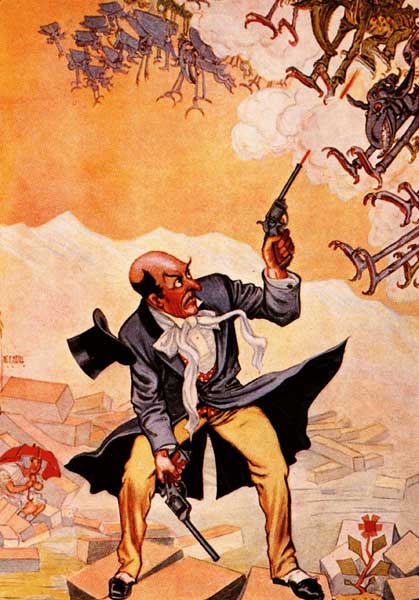
 And the Wizard even pulls out guns to fight the wooden gargoyles.  (Picture the Wizard of Oz from your childhood memories.  Do you imagine him shooting revolvers at wooden gargoyles?)
Illustration from the original edition 

Ozma rescuing everyone with her magic belt at the end feels like a bit of a cheat, but at least they had a lot of crazy adventures before the deus-ex-magic-belt saved the day. 

Once back in Oz, the action slows down a bit, as all the characters mill around meeting each other.  (Another staple of these Oz books is that each book introduces new characters, while having them meet the previous characters.)  There's some attempts to establish drama by having Jim the horse race the sawhorse, or putting Eureka the Kitten on trial for eating one of the tiny piglets.  But it doesn't match the made energy of the first part of the book.

Characters do a lot of things in this book that don't make logical sense.  Logic and consistency are not the strong points of this series, but wonderfully imaginative lands and strange creatures are the reasons to keep reading.

Links

The Wikipedia entry for this book is HERE.  Lots of interesting little tidbits on Wikipedia, including the fact that this book was written shortly after the 1906 California earthquake, which probably influenced Baum.  Also speculation on Wikipedia that the quality of this book and the dark tone were affected by the fact that Baum was rushing it out shortly after the previous book.  
Also via Wikipedia's entry on the Wizard of Oz, I learned that the reason he went back to being a good-guy in this book is that readers didn't like his portrayal as a bad-guy in the second book.  

I'm also continuing to read Mari Ness's reviews on Tor.com: Hating Fairyland: Dorothy and the Wizard of Oz  
Mari Ness makes a number of observations, including:
* Pointing out that the part about the Gargoyles is really dark.  In the book, it's left implied that there's a good chance there whole world will burn down, and Mari Ness points out that this is genocide in the land of Oz series!
* The fact that Jim the horse and Zeb the boy feel uncomfortable in Oz is a series first (and apparently only).  They apparently do not show up in any future Oz books.
* Mari Ness points out that the trial of Eureka the kitten is more proof that Ozma is really a poor ruler.
...and other observations.  Go read her review, she's really interesting.

Also, I'm doing this as a buddy read with Dane Reads, so check out his review:


and his written review HERE.  

Connections With Other Books I've Read

For another book about a journey through a hollow earth, see: Journey to the Center of the Earth by Jules Verne.

Extended Quotation

The houses of the city were all made of glass, so clear and transparent that one could look through the walls as easily as though a window. Dorothy saw, underneath the roof on which she stood, several rooms used for rest chambers, and even thought she could make out a number of queer forms huddled into the corners of these rooms.
The roof beside them had a great hole smashed through it, and pieces of glass were lying scattered in every direction. A near by steeple had been broken off short and the fragments lay heaped beside it. Other buildings were cracked in places or had corners chipped off from them; but they must have been very beautiful before these accidents had happened to mar their perfection. The rainbow tints from the colored suns fell upon the glass city softly and gave to the buildings many delicate, shifting hues which were very pretty to see.
But not a sound had broken the stillness since the strangers had arrived, except that of their own voices. They began to wonder if there were no people to inhabit this magnificent city of the inner world.
Suddenly a man appeared through a hole in the roof next to the one they were on and stepped into plain view. He was not a very large man, but was well formed and had a beautiful face—calm and serene as the face of a fine portrait. His clothing fitted his form snugly and was gorgeously colored in brilliant shades of green, which varied as the sunbeams touched them but was not wholly influenced by the solar rays.
The man had taken a step or two across the glass roof before he noticed the presence of the strangers; but then he stopped abruptly. There was no expression of either fear or surprise upon his tranquil face, yet he must have been both astonished and afraid; for after his eyes had rested upon the ungainly form of the horse for a moment he walked rapidly to the furthest edge of the roof, his head turned back over his shoulder to gaze at the strange animal.
"Look out!" cried Dorothy, who noticed that the beautiful man did not look where he was going; "be careful, or you'll fall off!"
But he paid no attention to her warning. He reached the edge of the tall roof, stepped one foot out into the air, and walked into space as calmly as if he were on firm ground.
The girl, greatly astonished, ran to lean over the edge of the roof, and saw the man walking rapidly through the air toward the ground. Soon he reached the street and disappeared through a glass doorway into one of the glass buildings.
"How strange!" she exclaimed, drawing a long breath.

****END QUOTE****--from chapter 2: The Glass City.
I thought this whole section about the floating people in the glass city was really trippy.

6 out of 10 Stars.  The first part of this book was so bizarre and so crazy I thought it was going to be a 7, but then the ending parts in Oz were pretty boring, so I'm going to keep it as a 6.

* November 14, 2021 Dorothy and the Wizard in Oz p.290-326
* November 21, 2021 Dorothy and the Wizard in Oz p.326-386 

Video Review (Playlist HERE)


Sunday, November 07, 2021

Ozma of Oz by L. Frank Baum

(Book Review--Land of OzClassicsFantasyChildren's Books)  

Started: October 25, 2021
Finished: November 4, 2021
(This review is written using my new format for book reviews.)

This is the 3rd book in the Land of Oz series.  For my previous reviews, see The Wonderful Wizard of Oz and The Marvelous Land of Oz.

My History With This Book

When talking about The Marvelous Land of OzI mentioned my history with the Disney movie Return to Oz.  But Return to Oz actually draws from both Ozma of Oz and The Marvelous Land of Oz.  So many of the characters in this book, and much of the plot, I was already familiar with because of  Return to Oz.  
Also, I read this book 5 years ago when I first attempted to work my way through The Complete Stories of Oz (as I mentioned HERE and HERE.)

Summary of the Book (*SPOILERS*)

This is the first sequel to feature Dorothy again.  (Dorothy was absent from the second book, The Marvelous Land of Oz.)  Dorothy gets washed overboard from a ship while crossing the ocean with her Uncle Henry.  
A rough life Dorothy has, huh?  First she gets picked up by a cyclone, and now she gets swept off to sea?  While, I guess we have to keep inventing ways for Dorothy to keep getting carried off to the Land of Oz.
Dorothy actually lands up in the Land of Ev (not Oz).  Ev is next to Oz, but the two lands are separated by a great desert.
But then, Dorothy's friends from Oz arrive at that exact moment, and everyone is reunited.
The friends from Oz journey into the Nome King's kingdom to free the princes and princesses of Ev, who have been imprisoned by the Nome King.
At the end, Ozma gets a magic belt that she can transport Dorothy to Oz with anytime.  So that plot point is now fixed for future books.  No more having Dorothy arrive in the Land of Oz by surviving a natural disaster every time.

Evaluation

Much the same as its predecessors.  
It's not a particularly logical story--coincidence and contrivance drive the plot, and the story is filled with things that don't make logical sense, or magical powers that are not clearly defined.  But at this point in the series, surely the reader knows to expect this by now.
Like all the Land of Oz stories, this is "Go on a journey and meet unusual things" type story, and the appeal is in the imaginative creatures and places that L. Frank Baum creates.  And it's also interesting to see how the Oz series and characters are developing.

External Links

As with the other books in this series, I'm relying on the Wikipedia page for background.  
Wikipedia notes that this book "was the first in which Baum was clearly intending a series of Oz books."  I suppose the evidence for this is that it's very clearly set-up at the end of the book that Dorothy now has a way to return to Oz anytime she wishes.  That ending was obviously written by a man who had sequels in mind.
Wikipedia also notes: "It is the first Oz book where the majority of the action takes place outside of the Land of Oz. Only the final two chapters take place in Oz itself. This reflects a subtle change in theme: in the first book, Oz is the dangerous land through which Dorothy must win her way back to Kansas; in the third, Oz is the end and aim of the book."  If memory serves, this is definitely true for the next couple books at least.  Oz is now the safe place, and the threats come from outside Oz.

Also, once again I found Mari Ness's review at Tor.com to be helpful: Following Your Inner Chicken: Ozma of Oz
Mari Ness makes the point that the shift in focus to lands outside of Oz was necessitated by the fact that everyone in Oz has already gotten their happy ending.  "What do you do when you need to write yet another book about a magical fairyland where everyone has already gotten a happy ending?  Take your characters to another country, of course."
Mari Ness is also very critical of Ozma's first outing as Queen of Oz, noting that Ozma blunders her way through everything.  (It's a good point.  Something that I didn't pick up on when I read it the first time, because L. Frank Baum seems to be intending to frame Ozma as a good ruler.  But as Mari Ness points out, Ozma's actual track record in this book is just one blunder after another.)
Also, if you have time, the comment thread at the bottom of the review gets into some interesting discussion about various issues--the inconsistencies in this series, and how a modern publisher would react to them, and speculation about whether some of the themes in this book were influenced by the Civil War

Also, over on Booktube, I'm doing this series as a Buddy Read with Dane Reads.  His review here:


Odds and Ends

* Inconsistencies: Dorothy, who spoke perfectly normal English in the first book, now in this book suddenly acquires some sort of "little girl" dialect where she leaves out some of the syllables in big words.  
Also, Billina the chicken suddenly acquires the power of speech once Dorothy and Billina arrive in the fairy lands of Ev and Oz.  The reason is because once an animal enters the fairy lands, they automatically can talk.  But this was not true of Toto in the first book.  (If memory serves, in one of the next books this Toto inconsistency will be addressed in the narrative.)

* Each Oz book seems to follow a formula--go on a journey and meet strange new things.
The other part of the formula is that each Oz book has to introduce new wacky side characters to go along on that journey.  In this book, the new wacky side characters are The Hungry Tiger, Billina the Chicken, and Tik-Tok the machine man.  
As each book introduces more and more wacky side characters, the cast of characters in the Oz books gets bigger and bigger, and L. Frank Baum can't fit them all into each book.  But, he doesn't want the reader to forget about the old characters entirely either, so a number of the books in this series have a chapter at the end where all the old characters pop in briefly to make a cameo and say hi.  Ozma of Oz is the first to have such an ending, where the Woogle-Bug, Jack Pumpkinhead, Jellia Jamb, Jinjur all pop in for a quick cameo before the book ends.

* And speaking of Tik-Tok, he is, according to Wikipedia, one of the first robots in literature.  Although he's never called a robot.  Instead he's called things like "machine man" because the word "robot" didn't come into the language until the 1920s.

Extended Quotation

She tramped across the sand, skirting the foot of one of the little rocky hills that stood near, and soon reached the edge of the forest.
At first she was greatly disappointed, because the nearer trees were all punita, or cotton-wood or eucalyptus, and bore no fruit or nuts at all. But, bye and bye, when she was almost in despair, the little girl came upon two trees that promised to furnish her with plenty of food.
One was quite full of square paper boxes, which grew in clusters on all the limbs, and upon the biggest and ripest boxes the word "Lunch" could be read, in neat raised letters. This tree seemed to bear all the year around, for there were lunch-box blossoms on some of the branches, and on others tiny little lunch-boxes that were as yet quite green, and evidently not fit to eat until they had grown bigger.
The leaves of this tree were all paper napkins, and it presented a very pleasing appearance to the hungry little girl.
But the tree next to the lunch-box tree was even more wonderful, for it bore quantities of tin dinner-pails, which were so full and heavy that the stout branches bent underneath their weight. Some were small and dark-brown in color; those larger were of a dull tin color; but the really ripe ones were pails of bright tin that shone and glistened beautifully in the rays of sunshine that touched them.
Dorothy was delighted, and even the yellow hen acknowledged that she was surprised.
The little girl stood on tip-toe and picked one of the nicest and biggest lunch-boxes, and then she sat down upon the ground and eagerly opened it. Inside she found, nicely wrapped in white papers, a ham sandwich, a piece of sponge-cake, a pickle, a slice of new cheese and an apple. Each thing had a separate stem, and so had to be picked off the side of the box; but Dorothy found them all to be delicious, and she ate every bit of luncheon in the box before she had finished.
"A lunch isn't zactly breakfast," she said to Billina, who sat beside her curiously watching. "But when one is hungry one can eat even supper in the morning, and not complain."
"I hope your lunch-box was perfectly ripe," observed the yellow hen, in a anxious tone. "So much sickness is caused by eating green things."
"Oh, I'm sure it was ripe," declared Dorothy, "all, that is, 'cept the pickle, and a pickle just has to be green, Billina. But everything tasted perfectly splendid, and I'd rather have it than a church picnic. And now I think I'll pick a dinner-pail, to have when I get hungry again, and then we'll start out and 'splore the country, and see where we are."
"Haven't you any idea what country this is?" inquired Billina.
"None at all. But listen: I'm quite sure it's a fairy country, or such things as lunch-boxes and dinner-pails wouldn't be growing upon trees. Besides, Billina, being a hen, you wouldn't be able to talk in any civ'lized country, like Kansas, where no fairies live at all."
"Perhaps we're in the Land of Oz," said the hen, thoughtfully.  (End Quotation. From Chapter 3).

I like this part because the idea of having lunch boxes grow on trees is really silly and stupid, but it's kind of so silly and stupid that it's kind of fun.  And that's the tone of a lot of the Land of Oz series.
Also, notice Dorothy's dialect.  As I mentioned above, this is quite different from how she talked in the first book.

6 out of 10 stars.  A plot that doesn't make any sense, but a pleasant book to read nonetheless.


Video Review (Playlist HERE)


Sunday, October 24, 2021

The Marvelous Land of Oz by L. Frank Baum

(Book Review--Land of OzClassicsFantasyChildren's Books)  

Started: October 10, 2021
Finished: October 19, 2021
(This review is written using my new format for book reviews.)

My History With This Book

Does anyone remember the 1985 Disney movie Return to Oz?  It bombed in the theaters, but it was shown a lot on the Disney Channel in the 1980s, which is where I saw it.  I believe it has a cult following among people who grew up in the 1980s and watched a lot of Disney Channel--if you fit that demographic.
Return to Oz was based partly on The Marvelous Land of Oz.  (And also partly on the next book, Ozma of Oz, but we'll talk about that book another day.)  If you've seen Return to Oz, and you remember the characters of Jack Pumpkinhead and the Gump--well, this is the book that they come from.  
This is the only book in the Land of Oz series that I actually read as a kid.  It was one of my aunt's old books, and I discovered it when spending time at my grandparents' house.  The cover art showed Jack Pumpkinhead and the Gump, both of whom I recognized from Return to Oz, so it got me interested, and I read the book.  (The cover pictured on the top of this blogpost was the same cover I saw as a kid.)  I hadn't read the original The Wonderful Wizard of Oz as a kid, but that didn't really matter because like everyone else in the world I know that story from the movie.
I also read this book 5 years ago.  (As I've mentioned before, 5 years ago I attempted to read through The Complete Stories of Oz as one giant book review project, before abandoning it and then re-starting it as a series of separate book reviews.)  So this is now my 3rd time through this story.

Plot Summary (SPOILERS)

The plot of this book is really all over the place.
Our hero starts out in the countryside.  He then journeys to the Emerald City to meet the Scarecrow. Then there's a rebellion in the Emerald City, and our hero and the Scarecrow have to escapes from the Emerald City, and go to meet the Tin Woodman.  Then they go back to the Emerald City.  Then they need to escape from the Emerald City again.  Then they find the good witch Glinda, and go back to the Emerald City.  So it's a lot of back and forth and back and forth.  But the main story is story all the friends they meet and all the adventures they have along the way--which is typical of these Oz stories--go on a journey, and meet new friends and have adventures along the way, that seems to be the template. 

The Reading Experience

As I started reading this book for the 3rd time, I thought to myself, "It's funny, I've read this book twice before now, and I still can't remember the plot."  It came back to me as I read it, naturally, but I think the reason I have such a hard time remembering the plot is that the plot is all over the place.  But then, that's part of the fun.
Like the original The Wonderful Wizard of Oz, this book is very easy to read.  And actually, it held my attention much better than The Wonderful Wizard of Oz--partly, I think it held my attention because of the wild plot, and also partly because the dialogue in this second book is a lot snappier.  (L. Frank Baum was planning on turning this into a stage play when he wrote it, so he included a lot of vaudeville style humor in the dialogue.)

Evaluation

Characters will often do things in this book that make no logical sense whatsoever.  For example, the witch Mombi tells Tip she will turn him into a statue in the morning, but then just goes to bed and doesn't attempt to prevent Tip from running away in the night.  At first I thought it was just lazy writing, but then I decided these kind of things were all part of the joke--part of L. Frank Baum's satire of fairy tales.  

But moving onto talk about the gender politics of this book.  
The gender politics of this book are... a mixed bag.  The main conflict in the story is created by an army of girls who take over the Emerald City because men have been ruling for long enough, (okay, fair enough I guess), and also because the Emerald City has lots of emeralds in it, and girls like shiny things (oh, this part hasn't aged well!).  
On the one hand, there is some attempt to show that the girls are stronger than the men of the Emerald City think they are.  But on the other hand, when portraying the girl army, L. Frank Baum indulges in so many dated stereotypes (the girls talk to much, they're afraid of mice, they like lazing about and eating sweets, etc.)
So, taken all together, that part about the girl army really hasn't aged well.

What is interesting, though, is the final reveal that the boy Tip has actually been a girl all along.  And that reveal at the end seems to be ahead of its time in terms of the acknowledgement that gender identity isn't always purely biological.

External Links

* So, once again I'm going to link to the Tor.com review:  Oz Revolts! – The Marvelous Land of Oz by Mari Ness.  Mari Ness mentions that L. Frank Baum's mother-in-law was a suffragette, and speculates that the whole plot about girls wanting to control the Emerald City was mocking the suffragette movement.  But Mari Ness also makes the point that in spite of all the problematic gender issues in this book, at the end we are left with two good women ruling Oz, and this will remain the status quo throughout the rest of the series.

There is a lot of interesting behind the scenes information about this book from Wikipedia.  
You see, it turns out that after the original The Wonderful Wizard of Oz was published in 1900, it became a successful stage musical in 1902.  The stage musical was also written by L. Frank Baum, but was a different take on the same material, with several differences from the novel and the musical.  
In the original novel, the Wizard of Oz is portrayed much the same as he was in the 1939 movie--a bit of a con artist, but not a bad person.  But in the stage play, he was a usurper who dethroned the original King of the Emerald City-- Pastoria.  So, in keeping with the stage play, that's why the Wizard of Oz is depicted as a villain in The Marvelous Land of Oz.
Also, in the stage play, the Scarecrow and the Tin Woodman were the breakout characters.  Which is why both of them figure so prominently in the sequel (even though Dorothy and the Cowardly Lion do not.)  L. Frank Baum also intended to turn The Marvelous Land of Oz into a stage play, which accounts for a lot of the features of the book. (A lot of the snappy dialogue was intended to be performed on the stage.  Also, the army of girls was intended to be chorus girls.  Also it was common to have women portraying boys on stage, which would aid with the gender reveal at the end.)
In order to promote this book, L. Frank Baum created a newspaper comic strip featuring the characters fromm this book called Queer Visitors from the Marvelous Land of Oz.  The breakout character ended up being the Woggle-Bug, who was spun off into his own book and then stage-play, according to Wikipedia
Baum's Woggle-Bug was a popular character at the time; he "became something of a national fad and icon...."[4] There were Woggle-Bug postcards and buttons, a Woggle-Bug song, and a Woggle-Bug board game from Parker Brothers.[5] Baum and Morgan's picture book was published in January 1905, to help publicize a new musical play, The Woggle-Bug, that was being mounted that year. (The play flopped.)
I found all of this fascinating--first of all for the long forgotten memories of American fads.  And secondly, because it shows that my collection of The Complete Stories of Oz isn't really complete at all.  Even if we limited ourselves to the stories by the original author L. Frank Baum, there's a whole Land of Oz extended universe that goes well beyond the 15 books collected in this volume.

* I'm doing this series as a buddy read with Dane Reads on Booktube.  See his video review HERE and his written review HERE.  

Odds and Ends

* So, the fact that the boy Tip was really the girl Ozma all along seems like it's ahead of its time in terms of gender identity, but...  I feel like once Tip turns into Ozma, it's not like he's the same person as before only now in a girl's body.  As she's portrayed in the subsequent books, the wise and benevolent Ozma is essentially a different character from the childish and mischievous Tip, right?  Or am I remember the subsequent books wrong?

* The Tin Woodman has a name now--Nick Chopper.  This is apparently also a legacy from the stage play.

* The Wizard of Oz is portrayed as a bad guy in this book, but don't worry.  He's going to come back again in book number 4, Dorothy and the Wizard in Oz.  And then he'll be back to his original portrayal.  

* I mentioned above the "Oz Extended Universe" which goes well beyond the 15 books collected in The Complete Stories of OzThis will also be a theme in the future books, as there will be more crossovers with L. Frank Baum's other books coming up in the Oz series.

Extended Quotation

They soon discovered that the Saw-Horse limped, for his new leg was a trifle too long. So they were obliged to halt while the Tin Woodman chopped it down with his axe, after which the wooden steed paced along more comfortably. But the Saw-Horse was not entirely satisfied, even yet.

"It was a shame that I broke my other leg!" it growled.

"On the contrary," airily remarked the Woggle-Bug, who was walking alongside, "you should consider the accident most fortunate. For a horse is never of much use until he has been broken."

"I beg your pardon," said Tip, rather provoked, for he felt a warm interest in both the Saw-Horse and his man Jack; "but permit me to say that your joke is a poor one, and as old as it is poor."

"Still, it is a Joke," declared the Woggle-Bug; firmly, "and a Joke derived from a play upon words is considered among educated people to be eminently proper."

"What does that mean?" enquired the Pumpkinhead, stupidly.

"It means, my dear friend," explained the Woggle-Bug, "that our language contains many words having a double meaning; and that to pronounce a joke that allows both meanings of a certain word, proves the joker a person of culture and refinement, who has, moreover, a thorough command of the language."

"I don't believe that," said Tip, plainly; "anybody can make a pun."

"Not so," rejoined the Woggle-Bug, stiffly. "It requires education of a high order. Are you educated, young sir?"

"Not especially," admitted Tip.

"Then you cannot judge the matter. I myself am Thoroughly Educated, and I say that puns display genius. For instance, were I to ride upon this Saw-Horse, he would not only be an animal he would become an equipage. For he would then be a horse-and-buggy."

At this the Scarecrow gave a gasp and the Tin Woodman stopped short and looked reproachfully at the Woggle-Bug. At the same time the Saw-Horse loudly snorted his derision; and even the Pumpkinhead put up his hand to hide the smile which, because it was carved upon his face, he could not change to a frown.

But the Woggle-Bug strutted along as if he had made some brilliant remark, and the Scarecrow was obliged to say:

"I have heard, my dear friend, that a person can become over-educated; and although I have a high respect for brains, no matter how they may be arranged or classified, I begin to suspect that yours are slightly tangled. In any event, I must beg you to restrain your superior education while in our society."

"We are not very particular," added the Tin Woodman; "and we are exceedingly kind hearted. But if your superior culture gets leaky again—" He did not complete the sentence, but he twirled his gleaming axe so carelessly that the Woggle-Bug looked frightened, and shrank away to a safe distance.

The others marched on in silence, and the Highly Magnified one, after a period of deep thought, said in an humble voice:

"I will endeavor to restrain myself."

"That is all we can expect," returned the Scarecrow pleasantly; and good nature being thus happily restored to the party, they proceeded upon their way.

***********End Quote.  The beginning of chapter 14, pages 150-151 in my edition ***** 
This quote does a good job of illustrating the back-and-forth verbal sparring that is in a lot of scenes in this book, apparently because L. Frank Baum was planning to do this as vaudeville on the stage.

6 out of 10 Stars.  A bit more entertaining than its predecessor.  But then, also a bit more problematic then its predecessor.

October 17, 2021 The Marvelous Land of Oz by L. Frank Baum p.98-134
October 24, 2021 The Marvelous Land of Oz by L. Frank Baum p.134-196

Video Review (Playlist HERE)