Wednesday, September 15, 2010

The Most Dangerous Man in America: Daniel Ellsberg and the Pentagon Papers

(Movie Review)

In the early 1960s, the Vietnam War had high levels of public support. The American public trusted their government, and they believed the war was a noble cause to protect freedom and democracy.
However as the years went on, lots of new information about the war came to light.
Journalists, activists, and ordinary citizens asked questions about the war, and people began to realize their government had misled them.
Once the true nature of the war became known, the public started to turn against it.
(I know that's oversimplifying the decade a lot, but I think it still works as a broad narrative.)

What frustrates me, as someone who went through school in the 90s, is that my generation didn't get any of the benefit of all these later revelations.

I was taught in school the "official" version of the Vietnam War. (And what I absorbed from the media of the time also reinforced this.)
In the version of the war I learned about, democratic South Vietnam was invaded by the North. America got involved in the war to protect the South Vietnamese people from this unjust aggression, and also to protect freedom and democracy.

The war was, in retrospect, a strategic failure perhaps, a quagmire, possibly not worth the American lives it costs, et cetera. But the American government had nothing but good intentions and high idealism.

This was the version of the war me and my classmates were taught, and this is what we believed.

In fact among my high school memories, I remember a special assembly at Grand Rapids Christian High School in which a speaker came to talk to us.
(I don't remember his exact topic. It was part of the spiritual assembly series we had every so often, so it was mostly a testimonial about his relationship with God. I remember he also touched on the importance of not having sex before marriage. We had several of these type of assemblies throughout the year.)
What I do remember clearly is that he talked about his service in Vietnam, and bragged that he had served in the war despite the fact that it was an unpopular war. "I love freedom and democracy more than I hate war. Now what do you think of that?" he asked.
The entire student body broke into loud applause, myself included. We didn't know any better.

It wasn't until I took a few courses at college, and began to read widely on my own, that I learned everything I had been taught about the Vietnam War was a lie.
Far from protecting democracy in Vietnam, the United States had actually stopped free elections in 1956 because they knew Ho Chi Minh would win. They then set up a series of dictators in South Vietnam, and helped keep these dictators in power against their own people.
The South Vietnamese never had freedom of speech or freedom of expression.

[The same was true about South Korea, which was a dictatorship during the Korean War and up until the 1980s, despite the fact that the Korean War was also supposedly fought to protect democracy. But that's another story.]

The Viet Cong was not an invading army from the North, but was mostly indigenous South Vietnamese fighting in their own country.

In my high school and middle school classes, we learned about the Gulf of Tonkin incident, but the teachers never told us it had been falsified.

And although we had learned about the 50,000 Americans killed in the war, and the suffering of American soldiers, no one had talked about the estimated 4 million Vietnamese killed.
Nor did we learn about the massive bombing campaign, during which the US dropped more bombs on Vietnam than all the bombs dropped during World War II by all countries combined.

As I began to read outside of the official history textbooks, I began to be more and more shocked about the difference between what I had learned, and what had actually happened.

And the thing is, none of this should have been new information. This wasn't newly uncovered data that I was just discovering. Much of this information had been in the public discussion about the war in the late 60s and 70s. But it had all been swept under the rug in the years since then.

Because the history of the Vietnam War has been quietly re-written, I think documentaries like this are very important.
The Pentagon Papers are among the many things I wish I had been taught about in school. And despite being headline news everyday for two weeks, it has been quietly left out of the history books since then. So much so that, as I mentioned in this post here, people of my generation and younger--history nerds and politicos aside--have never even heard of them before.

Given the revelations in these documents, it says a lot that they have been successfully airbrushed out of history. For example the Pentagon Papers very clearly state that all the reasons given for the war were completely false, and that the United States couldn't care less about democracy in Vietnam.

And perhaps, had the Pentagon Papers been remembered, the public would have been less likely to trust the word of the President in the build-up to the Iraq War.
That decision, unfortunately, is already in the past. But perhaps the legacy of the Pentagon Papers can help people to be skeptical when politicians give them the usual reasons for continuing to stay in Iraq and Afghanistan.

To the extent that this documentary (released just last year in 2009) helps to push these papers back into the public consciousness, it's doing a valuable service.
I somewhat wish they had focused more on the content of the papers instead of just the biography of Daniel Ellsberg. (At one point in the documentary Howard Zinn says that the media circus around these papers caused quite a stir, but the content of the papers was never fully absorbed by the American public. It's a comment that I wish the filmmakers had taken to heart more in their production.)

But they say the first rule of film reviewing is to review the film you are watching, not the film you wish you were watching. This film was meant to be primarily a biography of Daniel Ellsberg, and follows him on his journey from hawk to dove on the Vietnam War. It also seeks to explain the risks he took, and why he took them. And as such, it is a great piece of storytelling.

I learned a lot of interesting things from this film. For example, Daniel Ellsberg hung out with Howard Zinn and Noam Chomsky (even before he became a media sensation by releasing the papers.) And the three of them even formed an affinity group at the 1971 May Day anti-War protest in Washington. (Imagine all 3 of those guys hanging out together. That's got to be some pretty interesting conversation.)

I though the film also did a good job of including some choice clips from the Nixon tapes.
For example when talking to Kissinger about the bombings, Nixon angrily exclaims, "You're so goddamned concerned about civilians and I don't give a damn. I don't care."
Kissinger then replies that he is only concerned about the civilians because of world opinion.
(It's nice that we have these tapes of private conversations so we can hear what the politicians really think. It's a pity they stopped tapping themselves after Watergate, but I wouldn't be surprised if these same kinds of conversations still go on behind closed doors, regardless of what they tell us in public about their concern for the Iraqi and Afghanistan civilians.)

And then there's this gem the filmmakers also included:
Nixon: And, I still think we ought to take the dikes out now. Will that drown people?
Kissinger: About two hundred thousand people.
President: No, no, no, I'd rather use the nuclear bomb. Have you got that, Henry?
Kissinger: That, I think, would just be too much.
President: The nuclear bomb, does that bother you?...I just want you to think big, Henry, for Christsakes.


(Although to Nixon's credit, he does have a way with words. This is more apparent if you actually hear the audio. I particularly like his use of "sonofabitching" as an attributive adjective--as in "that sonofabitching thief" and "sonofabitching domestic council." It has a certain ring to it, no? I think I'm going to start using that one myself. "Hey, Tom, how's that sonofabitching coffee?")

All in all, a very interesting film, and well worth checking out. I'm glad the filmmakers made it, and I hope lots of people will see it. You can't emphasize these parts of history too much.

***************************************************

Update: I was just listening to an Audio CD of Noam Chomsky (Media Control--highly recommended if you can get your hands on it.) He talks about the Vietnam War and its place in history. Since this is what I was just talking about in this post, and because it resonates with my own experience, I thought I'd go through the trouble of quoting him here. The lecture is from the first Gulf War, and Chomsky is talking about the Vietnam syndrome, which a Reagan intellectual had defined as "the sickly inhibition against using military force."
This is from a lecture, so it loses something when you just see it printed on the page (the intonation and sarcastic tone at certain points, for example) but you get the idea.

"....It's also necessary to completely falsify history. That's another way to overcome these sickly inhibitions. To make it look as if when we attack and destroy somebody we're really protecting ourselves and defending ourselves against major aggressors and, you know, monsters and so on. There's been a huge effort since the Vietnam War to reconstruct the history of that. Too many people got to understand what was really going on and that was bad. Including plenty of soldiers and a lot of young people who were involved in the peace movement and many others. And it was necessary to re-arrange those bad thoughts and to restore some form of sanity, namely a recognition that whatever we do is noble and right, and if we're bombing South Vietnam that's because we're defending South Vietnam against somebody, namely the South Vietnamese, because nobody else was there. It's what the Kennedy intellectuals called, "Defense against internal aggression in South Vietnam"-- that was the phrase that Adlai Stevenson used. It's necessary to make that the official picture and the well understood picture. And that's worked pretty well actually. When you have total control over the media and the educational system and scholarship is conformist and so on you can get that across. One indication of it was actually revealed in a study that was done at the University of Massachusetts on attitudes towards the current Gulf crisis. A study of beliefs and attitudes and television watching. One of the questions that was asked in that study, people were asked: how many Vietnamese casualties would you estimate that there were during the Vietnam War? The average response on the part of Americans today is about 100,000. Now the official figure is about 2 million. The actual figure is probably 3 to 4 million or something like that. The people who conducted this study raised the appropriate question. They asked the question: what would we think about German political culture if when you asked people today how many Jews died in the holocaust they estimated about 300,000. What would that tell us about German political culture? Well, they leave the question unanswered but you can pursue it. What does that tell us about our culture? It tells us quite a bit. That's necessary to overcome the sickly inhibitions against the use of military force and other democratic deviations. And the same is true on every topic. Pick the topic you like: the Middle East, international terrorism, Central America, whatever it is, the picture of the world that's presented to the public has only the remotest relation to reality. The truth of the matter is buried under edifice and edifice of lies..."

Link of the Day
Chomsky on Drug War

Also--I'm about a month late linking to this, but I thought Roger Ebert's thoughts on the Mosque controversy were really good. Number 10 especially is worth reading, when he details what is going to be built at ground zero, and contrasts it with what could have been.

The Most Dangerous Man in America: Daniel Ellsberg and the Pentagon Papers: Movie Review (Scripted)

Wednesday, September 01, 2010

Flashman at the Charge by George Macdonald Fraser

(Book Review)

After reading:

Tom Brown's Schooldays,
Flashman,
Royal Flash, and
Flash for Freedom,

I now come to the 4th book in the Flashman series.

The reason I got into these Flashman books in the first place (as I mentioned in my review of the first Flashman) is because I was interested in "The Great Game" and the 19th Century rivalry between Britain and Russia over Afghanistan and Central Asia.

This book returns to that theme, although like the previous books it has Flashman rushing from one danger spot into another, so that it manages to cover a lot of diverse ground. The first third of the book deals with the Crimean War (in which the cold war between Russia and Britain momentarily turned hot), the middle of the book deals with Russia and the serf problem, and then the last 3rd goes South to Central Asia and back into Afghanistan.

As always, Flashman manages to be present at all the great historical battles. And as always, he's present against his will.

The first third of the book, dealing with the Crimean War, is very well researched, very well written, and brings to life many of the historical characters involved in the conflict, from William Howard Russell (The Times correspondent, who Flashman finds slightly annoying) to Frances Duberly (who Flashman is always trying to bed.)

The Crimean War is, viewed through the hindsight of history, a pointless war. (As almost all wars are viewed through hindsight.) Two empires were battling each other for strategic positioning in the East, and for this thousands of men on both sides were asked to throw their lives away.
(Of course that's not how the war was sold to the British public at the time--they were told they were fighting for freedom, and protecting Turkey against unfair aggression.)

Flashman, although a bully and a coward and thoroughly lacking in any redeeming virtues, is oddly enough the perfect narrator to see right through the Victorian hypocrisy. He realizes that, even though he's only ever cared for himself, he has never been guilty of sending off thousands of men to their deaths. In his own way, he figures he is actually less harmful than the army generals obsessed with honour and duty to country.
And the scary thing is that he's right.

The mismanagement which permeated the whole Crimean War has always been symbolically represented in the Charge of the Light Brigade (W) which Flashman manages to find himself dragged into (against his will.)

Like most Americans, I grew up having no idea what "The Charge of the Light Brigade" was, other than it had some connection to some famous poem or something. (My school education had been very American-centric.It could be that my ignorance is unique, but I suspect most other Americans out there are equally clueless.)

A few years ago I came across a BBC radio program explaining the whole thing, which I found quite interesting. (Link here--if you've got a few free minutes you can fill in the gap in your knowledge.)
After listening to that program, I had a basic idea of what had happened, but I still got a bit confused on the finer details of who ordered what when.

This book walks you through the whole disastrous chain of events step by step. And the beauty of a historical novel is that it's much easier to follow the action when it becomes a story. The faceless historical names become characters with personalities.
Fraser faithfully reproduces much of the petty squabbling and personality conflicts that took place among the British officers, and inserts Flashman into the historical narrative very cleverly.
Flashman has a strong dislike of Lord Cardigan, who actually led the charge, partly because of events carried over from the first novel (in which Lord Cardigan had a bit part) and partly because of what happens at the beginning of this one.

After the battle, Flashman is taken into Russia, where among other things he records his observations about how horribly the serfs were treated.

Again, much of this was absent from my historical education. (In traditional history telling, it is perhaps common to over-emphasize the sufferings of sovereigns like Louis XVI and Czar Nicholas II, but gloss over the horrors that these old regimes inflicted.)

At times I suspected Fraser was exaggerating how terribly the Russian serfs were treated, but every time I began to question an anecdote, there was a footnote backing up the story with reference to historical sources.

One of Lenin's ancestors appears later in the story agitating on the serf's behalf.
(I'm not sure how much Fraser intended the appearance of Lenin's ancestor to symbolically represent Lenin himself. But the loud, boisterous, rabble-rousing nature of the character seems at odds with my image of Lenin as the careful planner and schemer. I had a similar reaction to Fraser's portrayal of Karl Marx in "Royal Flash." But that's really my only historical criticism of these Flashman books.)

But Fraser does at times seem to be drawing a line between the horrific conditions of the Serfs, and the 1917 revolution. Since the serfs were all freed well in advance of this revolution, it may not be completely fair.

Still, as I read the book I couldn't help but remember Dickens' prophecy from "A Tale of Two Cities" :

Crush humanity out of shape once more . . . and it will twist itself into the same tortured forms. Sow the same seed of . . . oppression over again, and it will surely yield the same fruit according to its kind.

Dickens had published these words back in 1859. If the Russian government had only paid more attention to this warning, perhaps history would be a lot different.

Also while in Russia, Flashman runs into Harry "Scud" East from "Tom Brown's Schooldays." Having slogged my way through the original source material, it was nice to be rewarded by seeing another character from that book brought into the Flashman world.
In "Tom Brown's Schooldays", East had been Tom Brown's best friend, and the major supporting character in the book after Tom Brown himself. At the end of "Tom Brown's Schooldays," we learn that he is serving in India.
(There is apparently a sequel, "Tom Brown at Oxford," which fleshes out East's career in India more thoroughly, and which Fraser references in his footnotes. However having found the original "Tom Brown's Schooldays" a bit of a chore to get through, I won't be reading the second book anytime soon.)

The Scud East in the first part of "Tom Brown's Schooldays" is someone with an honest heart and noble heart, but has trouble resisting the urge to get into mischief. It might have been more interesting to have this Scud East appear, but Fraser chose instead to portray Scud East the Christian moralist, which is perhaps a bit of a missed opportunity. (We had hints that Scud East and Tom Brown were turning out this way towards the end of the first book, but in my opinion the transformation wasn't completed yet. I don't know what happens in "Tom Brown at Oxford.")

Nevertheless, East's strong sense of duty and self-sacrifice in this book contrast sharply with Flashman, who is only concerned about his own skin, making them the perfect Victorian foils against each other.

When East suggests they risk their lives to save the British Empire, Flashman narrates, "D'you know, when a man talks like that to me, I feel downright insulted. Why other, unnamed lives, or the East India Company's dividend, or the credit of Lord Aberdeen, or the honour of British arms, should be held by me to be of greater consequence than my own shrinking skin, I've always been at a loss to understand."

Flashman and East stumble onto a Russian plan to invade Afghanistan and India and take them from the British.
Once again, this sounds like pure fantasy, but Fraser backs it all up with footnotes, indicating that there really were such plans put forth to the Tsar, and that these proposals really were considered seriously by the Russian government.

Finally, Flashman ends up in Central Asia. Here Fraser digs up long forgotten historical characters for Flashman to interact with, such as Yakub Beg and Izzat Kutebar, who led the local indigenous resistance against the Russian drive South in the 19th century. As with everything else, the story is backed up with footnotes describing the ruthless Russian march South, and the local peoples who were brutally subdued in this campaign.

Flashman finds himself joining the local tribes (and their Chinese allies) and helping them fight against the Russians.
"There are obscure works on Central Asia by anonymous surveyors and military writers," Flashman the narrator says, "and I can look in them and find the names and places--Yabub Beg, Izzat Kutebar and Katti Torah; Buzurg Khan and the Seven Khojas, the Great and Middle Hordes of the Black Sands and the Golden Road, the Sky-blue Wolves of the Hungry Steppe, Sahib Khan and the remarkable girl they called the Silk One. You can trace them all, if you are curious, and learn how in those days they fought the Russians inch by inch from Jaxartes to the Oxus, and if it reads like a mixture of Robin Hood and the Arabian Nights--well, I was there for part of it, and even I look back on it as some kind of frightening fairy-tale come true."
A fascinating Victorian era adventure story, with just the right mix of satire, comedy, and travelogue. Definitely worth checking out.

Link of the Day
Noam Chomsky: Obama recycles George W. Bushs plans

Flashman at the Charge by George Macdonald Fraser: Book Review (Scripted)

Wednesday, August 18, 2010

A Passage to India

(Movie Review)

The reason I ended up watching this movie was somewhat due to the poverty of selection. (As a lot of my movie choices are.)
I was in the University library, looking over their limited movie selection. I knew I would be watching the movie on my small computer screen, so I didn't want anything with spectacular action sequences that would have been wasted on my small monitor. And I didn't want anything that was subtitled, because I didn't want to have to squint to read subtitles on the screen. I just wanted a nice, thoughtful little movie that I could enjoy over a cup of coffee. And hopefully something that would make me think a little bit.

This seemed to fit the bill. The DVD cover box describes it as:
[Enter a world where cultures clash so violently that an entire country could split at any moment. Nominated for eleven Academy Awards and winner of two, A Passage to India is a "wonderfully provocative tale full of vivid characters, all played to perfection" (the New York Times.)]

Well, so far so good. Sounds like an interesting story about culture clashes. I kept reading.

[When liberal-minded English ladies Mrs. Moore and Adela Quested arrive in India, they're shocked by the extreme racial prejudice that exists there. Fortunately, kind Dr. Aziz rises above the intolerance and guides the women on a splendid tour of the mysterious Marabar caves. But the outing turns tragic when Adela suddenly comes running from one of the caves--scratched, bleeding and terribly frightened. News of the incident quickly spreads across the whole of India...igniting a powder keg of tension just waiting to explode. "A rich tapestry woven of the clash between two cultures" (Newsweek), A Passage to India is supreme entertainment and a visual wonder that is truly spellbinding.]

It sounded like "To Kill a Mockingbird" set in colonial India--some good courtroom drama scenes, a bit of political tension--sounded good to me. Plus it had won lots of awards. Plus it was released in 1984, so it was a relatively recent film (by my standards) so it should have a relatively modern sense of pace and timing.

At least that's what I thought before watching it.

Now before I go into the review, I have a small confession to make: I have not read the novel on which this film is based. (Although it is on my list of "books to read someday.")
One of the rules I generally try to follow is to always read the book first before seeing the film (especially with the classics.)
...But, like a lot of rules I set for myself, I break this one all the time. And here is a case in point. I was in the mood to relax with a DVD, and I decided not to get puritanical about the fact that I hadn't read the book.
Besides, I have so many books on my list, and I'm such a slow reader, that it will probably be years before I ever get around to reading the book. By which time I'll have had plenty of time to forget the movie, and the plot can still seem new and fresh to me.

I do feel slightly unqualified to review this movie without having read the book first, but people do say that a good film should be able to stand on its own merits whether you've read the book or not. So I guess that's the criteria I'll have to judge this from. No doubt I would have had a different perspective if I had read the book first, but oh well.

My biggest criticism of this movie is that it takes forever to get to its point. The incident in the caves (the part where the movie actually develops some sort of plot) doesn't take place until 1 hour 25 minutes into the movie.

Up until then, nothing really happens. Characters are introduced, characters meet each other, characters make small talk with each other, characters go on bike rides and look around India, characters go to a tea party, et cetera.
It was kind of interesting for the first half hour. But an hour and a half of this was way too long. By the time the plot actually got started, I had given up on the movie.

Then to make things even worse, the court room drama, the key part of the movie that could have been really interesting, was either very poorly written, or very poorly edited. Most of the trial happened off-screen, and the audience was just brought up to speed by passing references.

For example, much is made of the fact that the political lawyer Amidullah comes to defend the case, but he's given very little screen time and almost no lines when he finally arrives.

In another case, the judge warns the defense team that yesterday's behavior will not be tolerated again. But the behavior itself was never shown on screen, we just get the judges reaction to it.

I suspect what happened here is that someone was trying to be too faithful to the structure of the book. The book may have included long passages describing characters and setting the scene before the real plot got underway. And in a well written book, you can get away with that.

But in a movie you need to pack your punches differently. You need to get the story off to a faster start, and then focus on the moments which allow for dramatic tension.

But that's just my opinion. Given how criticalyl acclaimed this movie was (W) and how many awards it was nominated for (W) perhaps I'm just an uncultured philistine. But I felt like it took what could have been a very interesting story, and bored me with it.

Link of the Day
Noam Chomsky - Fear of Democracy

A Passage to India: Movie Review (Scripted)

Tuesday, August 10, 2010

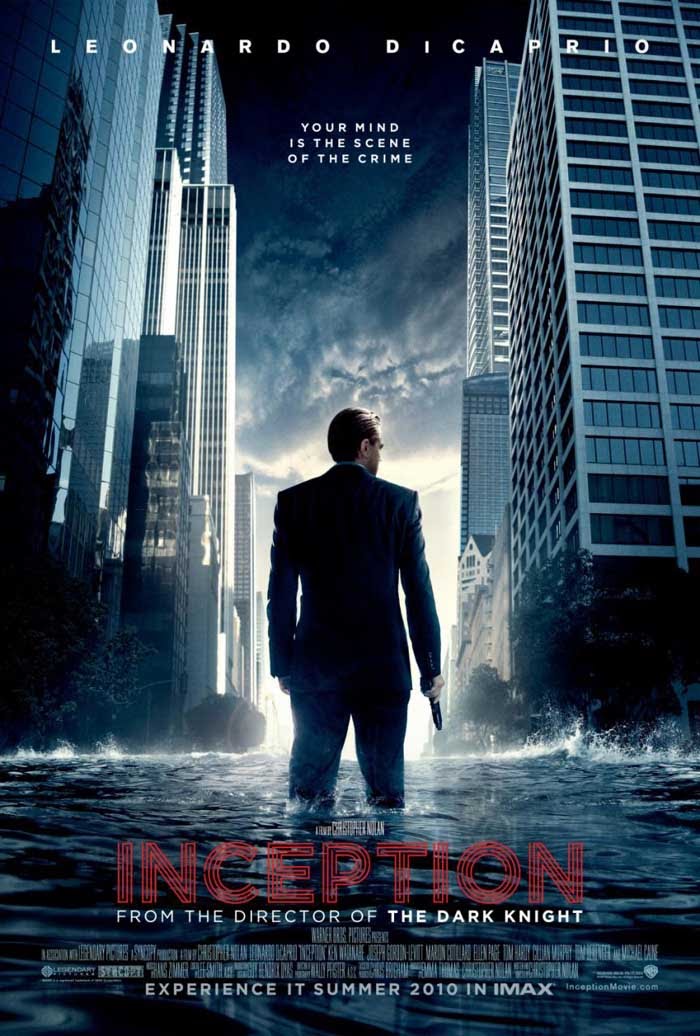
Inception

(Movie Review)

A quick recap of my Chris Nolan viewing history:

I didn't see Memento until a few years after it came out. But I rented it one afternoon, and was absolutely fascinated by it. In fact, I was so fascinated by it, I watched the DVD twice in one sitting. Once the movie finished, I just went back to the menu screen and played it again. (I've never done that before or since.)

Actually the second time I watched it, I noticed the plot wasn't quite as airtight as I had thought the first time. In fact, if you pay close attention there are a number of inconsistencies with the short term memory thing. Still, it was pretty entertaining.

"The Prestige" (which I reviewed on this blog) was a very similar experience. I didn't watch this one twice, but while I was watching it I was too absorbed in the magic of the story to think about the plot holes. Once the film ended, me and my friend started to pick away at bits and pieces of it.

(Nolan also did "The Dark Knight," but that's probably in a separate category as a super-hero movie.)

As for "Inception," I'm not sure if it all made sense or not. My brain was so busy trying to keep track of everything that I wasn't looking out for plot holes. Plus the pace of the movie just keeps you rushing from one scene to the next without really giving you a lot of time to think about what you just saw.

There were one or two scenes however, where I thought maybe the movie was breaking it's own rules. But I wasn't sure. Maybe I just missed something. I'd probably have to watch this movie a couple more times, or talk about it some more with a friend, to fully get my head around it.

So for the moment I'll leave aside the question of consistency, and just say that I thought the movie was very entertaining.

That's really the genius of these Chris Nolan movies. Sure movies like Memento, The Prestige, and Inception have lots of mysteries and plot twists that keep you guessing all the way through. But the movies are more than just their plot twists. They're also well told stories, well directed and expertly paced.

I loved the way the tension in this film kept building so I was on the edge of my seat the whole time. Even in the scenes where there's not a lot of action happening on screen, there's always a lot of tension.

And I loved the way the 1930s era pulp fictiony feel of this movie--the way the characters were always walking around with perpetual one day's stubble on their faces, the exotic locations and chase scenes through exotic streets. The protagonists are the standard rogues gallery of crooks who come together for a job, but it's done well: like the forger who is hiding out in Africa, or the chemist who hangs out in an office surrounded by chemicals.

At the beginning of the film you think you're in for an exploration of dream psychology. But after using just enough of this to set the tone, the dream world becomes totally unrealistic.
In fact the dream worlds reminded me a lot more of "The Matrix" world than actual dreams. Which is okay--you just have to accept that this is a Matrix type movie rather than a psychological exploration movie. There are certain alternate realities that the movie creates, and they're governed by certain rules which the movie lays out.

(Whether or not the movie does a good job of sticking to it's own rules is something I really would have to watch a second time to decide.)

The action scenes were for the most part pretty well done, although this movie loses at least one point for all those repetitive scenes in which the bad guys are firing tons of bullets but can't seem to hit anything.
(Yes, this is one of those cliche movies where every shot the bad-guys take is always wide of the mark, even when they're standing right next to their target.) But still a great movie.

Link of the Day
Noam Chomsky - The War Against Terror

Inception: Movie Review (Scripted)

Tuesday, August 03, 2010

Tom Brown's Schooldays by Thomas Hughes

(Book Review)

I encountered this rather obscure classic as a result of my interest in the Flashman series.

After my friend had originally recommended the Flashman series to me, the first thing I did was to go to wikipedia to read about it.

There I learned that the character of Flashman originally came from an 1857 novel called "Tom Brown's Schooldays."

(Ah wikipedia, what would we do without it? If I had read the Flashman series 10 years earlier, I would probably have just been confused about where the character came from. Now all the information is right at my fingertips. Already it's becoming hard to remember what life was like before wikipedia.)

Being the thorough reader that I am, I decided that if I was going to embark on the Flashman series, I would start with the source material first.
And so I did. And I got about 50 pages into "Tom Brown's Schooldays", before I got impatient with the slow pace of the book, and decided to jump right into the actual Flashman series itself. And while I read through the first few Flashman books, I simultaneously slowly chipped away at "Tom Brown's Schooldays."

I'm a slow reader as always, so it took me a few months to plod through this book. In the meantime, I finished off 3 books in the Flashman series:
Flashman,
Royal Flash,
and Flash for Freedom (see previous post).

I don't know how many other Flashman readers actual take the trouble to wade through the original source material. But I can observe that it was much easier to get ahold of the Flashman books than "Tom Brown's Schooldays." All of the local bookstores in my city had at least some of the Flashman books stocked (some had the whole series). "Tom Brown's Schooldays" was nowhere to be found in any of the bookstores I visited, and the only copy I was able to find was an old 1967 copy tucked away in the corner of the University library. So I can only conjecture that, at least as far as Melbourne goes, most people just plunge directly into the meat of the Flashman series.
(It's possible this book is more famous in it's home country of Britain. It was just made into a TV movie as recently as 2005 (IMBD). Or I don't know--maybe it's famous everywhere, and it's just my ignorance. If anyone else out there has heard of this book before, let me know.)

George MacDonald Fraser, however, does constantly reference back to this book in his Flashman series, however, starting with the very first chapter in which Flashman complains of his portrayal by Thomas Hughes (while admitting it was accurate for the most part). And many of the characters from this book make appearances throughout the Flashman series.
For example Doctor Arnold and Harry "Scud" East appear in the first chapter of "Flashman." Speedicut appears in the beginning of "Royal Flash." References are made to Young Brooke and Scud East in "Flash for Freedom." And Scud East is a major character in "Flashman at the Charge," (which I'm currently reading now). So I imagine anyone who hasn't waded through this book first will miss a lot of the references in the Flashman series.

Even if the Flashman books are a lot more fun than this one.

"Tom Brown's Schooldays" isn't a terrible book, but it's a book from a different time, with a different sort of pacing, and a different sort of prose style.

I'm sure you've noticed, as I do whenever I read a Victorian era book, that some of these classics have aged better than others. Some of them read like they could have been written yesterday. And some of them are written with a more antiquated style. This book is one of the latter.

Still, if you're willing to put in the effort of engaging the book, there's a lot to be gained from it.

As with any old book, the main value of it is in being able to get a glimpse of what life was like before you were born. What did schoolboys do in the days before television, video games, and the internet? How did they entertain themselves? What sort of mischief did they get up to, and what sort of values were instilled in them? What was boarding school like in England in the 19th century?

Of course a work of fiction from a single writer can't be counted on to represent faithfully all the complexities of life as it is or was.

But in this case one has reason to think that most of the book is true to life. The book is based on the same school that Thomas Hughes himself went to as a boy. And takes place around the same time that Thomas Hughes himself was a student there. And real life figures, such as Doctor Thomas Arnold (W), the headmaster of the school at the time, are incorporated into the story. And although Tom Brown and his friends are fictional characters, many of the incidents in this book are probably based off of real life.

Much of the book has a realistic feel to it, and details the kind of mischief that it's easy to imagine real boys getting into. (Although every generation likes to imagine that they were the first to discover rebellion, it is always interesting to read older books and discover that even the respectable Victorian gentleman started out as young boys causing mischief 150 years ago.)

The book is written with a heavy moralizing tone, but it's not exactly the strict schoolmarm type of "never speak unless spoken to and stay out of trouble," type morality. It's more of the British bulldog old fashioned morals of the schoolyard: Never pick on boys smaller than you, but don't be afraid to stand up to bullies even if they are bigger than you. Never shirk from a fight if challenged. Always throw yourself fully into sports without worrying about getting injured. A certain amount of mischief is natural for a young boy, but never lie or be dishonest about it when caught. Et cetera.

Harry Flashman is the villain of this book, and represents the antithesis of everything our young heroes stand for. He mercilessly bullies younger boys when he thinks he can get away with it, but "toadies" to all the older boys. He takes great pleasure in inflicting pain on others, but shrinks away from a fight as soon as someone stands up to him.
Although Flashman is only in a small portion of the book (he doesn't make much of an appearance until the book is a quarter finished, and he gets kicked out of rugby school before the book is halfway through) his character, and the younger boys struggle against him, dominates the part of the book that he is in.

One can certainly see in this short section all the bad qualities which George MacDonald Fraser would later make a series out of.
(It was a stroke of comic genius for Fraser to take the character of Flashman and decide to explore what kind of man he would turn out to be.)

Parts of the morality bit, or at least the preachy way in which a lot of it is conveyed, maybe a bit tiresome for the modern reader. But it was readable as far as it went. The real problem with this book is when the characters find religion.

I'm over the stage of my life where I have much patience for religious morality. But even then, if the religious preaching had been well written I would have had less of a problem with it. However the religious change these characters undergo feels very forced, and not natural to the story at all. And near the end there are some passages when these schoolboys are sitting around discussing the Bible, and it felt so unnatural. I couldn't believe these were even the same characters I had been following.
It was one of those scenes that was so bad that you almost feel embarrased for the author as you read it.

P.G. Wodehouse has written a satirical essay on this sudden change of tone called "The Tom Brown Question" (available on-line--link here) in which he suggests that only the first half of "Tom Brown's Schooldays" was written by Thomas Hughes, and the second half was written by a moralizing committee. And I can definitely see where Wodehouse is coming from.

Link of the Day
Chomsky in Lebanon

Tom Brown's Schooldays by Thomas Hughes: Book Review (Scripted)

Tuesday, July 27, 2010

Flash for Freedom by George Macdonald Fraser

(Book Review)

Having enjoyed the two previous Flashman books:

Flashman and
Royal Flash

I've moved onto the third book in the series.

As usual with these books, this one covers a lot of diverse historical ground: The 1848 Chartist demonstration, Disraeli, the African slave trade, King Ghezo and his amazon warriors, the underground railroad, and Abraham Lincoln himself.

But much of the book takes place in the good ol' United States itself.

For me, much of the appeal of the Flashman books is being able to learn about new places as Flashman's travels take him to the exotic ends of the Victorian empire.

To have most of the action take place in the United States made this book seem a little bit more ordinary. And at times the book was in danger of becoming just another historical novel about the underground railroad (albeit with the twist of Flashman being an anti-hero.)

What I found most interesting about this book was that it got into the the international politics of slave trading. It was legal to own slaves in America, but slave trading itself had been outlawed and was punishable by death. So when Flashman finds out he's on a slave trading vessel, he's horrified not for moral reasons, but because he's worried about being caught and hanged.

British and American navy ships both patrolled the African coast looking to catch slave ships. (The British navy even going so far as to attack and burn known slave trading outposts along the coast.) And if a vessel was captured even without slaves, it could still be condemned if it had slaving equipment (chains, et cetera) on it.
However the American government would not let any navy but its own search American ships, so the safest thing for the slavers to do was to fly an American flag, and just hope they don't run into American patrols.

All these points form an important part of the book's plot. As always, Fraser has put a lot of research into this book, and it shows.

That being said, the climax of the book itself did seem slightly too ridiculous to be believable, but I guess that's the kind of story these books are: mixing historical detail with an element of ridiculousness.

As always there are a few good laughs along the way. Disraeli is given a couple of brilliant dry lines in response to to one of Flashman's typical tactless comments.
And there's a very funny scene with Flashman and a runaway slave crossing the Ohio river. (A parody of "Uncle Tom's Cabin"--a book I, like most people, remember from high school.)

Link of the Day
Noam Chomsky - BBC Radio 5 - 23 June 2010

Flash for Freedom by George Macdonald Fraser: Book Review (Scripted)

Tuesday, July 20, 2010

Toy Story 3

(Movie Review)

It's been over 10 years now since I've seen either of the two previous "Toy Story" movies. (And well before I started reviewing movies on this blog).

Consequently, I don't remember those movies in much detail. But I do have vague memories about the experience of watching them. The first Toy Story I believe I saw somewhat against my will sometime in college. Someone put it in the VCR and I was too lazy to leave the room. And although I had thought it was just for kids, I remember being pleasantly surprised with how good it was, and how much I genuinely laughed at all the jokes.

My experience with the second Toy Story was similar. As I recall it was a family outing to the theaters. I had voted for a different movie, but lost out and somewhat sulkily followed everyone else inside to see "Toy Story 2." And then found myself enjoying it even more. The jokes were funnier, and some of the chase scenes had me on the edge of my seat even though it was a kids movie.

I guess it's somewhat cliche to praise Pixar movies for appealing to adults as well as kids (see: every review of Pixar ever written.) But it's true.

So by the time "Toy Story 3" came out, I went into the theaters of my own volition.

A fuller review of the trilogy, and how this film stacks up against the others, can best be done by someone who has the two previous films in more recent memory (see Whisky's take on it over here.)

I'm somewhat a victim to the gaps in my memory on the previous two films. But there's no doubt about it, those guys over at Pixar are talented writers. They do some amazing things with fast paced chase scenes in computer animation. And they can also be really funny.

Kids toys, and the different personalities they might take on if they were really alive, is a subject somewhat ripe for satire, but Pixar does it well. Sometimes the humor comes from playing up the stereo type such as a Ken doll who is just a little bit too into fashion, and (from Toy Story 2) Rock-em Sock-em Robots that are a bit too argumentative.
Sometimes the humor comes from playing against type, like the evil Teddy Bear, or the mild mannered Tyrannosaurus Rex or the sad clown Chuckles.

But either way it's always good fun. And a clever mix of nostalgia with humor and good story telling.
(For example: I never had a glo-worm (W) as a kid, but as a child of the 80s I remember well the advertising campaigns and commercials for it, and got a kick out of seeing it in this movie as a kind of evil librarian. I got a few laughs out of Ken insisting that he wasn't a girl's toy. And I liked the chatter telephone that talked like a 40s gangster film. All good fun.)

And, although I'm not quite sure the chase scenes lived up to the previous two films (subject to memory, that) I thought they were pretty decent.

What grained on me a little bit is the overdone sentimentality of this film.

With all the truly sad things that are happening in this world, I have a limited amount of emotional involvement I'm prepared to invest in a teenager outgrowing his childhood toys (if you'll excuse me for bringing in my cynical adult views to a children's story). In my humble opinion, it would have been better to just stay focused on the fun part of these stories. Sure Andy has to grow up eventually, and eventually the toys will get thrown away or broken. But in the world of film, there's no reason why this has to happen in real time. I don't go to this kind of movie to see a long drawn out story about toys coming to grips with their own mortality.

As we were walking out of the theater, my friend asked me what rating I would give this film out of 10.
"It loses a point for the gushy sentimentality," I said. "And perhaps it loses another point for being in unnecessary 3D," (in my opinion.) "But I'd still give it a solid 7 or even 8."

And I think I'll stick to that.

Link of the Day
Noam Chomsky Americas Messianic Vision Of Democracy.

Toy Story 3: Movie Review (Scripted)

Monday, July 12, 2010

The Prisoner of Zenda by Anthony Hope

(Book Review)

As mentioned in the previous post, since I was reading a parody of "The Prisoner of Zenda", I decided to use this as an excuse to read the real thing, and thus plug in one of the gaps in my literary background.

Actually, "The Prisoner of Zenda" has long been on my reading list anyway (as part of my reading project to work through the classics of pulp fiction--see also “Sherlock Holmes”, “The Martian Trilogy”, “The Insidious Dr. Fu-Manchu”, “Conan the Barbarian” and "The Scarlet Pimpernel").

This book was so pleasant, so easy to read, and so short, that I don't know why I didn't read it a long time ago.

My copy was only 152 pages, so I was able to finish it in almost no time at all.

It's a classic adventure story, with imaginary kingdoms, treacherous dukes, and beautiful princesses.

I suppose I should say something about "swashbuckling" in here, because it seems every review ever written about "The Prisoner of Zenda" must say "swashbuckling" at least once. The publishers introduction to my volume (Penguin Classics) goes a little nuts with the word "swashbuckling", mentioning it multiple times.

Well, there is plenty of action in the book, and lots of sword battles. So I guess "swashbuckling" is an apt adjective.

The book does have its flaws. Some of the sections on honor and duty I found a bit tedious. The love story seemed a bit forced and overly sentimental. But really, in a book that's only 152 pages, you can't really complain about anything. Nothing lasts too long for it to get annoying. The story moves quickly enough that the book is over before you know it.

Link of the Day
Noam Chomsky - Israel Apartheid 2010-03-02

The Prisoner of Zenda by Anthony Hope: Book Review (Scripted)

Wednesday, June 23, 2010

Royal Flash by George MacDonald Fraser

(Book Review)

Having enjoyed the first book in the "Flashman" series (see previous post) I've decided to move onto the second.

My British friend who originally recommended the series to me did warn that: "because all the books have the same structure (Flashman performs several feats of cowardice and villainy, and then somehow gets recognized as an honorable Victorian hero by the end) they do get pretty repetitive if you read them all together."

But so far I'm still having fun with them. They're light and easy enough to provide a touch of escapist reading while I slug my way through grad school, and yet they provide enough historical context to keep the history geek in me satisfied.

And actually, this book is considerably different than the one before it.

Whereas the previous book was heavily peppered with historical people and places, this book takes place in a fictional kingdom. The story is a parody of "The Prisoner of Zenda."

Up until now, I had never actually read "The Prisoner of Zenda." But since it's been on my reading list for a while now, I decided to use this book as an excuse to get it out of the library, and I read both books simultaneously. (Review of "The Prisoner of Zenda" coming soon--soonish--well, sooner or later anyway.)

And reading both books together, it was interesting to see all the little parallels and tributes to the original story that Fraser had put into "Royal Flash."

Also, because the original "Prisoner of Zenda" focuses on a Victorian sense of honor, duty, and heroism, it is particularly amusing to see Flashman (the antithesis of all these virtues) thrust into the same position, and watch how differently he reacts than the original hero.

But, as I said in the previous review, the humor is more in the plot structure and in the general tone of the book. I didn't have any big laugh moments reading the thing, but enjoyed the situation nonetheless.

Most of the story takes place in the fictional duchy of Strackenz. (According to wikipedia, thus making it the only Flashman story to take place in a fictitious location). However the beginning and the end of the novel place it in historical context.

The book takes place during the "Revolutions of 1848", however the actual revolutions themselves are only something mentioned in passing, and don't have too much of an impact on the story.

Karl Marx himself makes a brief appearance as a rabble rousing orator haranguing the crowds. (This portrayal somewhat jarred with the impression I had of Marx as a more academic philosopher. However as the author George MacDonald Fraser clearly knows his stuff--he's written a couple history books in addition to historical fiction--I'll have to trust his judgement.)

Richard Wagner also appears briefly.

But the big historical figures in this book are Otto Von Bismark, and Lola Montez.

I didn't learn much about Bismark that I didn't already know, but it was an interesting portrayal.

Lola Montez I knew a little about from Priscilla Robertson's "Revolutions of 1848", but Fraser, who clearly thinks she is one of the more fascinating historical figures, fleshes her out into a much more fascinating literary portrait.

I also learned a thing or two about the Schleswig-Holstein Question, something I had previously known nothing about, but now feel informed on thanks to this book.

Link of the Day
Chomsky interviewed on Channel 2 News in Israel

Royal Flash by George MacDonald Fraser (Scripted)

Sunday, May 02, 2010

Flashman by George Macdonald Fraser

(Book Review)

A few months back, when I was reading the biography of Captain Sir Richard Francis Burton by Edward Rice, I became very interested in the history of the British Empire in Afghanistan and "The Great Game."

I was talking about it with a British friend back in Japan, and he at once recommended the "Flashman books".

"They're absolutely hilarious," he said. "And you learn a learn a lot of history from them."

He then proceeded to tell me the idea behind the series. "He's a coward and a scoundrel, but somehow he always ends up getting the reputation of a hero. The books are written from the perspective of the 80 year old Flashman, who is trying to set the record straight on what really happened.
"Plus, the books are very well researched, so you learn a lot of history from them as well."

I had never even heard of these books before. (I'm not sure if that's just my ignorance, or if they're less popular in North America. Has anyone else read or heard of this series?) But, this was definitely enough to pique my interest.

Also, as often happens when you learn about something new, I found that once these books had been put on my radar screen, I began to notice references to them all over the place. Christopher Hitchens, in one of his clips on Youtube, made a passing reference to this series. John Updike and Terry Prattchett, it turns out, are both big fans.

So, eventually I decided to check it out. Since this book is light and easy to read, I've been using it as a way to relax in the evening while doing graduate school.

It is, if nothing else, a very pleasant way to learn history.

I have long -- been-- a-- fan-- of -- historical-- novels as an easy and exciting way to learn history.

But, if the pleasure of learning history is increased by making it into a novel, then that pleasure is doubled by making it into a comical novel.

The humor of this book (how the scoundrel Flashman keeps ending up a hero) is more an ironical humor than it is a-laugh-out-loud punchline every page type humor. But it should be enough to at least put a hint of a smile at the corners of your mouth as you read.
Personally my favorite parts were the descriptions of Flashman whining and crying when he was forced to defend a fort against an Afghan attack.

The history of the period is also quite cleverly woven in with the story. Although Flashman himself is purely fictional, he interacts with many historical figures and, Forest Gump like, somehow manages to always be present at all the key points in history (mostly against his will). He is present at the assassinations of some of the leading British political officers in Afghanistan, as well as many of the key battles.

As any good historical novel does, this takes a complex history and makes it understandable. When I first started reading about the British in Afghanistan, I very quickly became confused about the rival warlords and tribes. But when they all become characters in a novel, it's much easier to remember who is who.

In fact this little books is so chock full of historical figures and events that, if you're already addicted to wikipedia as I am, it's hard to resist the temptation to keep looking up people as you read through the book--Something that probably was less of an issue when this book was first published in 1969, but oh how times have changed.

Something else which has changed since the book's original publication is its relevance to current events. Now that our own army is bogged down in Afghanistan, attempting to do what the British and the Russian armies have failed to do, the lessons of history are perhaps again becoming relevant.

Update:
I was reading some of the reviews for this book on amazon.com (A). Most of the negative reviews focused on Flashman's treatment of women. Specifically there's a scene in this book where he rapes a woman. The actual rape itself is more implied than shown, but this was obviously enough to turn some people off from the book.
This made me wonder if perhaps I was a little bit too kind to this book in my initial review. Should I have been harder on this book for being insensitive to women?
Of course the whole premise of this book is that Flashman is a scoundrel, so nothing Flashman does is meant to be good. And the book sort of justifies itself by having the woman later get the upper-hand on Flashman. But maybe a line is crossed nonetheless?
I wish the author would have left the rape out of the book personally, but I still liked the book as a whole anyway.
But at any rate, a caveat should definitely be attached to my recommendation.

Link of the Day
Noam Chomsky on class in America

Flashman by George Macdonald Fraser: Book Review (Scripted)