Saturday, May 2nd, 2009
As with the previous post, it's- still - Golden - Week - here in Japan, so the name of the game is to try and beat the crowds.
Therefore, I attempted to elude the crowds by heading out to Kunimi, the Northernmost point on the Kunisaki Peninsula. And, mission accomplished. There were absolutely no crowds up on Kunimi. I felt like I had the whole city to myself.
Kunimi is the closest city to Himeshima Island, so a couple years ago when I toured Himeshima I took the ferry from Kunimi. (I still have good memories of Himeshima Island, by the way. What a beautiful place that was.)
One of my first stops was to visit the ferry port again. And the Betsugusha temple that was next to it.


A little bit further down the road, I came to signs for Gogenzaki beach and camp ground. I parked my car near the camping area, and took the walking trail through the grounds.


This eventually led me down to the seaside park.
The beach itself wasn't so spectacular but, as with Himeshima Island, the water around here was very beautiful and looked untouched. It was crystal clear when you got up close to it, and looked a beautiful deep blue color out in the distance.


(It's funny how the ocean works. Nakatsu is just a few towns over, and the ocean water their always manages to look murky brown.)
I walked up and down the beach for a while, going out on each of the two piers. The beach wasn't crowded, but there were some other people about, including a group of elementary school kids and a couple coaches practicing soccer. Watching those kids do the same drills over and over again brought back memories of my own childhood little league soccer experiences.
Only in Japan, yelling out the correct words seem to be just as important as doing the drills. This is something I used to notice as an ALT (W) watching the junior high school teams practice.
And it was true here as well. The boys yelled out the same word every time the ball was passed to them (something that sounded like "hey") which ended up giving their practice an almost rhythmic sound.
After having walked the length of the beach a few times, I returned to my car and headed down the road a bit to see what else Kunimi had to offer.
Next stop turned out to be Petro Kasui Kibe memorial park.
Petro Kibe, native son of Kunimi, is the town's biggest claim to fame. However, since I didn't do my research ahead of time, I had no idea who Petro Kibe was. So I looked around at the signs and with my limited Japanese I gradually was able to figure out a few details of his life.
Petro Kibe lived from 1587 to 1639. He was one of the early Japanese Christians, and was the first Japanese person to travel the world. He went to India, to the holy land, to Rome, to Spain, to Africa, et cetera. He was eventually martyred in Nagasaki along with 187 other Japanese Christians after Christianity became outlawed in Japan.
(And that was all I was able to figure out at the time. Needless to say though there's a lot more information available on-line for anyone who's interested. You can start with Petro Kibe's wikipedia article here).
The outside of the park had a couple statues, and a map of Petro Kibe's world travels. There was also a very picturesque chapel in the middle of the garden. The chapel was closed from the outside but which had a view hole to see in. I'm not sure if the chapel actually functions for Sunday church services, or is only a tourist prop.


At the door of the chapel is a notebook for tourists to sign and to leave their thoughts. I was surprised flipping through the book to discover that it covered only the last few months, and was already filling up fast. Apparently a lot more people tour Kunimi than you would think.
The entries were written mostly in Japanese, as you would expect, but there were several other languages mixed in with it. A few entries were in English, and a few entries in languages I didn't recognize. People signing the book claimed to be from such exotic places as the Netherlands, and Slovakia.
And almost all of the entries were more about the signer's own travels than reflections on Petro Kibe's martyrdom. "Here we are on our tour of Japan. Half way done!" et cetera.
Somewhat less classy, I thought, were a pile of free catalogues which contained order forms for items such as Petro Kibe crystal commemorative plates (only 6,000 yen for the foot stand type, 8,000 yen for the desktop type, and 4,500 yen for the book stand type). It's good to know people are still making lots of money off of religion.
The park was built at the foot of a hill, and there was a trail leading up. Before I went up, an old lady on bicycle came by and told me to make sure I noticed the remains of an old castle, which was also on the hill.
The path was pretty overgrown, and it was evident that although there had probably been a nice trail here at one point, nobody had bothered to keep it up. From the top you could get a bit of a view of Kunimi city, although there were too many branches in the way to see clearly. And, on the way down the backside, I saw what looked like part of an old castle wall.


There was a museum for Petro Kibe behind the park, and I bought a ticket for that.
"Do you speak Japanese?" asked the ticket lady.
"Um, a little, yes."
She then launched into an explanation of the museum of which I caught only bits and pieces. The museum was actually an old historical Japanese house, which had been donated by a rich man to the city of Kunimi, and they had turned it into a museum.
"It's not Petro Kibe's house then?"
"No, his house was more over by the seaside. But there's nothing left of it now. This is just another house that was turned into a museum."
After giving me my ticket and a couple brochures, the lady told me to feel free to wander all around the house. "Don't worry about anything," she said. "Any door that's unlocked means you can go inside."
I was the only one there, so I had the house all to myself. The first room was all about Petro Kibe, where I learned a little bit more about his life. In fact I learned that there had even been an Opera about the life of Petro Kibe which had been performed in Oita city a few years back.
The house, in the typical style of old style Japanese houses, was kind of built like a square with an open garden in the middle. It seemed straight out of a Samurai movie.
Only the first room was dedicated to Petro Kibe. The rest of the house was about the history of Kunimi, and other famous people from Kumimi town.
There was a gallery that had the works of Kunimi artists like Eto Tetsu, Kawai Seitoku, and Tanabe Kothikusai. (I have no idea who any of these people are, but apparently all famous native sons of Kunimi).
And there were rooms filled with just random old stuff and various antiques.


After this, I got back in the car and drove a bit further down Kunimi's coast.
I couldn't take any pictures while driving of course, but the Kunimi coast line is absolutely beautiful. The ocean was a clear sparkling blue, and the mountains had turned a very deep rich green.
The mountains in Japan never lose all of their green even in the winter. There are enough evergreens, bamboo, and other permanently green vegetation to keep them green year round. And so in the middle of winter I often forget how vibrantly green they can be in the summer. And every spring I'm surprised anew when I look at the mountains and suddenly see a rich green I'd forgotten they used to have.
I always used to assume this was their summer green color, but a Japanese friend was telling me yesterday that it is most noticeable in May, when the light green colors, dark green colors, and yellowish green colors are all blending together. Apparently this only lasts through the spring. (I must not have been paying attention when I thought it was all summer long.)
There were a shortage of good places to stop the car, so I just pulled over by one of the fishing ports to try and take in the mountains and the ocean. There was no good sidewalk here, but I went up and down the road for a while just for an excuse to walk around and take it all in.

There was a high school overlooking the ocean, with windows facing out to the water on one side and the mountains on another. What a beautiful place to go to school, I thought, slightly envious of the students there.
Although, who knows? Maybe getting tantalized with a view like that everyday would make you feel worse about being stuck in school. When I was at Beppu University, which also had a great view of the ocean, I would sometimes spend more time looking out the window than at the teacher.
A little further down the road I stopped at yet another seaside area, Mukata beach. I wandered up and down the beach for a while.

And I even walked up the road a bit, to try and capture on film the view you would have from the car driving through this town.
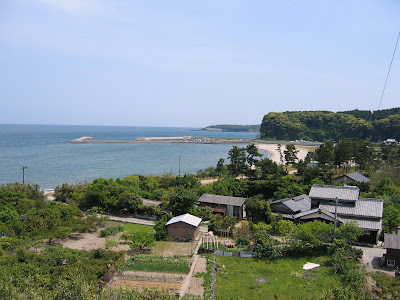

(It was also interesting to notice how many of these old Japanese countryside houses were equipped with solar power panels on their roofs. This is a common sight in Japan, and while this wasn't the first time I noticed it, I took notice of it again. Why do so many Japanese houses have solar power panels, and so few in America?)
I was still feeling enamoured with the beauty of the mountain sides and I wanted to try and find some hiking trails through them. It was about 1 in the afternoon by now, so I decided that if I was going to do any hiking I should start now or I was going to run out of daylight. I looked at the map, and saw some hiking by Mount Sento.
From where I was, it looked like the quickest way to Mount Sento was to briefly cross the boarder into Kunisaki town, and then take the 544 road into the mountains rather than back track through Kunimi. So that's what I did.
As I drove through the mountains of Kunisaki (also in full green beauty for the month of May) I realized how much stuff I had missed when I visited that town last fall.
I drove into the Kunisaki mountains and entered an Oita wildlife preserve. Somewhere along the way passed the boarder back into Kunimi.
At the risk of repeating myself, I was absolutely blown away by the beauty of these mountains as I drove through them. It was like swimming in a sea of green.
The entrance to the hiking trail was by a small lake (created by an artificial dam).
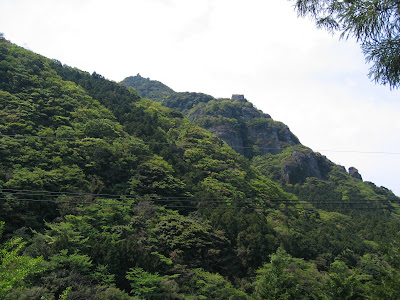

The sign for the trail head was a bit hard to catch, and I drove by it twice before I figured out where it was.
Even after I got on the trail, for a long time I wasn't sure I was hiking up the right place.
The beginning of the trail was an old concrete road that had fallen into disuse. There were enough fallen branches on it that I wouldn't have wanted to risk taking my car up it, but you see these kind of forgotten roads to nowhere all the time in the countryside, and most of them are not labelled as hiking trails.
It was at a fairly steep elevation, so despite the fact that it was nicely paved I was huffing and puffing the whole way up--and all this time being worried I was going the wrong way. Eventually though I did see some signs that let me know I was on the correct hiking trail.
As often happens when you actually hike through a mountain, the beautiful green colors that looked so rich and deep when they all blended together from a distance looked a lot more plain and ordinary up close. In fact, slogging my way through the trail what I mostly saw was just the brown bark on the trunks of evergreen trees. (The green needles being above my head.) And some of the various insects that swarmed around me also took off a bit from the romance.
I suspected that the hiking trail I was on now was an old logging road. That may have been why instead of seeing a variety of different growth common to an ancient forest I just saw rows of evergreens that may have been replanted after the original trees were cut down. But then I'm no foresting expert.


However as I continued on the trail turned into a real footpath instead of a road, and at that point the mountain did seem to become a lot more green and the plants more varied.


The sweat was pouring off of my face, and stung my eyes slightly as it dripped off from my forehead (especially as it mixed with my sunscreen). Already in early May I could tell that in a month or two it might be too hot to do this kind of thing. I wished I had gotten out more in the early spring months of March and April.
I also saw two wild deer on the mountain. (They ran off as soon as they saw me, naturally). This was one of the very few - times I had seen wild deer in Japan.
Eventually I reached the top. From there I got a splendid view, as you would expect. One one side, rolling mountains. On the other side a widening valley that turned into the town of Kunimi, and a view of the ocean.
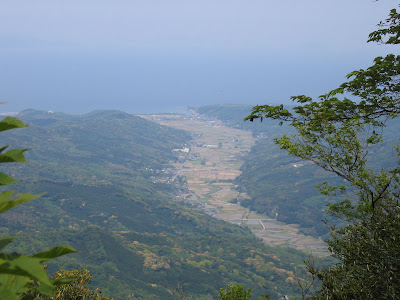
But the hike was far from over. The trail continued down the other side of the mountain, and then lead into another trail called Gorin fudo sen, an old buddhist pilgrim's trail I believe, which lead through a forest around the base of another mountain.


The way down was, in a lot of respects, more difficult than the way up. It was certainly less tiring, and easier on my lungs, but the trail was steep and narrow, and I often had difficulty getting a good grip with my shoes. I turned my ankle a little bit, which worried me because I was hoping to get out and do some more hiking later in the week, and I didn't want any injuries now.
As I left one new trail and entered onto another I was more and more getting concerned about the time, and constantly glancing at my watch. It was getting close to 4 now, and in a couple hours the sun would be going down. The last thing I wanted to do was to have to walk this trail back in the dark to get to my car.
I could probably have made it if I stayed on the trail, but at a certain point I realized I was too busy worrying about the time to really enjoy myself. Shortly afterwards there was a sign pointing to an exit off the trail and I took it.
I very rarely leave a hike before finishing. It makes me feel guilty, and I always worry about what wonderful scenery I might be missing. But, although it seemed to me like I was committing a sin, sometimes it can't be avoided.
I still had to get back to my car, however. Looking at the map, I decided that rather than going back up and back down the mountain again, I could get back to the main road and walk back the same distance along route 31.
I was still high enough up the moutain however that I had a fair bit of walking to do before I even got down off to the main road.
On the way down, I came across the ruins of Sento temple, and so took a brief detour to follow the old stone temple road up the mountain for a while, finally leading to a series of stone steps to the back of the temple.


Also on the way down I passed an another set of buddhist statues marked as "Saigyo modoshi". I didn't have a clue what it was, but I took a picture anyway.

Eventually I came close to the main road, and the local houses alongside it.
There was another sign indicating some spot of interest, so I went down the trail indicated near someone's backyards. (In the countryside, one often sees signs for historical places of interest that are almost right in someone's backyard. I've learned not to be shy over the years).
A Japanese woman came out to greet me.
And here once again, as so often happens in the Japanese countryside, I found myself the recipient of the local people's kindness.
She started talking to me in Japanese, but at my first slip up she switched into English which, although far from flawless, she was quite proficient in. (Much better than my Japanese, at any rate).
She asked me where I was from, what I was doing in Japan, and patiently explained all about the area to me.
"I just passed a place called 'Saigyo Modishi'. What is that?" I asked.
"Saigyo (W) was a famous buddhist priest who wandered all over Japan," she explained. "When he came to this town, he met a young boy. And the boy was so cool, that Saigyo decided he didn't need to climb the mountain. Do you understand?"
"Um, maybe."
"Hmmm. How can I explain this in English?"
After a bit of back and forth, it turned out that the young boy was carrying wares on his backpack. Saigyo asked him if he was selling something ("Uruka" in Japanese) and the boy told him he could get fish stomachs from the stream in the river (the fish stomachs also being "uruka" in Japanese, so there is a bit of a pun going on). Saigyo decided the people of this town were already much smarter than him, so he didn't need to climb up their mountains. (Or something like that. Actually I'm still a bit sketchy on the details.)
The woman and her family ran an art gallery out of their house, and the second story bedrooms also doubled as guest rooms for visiting tourist. (She very kindly offered me a place to stay for the night, but I had plans back in Nakatsu that evening).
She brought me inside to see some of the art, most of which was done by her husband and her father-in-law.
I guess I was expecting something a little bit kitchy, and was unprepared for what I saw. A huge wooden statue of buddha intracately designed and flawlessly built. It looked like something you would see in a historical museum, not tucked away in a private house. Her husband and father-in-law, both wood carvers by trade, had made it over the past two years.
She showed me several other things in the gallery, and very kindly explained the significance of each of them. Unfortunately (and this is so typical of me) I was feeling exhausted from the hike and my brain was a little sunbaked, and I faded in and out of the conversation a bit. Every once and a while I would suddenly noticed that she had finished talking and was waiting for a reply from me, and I which quickly try and ask a question about the piece of work to try and cover for myself. (Conversation is unfortunately not one of my strong points, but I really appreciated her showing me around nonetheless.)
She even gave me a ride back to my car, so I didn't have to walk all the way back. I appreciated the offer, and I appreciated it even more once we actually drove the distance, and I realized how long of a walk it would have been. Even going along the main road and cutting out the mountain climbing, it was still a good distance back. It only took us about 5 minutes in the car, but it would probably have taken me forever to walk.
And with that, I finished my adventures in Kunimi.
Kunimi Links
Kunimi Furusato Pavilion,
Gaijin Wife (Blogger living in Kunimi)
Kebesu-matsuri Kebesu Festival
Link of the Day
Noam Chomsky - Anarchism (Libertarian Socialism)
and May Day: Celebrate Workers Power


