This is the 14th book in the Oz canon, and the last book written by L. Frank Baum before his death. It was published posthumously in 1920. (L. Frank Baum died in 1919.)
My History with this Book
I think my sister had a copy of this book way back when we were kids. I never read it at that time, but I do have a memory of reading the back cover and the publisher's introduction, which talked about how this was the last Oz book L. Frank Baum ever wrote, and that it was darker than the others because it was influenced by L. Frank Baum's declining health, and also the events of World War I.
In the years since, I think I've stumbled upon a couple other summaries of this book which also made references to the World War I allegory. So, I was fully expecting this book to be a lot more deep than the other Oz books.
These high expectations were a mistake. This book is every bit as silly as all the other Oz books that L. Frank Baum wrote.
My Reading Journey
I've been doing these Oz books as a buddy read with Dane Cobain, but I've fallen way behind schedule. The original plan was to do one Oz book every 2 weeks. These Oz books are very short and light, so this was in theory quite doable, even for a slow reader like me. But after keeping on the schedule for the first several books, I eventually fell off the schedule this spring. A combination of factors: my second child being born, and a corresponding drop in my free time. Plus, the covid lockdown in Vietnam came to an end, so I started to travel back to in-person work again. And the book I was reading these Oz stories out of, The Complete Stories of Oz, was way too big and bulky to take with me to work every day. (And since the second child was born, lunch break at work is now where I get all of my reading done.)
That, plus... I think I was just getting sick of these Oz stories after a while. In my opinion, L. Frank Baum lost his magic touch a long time ago, and he's just going through the motions by this point in the series. It was not captivating reading, and I was subsequently easily distracted from it.
I finished the 13th book in this series, The Magic of Oz, and reviewed it on June 23, 2022. I procrastinated a couple weeks before starting this final book in the series, but finally got around to starting this book back on July 6. I inched along - with - slow - progress for a few weeks, but then got busy again and stopped reading this book.
(Also, come to think of it, I suppose my new comic book review project also slowed down my progress on Glinda of Oz, since I primarily read those comic books in my few minutes of free time before bed--what would otherwise have been time to chip away at the Oz books.)
But then October came around, and I realized how quickly time was getting away from me. I also worried that if I didn't force myself to come back to Glinda of Oz soon, I would be in danger of just drifting away from the book, and never coming back to it.
Once I finished The Wayfarer Redemption, I decided I was going to turn all my attention on finishing Glinda of Oz next. I brought The Complete Stories of Ozwith me to work for a couple of days, but was immediately reminded of why I had decided not to bring it to work. It was much to big and unwieldy for me to read casually while I was in the sandwich line.
It strikes me now, reading over what I have just written, that this is all sounding a bit ridiculous. These Oz books are so short and light, I really am making way too big of a deal about the struggle to finish an 87 page children's book. But I'm a slow reader who quite often only managers about 30 pages a week, and I just lost motivation to finish the last 50 pages.
(If you buy the original edition of this book, with the larger print and all the illustrations, then it's actually 279 pages--according to Wikipedia. But it's 87 pages in The Complete Stories of Ozedition.)
Since I had taken a couple month break in the middle of this book, after finally finishing it up, I listened to the audiobook of it in order to refresh my memory before writing this review. (The free librivox version of this audiobook is on Youtube HERE.)
For example, one of the reoccurring inconsistencies in these Oz books is that Ozma is established to be the ruler of all of Oz. And yet, almost every Oz book contains some sort of independent kingdom inside of the Land of Oz that has never heard of Ozma, and does not recognize her authority.
To be fair, I suppose L. Frank Baum kind of had to do this. Once he had established Ozma as the ruler of all of Oz, he had written himself into a corner. How could there be any narrative drama if every Oz story was just about Ozma peacefully ruling over Oz? And so, by necessity, every Oz story now has to contain some sort of independent little kingdom deep inside Oz that has never heard of the rest of Oz. But it does still beg the question: what kind of ruler is Ozma anyway? How can she possibly claim to be ruler of Oz when it seems that most of Oz doesn't even know who she is or recognize her authority?
Anyway... in this particular story, Ozma and Dorothy discover (via Glinda's magic book) that there are two independent kingdoms deep in the land of Oz who have never heard of Ozma and are planning to go to war with each other. And then once they find out these kingdoms are about to go to war, Ozma decides that they must journey to stop them. After all, Ozma is still their ruler, even if they have no idea who she is.
As Ozma herself says:
"I am Ruler of all the Land of Oz, which includes the Gillikin Country, the Quadling Country, the Winkie Country and the Munchkin Country, as well as the Emerald City, and being the Princess of this fairyland it is my duty to make all my people—wherever they may be—happy and content and to settle their disputes and keep them from quarreling. So, while the Skeezers and Flatheads may not know me or that I am their lawful Ruler, I now know that they inhabit my kingdom and are my subjects, so I would not be doing my duty if I kept away from them and allowed them to fight." (p.1402, in my edition)
So, Dorothy and Ozma journey to the land of the Skeezers and the Flatheads to try to stop the war.
All of L. Frank Baum's Oz stories are, one way or another, journey stories. Journey from point A on the map to point B on the map, and encounter some strange things along the way. And so it is with this story. Dorothy and Ozma journey along and encounter along the way the kingdom of the giant spiders (yet another kingdom inside Oz which has never heard of Ozma and doesn't recognize her authority) and then the land of the Mist Maidens, before finally arriving at the lands of the Skeezers and the Flatheads.
After failing to negotiate a truce between the two kingdoms, Dorothy and Ozma travel to the domed island city of the Skeezers, where they are imprisoned by the queen of the Skeezers, who (you guessed it) doesn't recognize Ozma's authority.
It then turns out that the domed city of the Skeezers can submerge itself under the water, to protect themselves against the flatheads. Which they do. But now Dorothy and Ozma are trapped in the domed city under the water.
Once word gets back to the emerald city that Dorothy and Ozma are in trouble, Glinda and the Wizard of Oz come to their rescue. And they bring along with them practically every other Oz character from all the previous books. There's the Tinman, the scarecrow, the Patchwork Girl, the Shaggy Man, Tik-Tok, Jack Pumpkinhead, Cap'n Bill, the Wogglebug, the Frogman, Uncle Henry, the glass cat, Betsy, Trot, Ojo, Button Bright and the Cowardly Lion.
Okay, so that's not quite all the Oz characters. L. Frank Baum has by this point in his continuity established a huge cast of supporting characters. (There's no Hungry Tiger, Billina the Hen, Eureka the Kitten, Woot the Wanderer, etc). But it is still a lot of characters to juggle on this journey.
And sure enough, L. Frank Baum doesn't quite know what to do with all these characters. Most of them are given nothing to do on the journey.
Anyway, the rescue party arrives. Most of them do absolutely nothing, but the key bits of magic are worked out by Glinda of Oz and the Wizard of Oz. And Dorothy and Ozma are saved. The end.
Like a lot of the commentary around this book, Mari Ness leans heavily into the World War I allegory interpretation. To quote from the opening of her review:
Glinda of Oz, L. Frank Baum’s last Oz book, was written during World War I and published posthumously shortly after its end. Perhaps influenced by that conflict, it focuses on the dangers of technology, with a great domed city that can be both protection and trap, and the limitations of magic and magical assistance. Further echoes of that conflict may be seen in the use of submarines to wage war, the appearance of firearms (in earlier books, characters disliked guns since they could go off by mistake and scare people), unhinged leaders dragging their peaceful subjects into unwanted wars, and futile peace missions where neither side is particularly interested in peace.
I'm not sure I entirely agree that this book is a World War I allegory, but I'll get to my own views in the next section.
On the whole , though, I really liked Mari Ness's review. And she does a good job of pointing out a lot of the inconsistencies in this book, even though she mostly does so from an affectionate standpoint.
And as mentioned above, I'm doing this series as a buddy read with Dane Cobain. His written review is here:
Perhaps the most interesting thing about this one is that while the story itself might not have been the best out of all of the Oz books, it did have some of the best life advice for young readers. That’s kind of fitting because of the fact that it’s the last of the books that Baum wrote in the series. It’s as though it’s his swan song featuring his last bits of wisdom that he wants to remember.
The life advice Dane is referring to comes from a conversation between Ozma and Dorothy in chapter 4:
Dorothy, resting herself at her fairy friend's command, and eating her dinner with unusual enjoyment, thought of the wonders of magic. If one were a fairy and knew the secret laws of nature and the mystic words and ceremonies that commanded those laws, then a simple wave of a silver wand would produce instantly all that men work hard and anxiously for through weary years. And Dorothy wished in her kindly, innocent heart, that all men and women could be fairies with silver wands, and satisfy all their needs without so much work and worry, for then, she imagined, they would have all their working hours to be happy in. But Ozma, looking into her friend's face and reading those thoughts, gave a laugh and said:
"No, no, Dorothy, that wouldn't do at all. Instead of happiness your plan would bring weariness to the world. If every one could wave a wand and have his wants fulfilled there would be little to wish for. There would be no eager striving to obtain the difficult, for nothing would then be difficult, and the pleasure of earning something longed for, and only to be secured by hard work and careful thought, would be utterly lost. There would be nothing to do, you see, and no interest in life and in our fellow creatures. That is all that makes life worth our while—to do good deeds and to help those less fortunate than ourselves."
Although... if we jump back to Mari Ness's review, Mari Ness points out that Ozma's moralizing is undercut by the fact that all the Oz main characters are living a life of idle play at Ozma's palace in the Emerald City.
Oh well. I agree with Dane that the message is good in theory, at least.
I'm beginning to think that this book gets too much credit for being a World War I allegory. To me, much of this book just seems like L. Frank Baum recycling plots again.
We've already seen the plot about two separate nations in Oz be on the verge of war--that was the Hoppers and the Horners in The Patchwork Girl of Oz.
And we've already seen the plot about how a dictator is able to rule over the people of his kingdom by deceiving them and making them think they are all equal. This was the High Coco-Lorum in the land of Thi in The Lost Princess of Oz.
So, for the most part, this book did not get a "Wow, isn't it so deep the way L. Frank Baum is commenting on World War I" reaction from me.
Instead, it got a "Yawn. L. Frank Baum is out of ideas, and recycling plot points again" reaction from me.
I don't know... maybe it's also supposed to be an allegory for World War I. (I can't claim to know what is in L. Frank Baum's head.) But the shallowness of it all left me unimpressed.
Of course, it's always unfair to judge an Oz book by its plot. The plot is always paper-thin in all these books, and serves merely as a device for the characters to go to strange and bizarre lands.
But in this book, the imagination is not on par with the other Oz books. The lands that the characters travel to are distinctly uninteresting. The Kingdom of the Giant Spiders is just a bunch of spiders, and is not developed. The land of the Flatheads is uninteresting.
The domed city of the Skeezers is kind of interesting at first. As Mari Ness points out, it's kind of a science fiction element introduced into the land of Oz, which is a first. The domed city is able to rise and lower itself by means of mechanical gears. Now, all these gears are controlled by magic, so L. Frank Baum is still firmly in the world of fairly tales. But still, the concept has got at least somewhat of a Jules Verne vibe going on.
But on the whole, I was underwhelmed.
In chapters 18 and 19, there's a little narrative discursion into a subplot about Ervic the Skeezer who has to trick Reera the Red the Yookoohoo into transforming the 3 Magical Adepts back into their original form. Reera the Red tries to scare Ervic away, but through patience and cunning, Ervic eventually tricks Reera the Red into transforming the Adepts back into their original forms. My little summary here probably isn't doing it justice, but the whole episode reads like a tale straight out of The Brothers Grimm. Since L. Frank Baum was consciously trying to imitate the style of the Grimm Brothers in his Oz stories (W), I suppose you have to give him credit where credit is due here. He did succeed in what he was trying to do.
...except I thought it was a bit odd that this whole episode focused on Ervic the Skeezer, who came into the narrative out of nowhere, and didn't seem to have any introduction or personality. And it was especially odd when this is happening in an Oz story in which L. Frank Baum is already juggling too many returning characters that he doesn't know what to do with. Why not have just given this role to one of the many characters L. Frank Baum already has along on the journey?
The ending of the book was very rushed. L. Frank Baum just wraps up all the remaining plot threads in a few rushed paragraphs. Although perhaps that's just as well. (There's no point in dragging out the ending in a book like this.)
Other Odds and Ends
* At this point in the Oz series, I suppose it's probably a little bit silly to keep complaining about the inconsistencies. There are plenty of inconsistencies in this book, but is it even worth bringing them up? The magic belt, for instance. Who does it belong to now, Dorothy or Ozma? What can it do and what can't it do?
And all the magic in this book seems very confused. Despite the fact that it's repeatedly established that Ozma has outlawed magic in Oz, there are way too many magical creatures in this book who have a lot of magical powers that aren't clearly defined.
To be fair, no one actually dies in this book. But the threat of death seems real. In the wild Gillikin country, for example, there is the threat of being eaten by the ferocious animals. And then in the lake surrounding the city of the Skeezers, it's mentioned multiple times that the fish are in danger of being poisoned or eaten.
Extended Quotation
When night fell all the interior of the Great Dome, streets and houses, became lighted with brilliant incandescent lamps, which rendered it bright as day. Dorothy thought the island must look beautiful by night from the outer shore of the lake. There was revelry and feasting in the Queen's palace, and the music of the royal band could be plainly heard in Lady Aurex's house, where Ozma and Dorothy remained with their hostess and keeper. They were prisoners, but treated with much consideration.
Lady Aurex gave them a nice supper and when they wished to retire showed them to a pretty room with comfortable beds and wished them a good night and pleasant dreams.
"What do you think of all this, Ozma?" Dorothy anxiously inquired when they were alone.
"I am glad we came," was the reply, "for although there may be mischief done to-morrow, it was necessary I should know about these people, whose leaders are wild and lawless and oppress their subjects with injustice and cruelties. My task, therefore, is to liberate the Skeezers and the Flatheads and secure for them freedom and happiness. I have no doubt I can accomplish this in time."
"Just now, though, we're in a bad fix," asserted Dorothy. "If Queen Coo-ee-oh conquers to-morrow, she won't be nice to us, and if the Su-dic conquers, he'll be worse."
"Do not worry, dear," said Ozma, "I do not think we are in danger, whatever happens, and the result of our adventure is sure to be good."
Dorothy was not worrying, especially. She had confidence in her friend, the fairy Princess of Oz, and she enjoyed the excitement of the events in which she was taking part. So she crept into bed and fell asleep as easily as if she had been in her own cosy room in Ozma's palace.
A sort of grating, grinding sound awakened her. The whole island seemed to tremble and sway, as it might do in an earthquake. Dorothy sat up in bed, rubbing her eyes to get the sleep out of them, and then found it was daybreak.
Ozma was hurriedly dressing herself.
"What is it?" asked Dorothy, jumping out of bed.
"I'm not sure," answered Ozma "but it feels as if the island is sinking."
As soon as possible they finished dressing, while the creaking and swaying continued. Then they rushed into the living room of the house and found Lady Aurex, fully dressed, awaiting them.
"Do not be alarmed," said their hostess. "Coo-ee-oh has decided to submerge the island, that is all. But it proves the Flatheads are coming to attack us."
"What do you mean by sub-sub-merging the island?" asked Dorothy.
"Come here and see," was the reply.
Lady Aurex led them to a window which faced the side of the great dome which covered all the village, and they could see that the island was indeed sinking, for the water of the lake was already half way up the side of the dome. Through the glass could be seen swimming fishes, and tall stalks of swaying seaweeds, for the water was clear as crystal and through it they could distinguish even the farther shore of the lake.
"The Flatheads are not here yet," said Lady Aurex. "They will come soon, but not until all of this dome is under the surface of the water."
"Won't the dome leak?" Dorothy inquired anxiously.
"No, indeed."
"Was the island ever sub-sub-sunk before?"
"Oh, yes; on several occasions. But Coo-ee-oh doesn't care to do that often, for it requires a lot of hard work to operate the machinery. The dome was built so that the island could disappear. I think," she continued, "that our Queen fears the Flatheads will attack the island and try to break the glass of the dome."
"Well, if we're under water, they can't fight us, and we can't fight them," asserted Dorothy.
"They could kill the fishes, however," said Ozma gravely. (End Quote. From Chapter 10)
[I've been complaining about this book a lot, but in an effort to be fair, I thought I would use the extended quotation section to highlight what I thought was one of the cooler scenes of the book--the whole domed city sinking into the water. I thought that this scene was fun to imagine. Although, I also can't resist pointing out that that last line by Ozma is once again contradicting Baum's "no one can die in Oz" policy.]
As you probably already know, there's a whole series of these books out now (see list on Wikipedia). My school library has several of them. I may check out a few more books from this series eventually. But I don't want to ruin it by doing it all at once. (Sometimes the humor of a particular author or cartoonist can get spoiled if you indulge too much too quickly). Maybe I'll give it a few weeks before checking out the next one.
But, I changed my mind. We had a 4 day holiday weekend here in Vietnam, I was looking for some light reading, and I thought to myself, "Well, after all, why not? If I'm having fun with this series, why not just continue?"
And so I went back to the shelves of the school library.
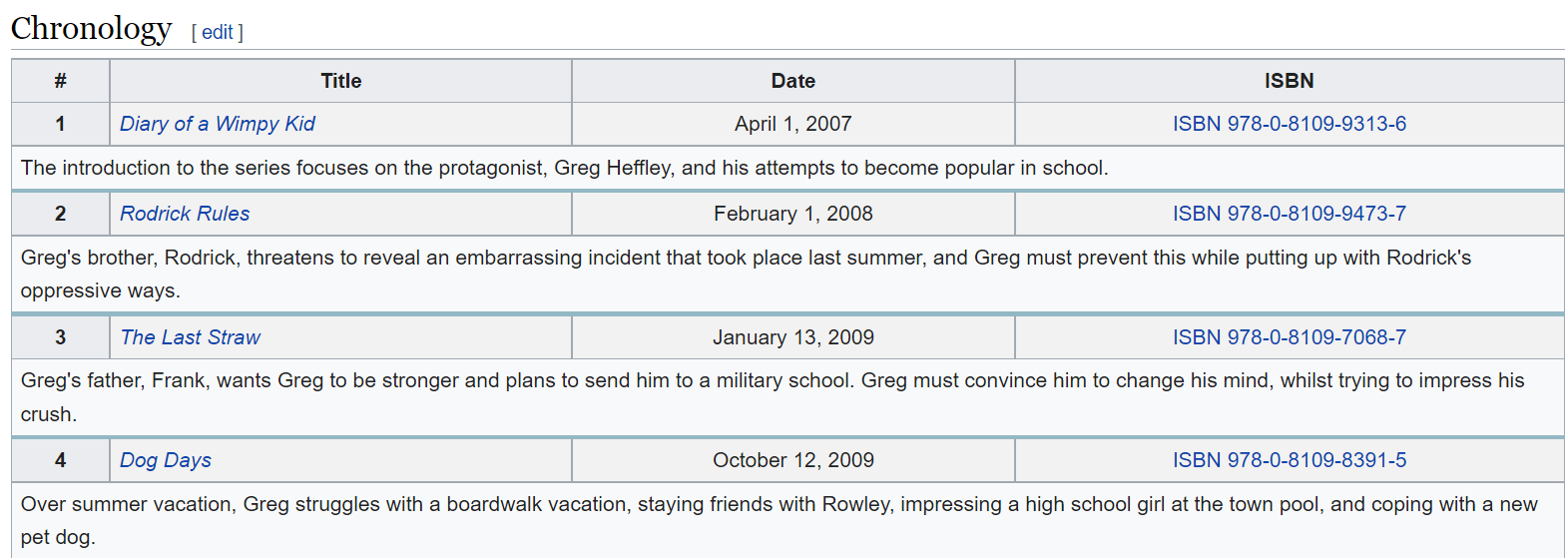
I had wanted to continue with the Wimpy Kid books in order, but the 2nd and 3rd books (Roderick Rules and The Last Straw, respectively) were not on the library shelves. (Either our library didn't have them, or someone else had them checked out. I never did bother to check the library database to see which it was.) And so, I jumped to the 4th book in the series: Dog Days.
The Reading Experience / Evaluation
With a series as prolific as Diary of a Wimpy Kid, (17 books and counting), I knew it was probably only going to be a matter of time before the author started running out of ideas, and the books began to decline in quality. But the question is, how long would it be before that happened?
Well, here we are. 4 books in, and the author has run out of ideas, and the books have declined in quality.
I wonder how the 2nd and 3rd books hold up. Was the drop off in quality immediate after the first book? Or was the decline more gradual? Maybe some day I'll get my hands on the 2nd and 3rd books, and then I can let you know. But for the moment, all I've got is the 4th book, so that's all I can talk about.
A number of the same ideas are recycled from the first book: once again, much of the plot is about the friendship between the main character (Greg Heffley) and his best friend (Rowley Jefferson). Once again, they have a fight, and then have to get reconciled. Once again, during Greg's fight with Rowley, the weird kid Fregley shows up as a possible substitute friend.
Once again, there's a comic strip in the paper that comes to an end, and once again Greg Heffley tries to submit his own comic as a replacement.
Once again, Greg Heffley has a lazily thought out get-rich-quick business plan, and ropes Rowley into it. And once again, the poorly thought out idea immediately falls apart on them.
To be fair, I don't know what else I really expected Jeff Kinney to do. He's locked into the same characters and settings from the first book. This whole series is exploring the drama of junior high school. It's not like Tintin where he can send Greg and Heffley to a new exotic location with every new book. There's probably only a limited number of stories he can tell with the setting he's got. (How in the world did he get 17 books out of this series? I'm almost tempted to read the whole thing just to find out.)
But... more than the recycled plot elements, the big thing is that this book just isn't that funny.
The first Diary of a Wimpy Kid was funny. I chuckled a lot while reading it. But there were no chuckles to be had while reading Dog Days.
Now, pinpointing exactly why something is funny, and why something is not, is always difficult to do. Some people who understand the mechanics of humor very well can do it, but I've never been one of those people. I usually just know when I laugh, and when I don't.
That being said, the one thing I can point to is that the first Diary of a Wimpy Kid was more grounded and realistic. It was the kind of thing you could totally imagine a junior high school kid doing or thinking, but just told in a humorous way.
Mostly. As I wrote in my original review, it could alternate between realistic and far-fetched. But the realistic elements were there.
But in Dog Days, it's mostly far-fetched. The main character does things that are so cringe that you can't imagine any real kid doing them.
Now, there is admittedly a kind of draw to cringe humor. There are a number of episodes in this book when Greg Heffley gets himself deeper and deeper into cringe situations, and as things get more and more cringe, there is a fascination with wondering how it will all blow up in his face, and what the big pay-off is going to be.
...except, there's never any big pay-off. Greg Heffley will just mention that someone got upset with him, or someone gave him a dirty look, or something like that, and that seems to be all the pay-off you get with this book.
So, although this book did hold my attention at the time, and did keep me turning the pages (I finished it in just one day), it also did leave me with a flat and empty feeling at the end. I didn't feel rewarded for having read this book, I just mostly felt let down.
Connections with Other Books I've Read
* At one point in this book, Greg's mother tries to make him read Charlotte's Web.
Odds and Ends
* In spite of the negative review I gave to this book, I just may yet continue on with this series. Stay tuned.
Originally published in 1919, this is the 13th book in the Oz series written by L. Frank Baum. It is also the second to the last Oz book that L. Frank Baum wrote before he died. (Although Baum would die before this book hit the shelves--Baum died in May, 1919, and this book was published in June.)
Summary of the Plot
L. Frank Baum is once again recycling plots from previous books. (Yet another sign that he had run out of ideas for his Oz series, but that he still needed the money.)
It's Ozma's birthday, and everyone is concerned with the preparations. Then, at the end, there's a grand party, and all the Oz characters make a brief cameo. This is the same plot that we saw before in book number 5: The Road to Oz. While this is going on, the evil Nome King is plotting to take over the land of Oz, but he is ultimately defeated by drinking from the fountain of oblivion. Again, we saw this same plot before in book 6: The Emerald City of Oz.
Links
I am once again relying on the analysis of Mari Ness at Tor.com . Her review is titled: Boredom in Fairyland: The Magic of Oz. You may get a sense of her opinion just from that title. But if there's any doubt, you can read her introduction.
So Ozma is having a birthday again. Yawn. And the various adopted citizens and hangers-on at the palace don’t know what to get her. Yawn. And an old enemy of Oz reappears. Yawn. Yawn. Have we reached the end yet?
Magic of Oz, the thirteenth book in Baum’s Oz series, is, above all, a tired book. Very little new happens. Glinda sets a group of young girls to weaving and sewing a gown formed from silk spun from softened emeralds. Trot, Cap’n Bill and the Glass Cat figure an ever changing magical plant will do the trick. Dorothy and the Wizard, cudgeling their brains together, come up with…performing monkeys. It’s even drearier than it sounds.
She eventually ends the review by saying:
With most authors, a book of this sort would be a clear sign to give up and move on. But Baum had one more Oz book left in him.
Ouch!
I'm also doing this book as a buddy read with Dane Cobain. He was a bit more kind to this book. His written review is HERE:
This book was just okay, and that’s pretty much all I have to say about it. Unfortunately, because I’ve left it a little while before getting to my review of this one and because I’ve also read another Oz book in the interim, I can’t really remember the details.
I can remember how it made me feel though, and in general it was a decent enough entry into the Oz series. Baum hit a bit of a bad patch with a few of the books before this one where it felt as though he was just churning out books because he had to, which is supported by the fact that he basically needed the money.
All in all, this was alright, but nowhere near as good as some of the others in the series. So there’s that.
Mari Ness isn't necessarily wrong. The plot of this book is pretty underwhelming.
Ozma having a birthday party is a pretty lame plot. It was pretty lame the first time around inThe Road to Oz, so it's an odd choice to recycle this underwhelming plot point.
The Nome King's attempts to take over the Land of Oz (a recycled plot from The Emerald City of Oz) could, in theory, lead to a dramatic climax. (Picture it in your head: an epic battle! All the forces of evil lined up on one side. All the characters of Oz lined up on the other side. They meet in a battle charge! Picture it like the scenes from The Lion, the Witch and the Wardrobe, or The Return of the King).
Except, in both books, the Nome King never actually gets that far. We spend a lot of time watching him bumbling around, and then he is defeated (both times!) by the Fountain of Oblivion.
What makes the Fountain of Oblivion plot point particularly irritating is that it was supposed make the Nome King forget everything and render him harmless the first time he drank it in book 6. That later got retconned in book 8, where it appeared that the Nome King could remember everything after all.
Okay, fair enough. L. Frank Baum has a lax approach to continuity, and likes to retcon things. I've learned to accept that by this point in the series. But then, after having retconned that plot point, to reintroduce the Fountain of Oblivion as a plot device a second time to resolve the exact same plot point as before? That is really pushing things! I've been forgiving a lot as I've been reading this series, but there is only so much lazy writing I can put up with.
But, in spite of all my complaining, I actually didn't completely hate this book. It's got enough of a manic imaginative energy to it that I found it mostly entertaining, in spite of all its flaws. I'll try to illustrate some of this with a quotation below:
There had been trouble in the Forest of Gugu that morning. Chipo the Wild Boar had bitten the tail off Arx the Giraffe while the latter had his head among the leaves of a tree, eating his breakfast. Arx kicked with his heels and struck Tirrip, the great Kangaroo, who had a new baby in her pouch. Tirrip knew it was the Wild Boar’s fault, so she knocked him over with one powerful blow and then ran away to escape Chipo’s sharp tusks. In the chase that followed a giant porcupine stuck fifty sharp quills into the Boar and a chimpanzee in a tree threw a cocoanut at the porcupine that jammed its head into its body.
All this was against the Laws of the Forest, and when the excitement was over, Gugu the Leopard King called his royal Counselors together to decide how best to punish the offenders.
The four lords of the forest were holding solemn council in a small clearing when they saw two strange beasts approaching them—beasts the like of which they had never seen before.
Not one of the four, however, relaxed his dignity or showed by a movement that he was startled. The great Leopard crouched at full length upon a fallen tree-trunk. Bru the Bear sat on his haunches before the King; Rango the Gray Ape stood with his muscular arms folded, and Loo the Unicorn reclined, much as a horse does, between his fellow-councillors. With one consent they remained silent, eyeing with steadfast looks the intruders, who were making their way into their forest domain.
“Well met, Brothers!” said one of the strange beasts, coming to a halt beside the group, while his comrade with hesitation lagged behind.
“We are not brothers,” returned the Gray Ape, sternly. “Who are you, and how came you in the forest of Gugu?”
“We are two Li-Mon-Eags,” said Ruggedo, inventing the name. “Our home is in Sky Island, and we have come to earth to warn the forest beasts that the people of Oz are about to make war upon them and enslave them, so that they will become beasts of burden forever after and obey only the will of their two-legged masters.”
A low roar of anger arose from the Council of Beasts.
“Who’s going to do that?” asked Loo the Unicorn, in a high, squeaky voice, at the same time rising to his feet.
“The people of Oz,” said Ruggedo.
“But what will we be doing?” inquired the Unicorn.
“That’s what I’ve come to talk to you about.”
“You needn’t talk! We’ll fight the Oz people!” screamed the Unicorn. “We’ll smash ’em; we’ll trample ’em; we’ll gore ’em; we’ll—”
“Silence!” growled Gugu the King, and Loo obeyed, although still trembling with wrath. The cold, steady gaze of the Leopard wandered over the two strange beasts. “The people of Oz,” said he, “have not been our friends; they have not been our enemies. They have let us alone, and we have let them alone. There is no reason for war between us. They have no slaves. They could not use us as slaves if they should conquer us. I think you are telling us lies, you strange Li-Mon-Eag—you mixed-up beast who are neither one thing nor another.”
***END QUOTE*** The scene actually goes on for a couple more pages, but you get the idea.
In one sense, this is terrible writing. L. Frank Baum is writing here like either he's on a caffeine high, or like he's sleep deprived and is just putting whatever comes into his head to fill up his word count.
But, on the other hand, there's a kind of fascination here with this bizarre Loony-Tunes world. I mean, a crazy forest where the animals are constantly getting into shenanigans? Ruled by a Jaguar King who is being advised by a paranoid maniac unicorn? Yeah, sure, I can stick around to see where this is going.
Odds and Ends
* This is yet another Oz book in which L. Frank Baum worked in some brief tie-ins with some of his previous fantasy books. (Queen Zixi of Ix, John Dough and the Cherub). So yet another reason why the series really should be called "The Expanded Universe of Oz".
* The idea that no one can die in the Land of Oz has proven to be one of L. Frank Baum's worst ideas. He can't keep it consistent, and he doesn't know how to introduce any kind of danger without breaking his own rules.
I read this book 5 years ago when I first attempted to work my way through The Complete Stories of Oz(as I mentioned HERE and HERE.) If memory serves, this was the last complete book I read through in that collection before I lost interest and stopped reading.
Summary of the Book (*SPOILERS*)
Dorothy is just minding her own business on her farm back in Kansas when a scruffy looking hobo known as "Shaggy Man" shows up and asks for directions. Dorothy is in the middle of showing him which road to take, when somehow she suddenly becomes lost in Fairy Land. While Dorothy and the Shaggy Man try to find their way, they become aware that Ozma of Oz is going to be having a birthday celebration, and that everyone wants to come.
Dorothy, the Shaggy Man, and other friends they meet along the way (Polychrome the Rainbow's Daughter and Button Bright) travel through fairy lands to try to make it back to Oz for Ozma's birthday party. They encounter the usual strange creatures and dangers along the way, before they finally make it back to Oz.
Once back in Oz, all the characters from the previous books show up to make cameo appearances and remind us that they exist.
I'll be honest, I'm starting to get a little bit bored with these stories. Upon reflection, I don't think it's a coincidence that I gave up on The Complete Stories of Oz5 years agoshortly after finishing The Road to Oz. (I never intentionally abandoned The Complete Stories of Oz. I seldom intentionally abandon any book. I just started going longer and longer between reading sessions as my interest gradually waned, and before I knew it, it had been months since I last touched the book.)
Anyway...
Part of the problem with The Road to Oz is that these books are becoming pretty transparently formulaic at this point. We are now 5 books in, and the formula is very well established. Namely:
* These books are always about a journey. There's never any real plot. The characters are going from point A to point B, and they encounter stuff on the way. In the first 2 books, the characters were travelling within the land of Oz. But after book 2, there was a shift in perspective. Oz was no longer the dangerous and wild land--Oz was now the safe and happy land, and in books 3, 4 and now 5, the journey is to get to the land of Oz.
* Each new journey is accompanied by a new set of characters. For whatever reason, L. Frank Baum was apparently reluctant to simply re-use characters from the previous books on these journeys. So each new book introduces a whole new cast of travelling companions. In The Road to Oz, Dorothy and Toto are, of course, familiar, but all the rest of their travelling companions (Shaggy Man, Polychrome, Button Bright) are new.
* However, when they do finally get to the land of Oz, then all the old characters from previous books come back for cameo appearances, and the final third of each book is essentially old characters popping up and saying "Hi Dorothy. Remember me?"
All of that is beginning to get a little bit tiring by the 5th book in.
That, plus in this book, the quality of the imagination seems to dip from the previous books. The new lands and new creatures encountered in this book are...okay, I guess. But not nearly as bizarre and fun as the previous books. And for most of the book there is very little in the way of actual danger or serious stakes. (With the exception of the encounter with the Scoodlers.)
All that being said, there are a couple of interesting things going on around the edges of this book:
1) As someone who's always been a big geek, and fascinated by fictional continuity, I'm kind of fascinated by the Oz extended Universe that L. Frank Baum is trying to create in this book. Even though I'm not sure I'll ever read the other books, I still think it's cool that they're all integrated.
2) This book marks a big turning point in the Oz Mythos. L. Frank Baum is now envisioning Oz as some sort of Utopian land where no one needs to use money, because everyone wants to help each other. This will become a big element in future Oz books to come (or so I'm lead to believe by Mari Ness's Oz reviews.)
Extended Quotation
Nick Chopper, the Emperor of the Winkies, who was also known throughout the Land of Oz as the Tin Woodman, was certainly a remarkable person. He was neatly made, all of tin, nicely soldered at the joints, and his various limbs were cleverly hinged to his body so that he could use them nearly as well as if they had been common flesh. Once, he told the shaggy man, he had been made all of flesh and bones, as others people are, and then he chopped wood in the forests to earn his living. But the axe slipped so often and cut off parts of him—which he had replaced with tin—that finally there was no flesh left, nothing but tin; so he became a real tin woodman. The wonderful Wizard of Oz had given him an excellent heart to replace his old one, and he didn't at all mind being tin. Every one loved him, he loved every one; and he was therefore as happy as the day was long.
The Emperor was proud of his new tin castle, and showed his visitors through all the rooms. Every bit of the furniture was made of brightly polished tin—the tables, chairs, beds, and all—even the floors and walls were of tin.
"I suppose," said he, "that there are no cleverer tinsmiths in all the world than the Winkies. It would be hard to match this castle in Kansas; wouldn't it, little Dorothy?"
"Very hard," replied the child, gravely.
"It must have cost a lot of money," remarked the shaggy man.
"Money! Money in Oz!" cried the Tin Woodman. "What a queer idea! Did you suppose we are so vulgar as to use money here?"
"Why not?" asked the shaggy man.
"If we used money to buy things with, instead of love and kindness and the desire to please one another, then we should be no better than the rest of the world," declared the Tin Woodman. "Fortunately money is not known in the Land of Oz at all. We have no rich, and no poor; for what one wishes the others all try to give him, in order to make him happy, and no one in all Oz cares to have more than he can use."
"Good!" cried the shaggy man, greatly pleased to hear this. "I also despise money—a man in Butterfield owes me fifteen cents, and I will not take it from him. The Land of Oz is surely the most favored land in all the world, and its people the happiest. I should like to live here always."
The Tin Woodman listened with respectful attention. Already he loved the shaggy man, although he did not yet know of the Love Magnet. So he said:
"If you can prove to the Princess Ozma that you are honest and true and worthy of our friendship, you may indeed live here all your days, and be as happy as we are."
(End Quote From Chapter 15: The Emperor's Tin Castle)
This is one example of Utopianism in Oz. Later in the book, the Tin Woodman also reveals that the people in Oz work no more than half the day. And also that no one ever dies in Oz, unless they are condemned to die by the citizens.
Oooh, Ozma is having a birthday party! Can Dorothy and her friends make it in time for the party? Can they? CAN THEY?
It must be confessed from the outset that The Road to Oz does not have much of a plot. (You just read pretty much the entire thing.) But, even plotless, The Road to Oz is one of the most critical books in the development of Oz, since here at last we see the nearly ultimate, persistent version of Oz: Oz as communist utopia.
In the comments section of that review, there's some debate about whether what L. Frank Baum is describing is actually communism or mere utopianism.
I'm also doing this book as a buddy read with Dane Reads, who reviews the book on his blog HERE.
This is the first time since I started reading the Oz series (as a buddy read with Joel Swagman) that I’ve wondered what I’ve got myself into. It just didn’t have the same magic as the other books, at least for me, and by this point it’s starting to feel a little bit formulaic.
I think that sums up my feelings about this book as well.
Looking ahead, it looks like in 1911 and 1912, L. Frank Baum will also do Oz crossovers with The Sea Fairiesand Sky Island.
The completist inside of me is tempted to try to track down all of these related books. (After all, if you're going to read The Complete Stories of Oz, then you might as well read the Complete stories of Oz.) If I were back in the U.S., I'd probably already be checking the library for these books. But I'm not sure how much luck I'll have tracking them down in Vietnam. Although it looks like all of this stuff is on project Gutenberg. Maybe I might look into getting the printed out here one day.
* The Road to Oz is the first time Toto's been back to the land of Oz since the first book.
But this brings up yet another continuity problem with this series. In books 3 and 4, it's clearly established that any animal that comes to Oz is able to talk. So why can't Toto talk? (According to Wikipedia, this will be addressed in the future books, so I guess I'll have to wait for those.)
* And speaking of continuity problems, this is the second book in a row now that Dorothy seems to have forgotten that Ozma's belt can bring her to Oz at any time. Why didn't she signal to to help her?
This is addressed (kind of) later in the book:
"I've watched you in my Magic Picture all the way here," declared Ozma, "and twice I thought I should have to use the Magic Belt to save you and transport you to the Emerald City. Once was when the Scoodlers caught you, and again when you reached the Deadly Desert. But the shaggy man was able to help you out both times, so I did not interfere.
Okay, so that explains things from Ozma's point of view. But from Dorothy's point of view, why didn't she try to signal to Ozma sooner.
* Based on what I've been reading on Wikipedia and from Mari Ness, I understand that L. Frank Baum is now beginning to transform his vision of Oz into a Utopia in which there is no money, and nobody ever dies. The part about no money I've already mentioned above. But the part about nobody ever dying is also in this book, although very briefly. From chapter 16:
"What is this?" asked Dorothy, in wonder.
"It's Jack Pumpkinhead's private graveyard," replied the Tin Woodman.
"But I thought nobody ever died in Oz," she said.
"Nor do they; although if one is bad, he may be condemned and killed by the good citizens," he answered.
Notice how L. Frank Baum tries to just slip that in there, as if Dorothy is simply referencing something that was already established. But this wasn't already established. Lots of creatures died in the first Oz book. So this is yet another retcon. There have been so many retcons in this series so far that it's no use getting upset about them now. But what's odd about the "no one ever dies in Oz" retcon is that it's not even consistent within this same book itself. In the very next chapter (Chapter 17), we hear about Dyna the sorcerer and her beloved bear.
It happened she had once had a big blue bear for a pet; but the bear choked to death on a fishbone one day, and she loved it so dearly that Dyna made a rug of its skin, leaving the head and four paws on the hide. She kept the rug on the floor of her front parlor.
So this is confusing. Can creatures die in Oz or not? I guess I'll have to wait till later books to see how this concept develops.
Connections to Other Books I've Read
* When Dorothy sees a play in the town of Foxville, she remarks how it reminds her of one of Aesop's fables.